Gold rallies as buyback sinks yields despite Fed hawkish minutes
- Gold climbs as long-end US yields edge lower.
- Fed Minutes show three dissenters backing more restrictive policy.
- The US Dollar slide supports bullion ahead of claims, Musalem and PMIs.

Gold (XAU/USD) rallies during Wednesday’s session after the US Federal Reserve (Fed) released the minutes of its July meeting, in which the US central bank held rates unchanged but not unanimously, with three members dissenting and calling for a rate hike. The XAU/USD pair trades at $4,482, up over 3.50% at the time of writing.
XAU/USD rallies as lower yields offset hawkish Fed Minutes
The minutes stated that the dissenters “remarked that price pressures appeared broad-based and judged that the FOMC should adopt a more restrictive policy.” The document showed that of "many" participants “assessed that policy tightening would likely be necessary if inflation did not decline.” The FOMC’s minutes revealed that there were no discussions for a rate cut
US Treasury buybacks are behind bullion’s advance as US Treasury yields continued to dive further during the session. The US 30-year yield, which hit its highest level since 2007 on Tuesday, drops by over eight basis points to 5.20%. At the same time, the yield of the US 10-year benchmark note is down almost five basis points, down to 4.660%.
Sources cited by Bloomberg said that “This administration needs a win and maybe that comes in the form of artificially trying to keep long Treasury rates contained.”
Worth noting that US bond yields have risen sharply since July, sponsored by high energy prices as the Middle East conflict continues, which has increased inflation expectations in the US. Also, the Federal Reserve (Fed) has held interest rates unchanged at its last five meetings, amid cooling prices.
The non-yielding metal is also boosted by the Dollar's decline. The US Dollar Index (DXY), which measures the performance of the buck’s value against a basket of six peers, is down 0.80% at 98.85.
Ahead, the economic docket will feature Initial Jobless Claims, a speech by St. Louis Fed President Alberto Musalem and S&P Global Flash PMIs.
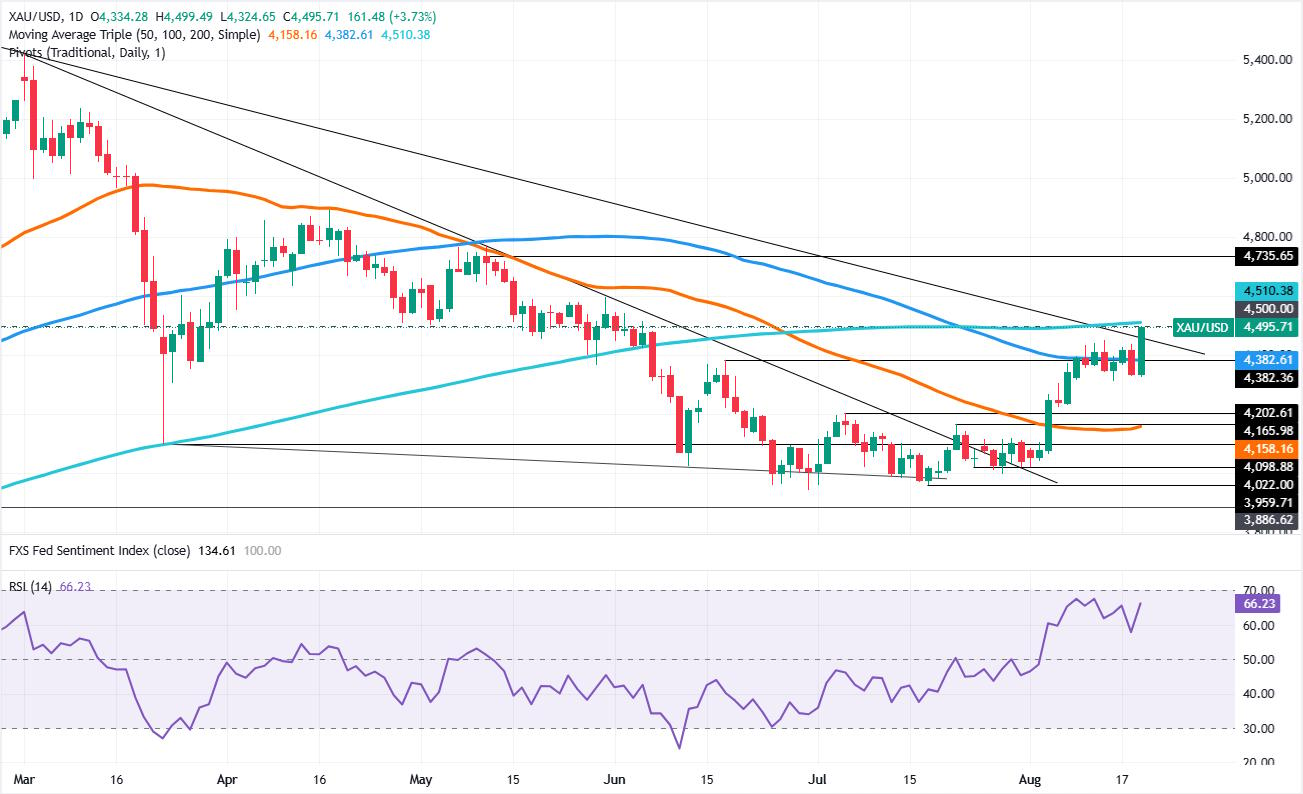
XAU/USD technical outlook: Gold hovers near $4,500 as bulls target the 200-day SMA
Gold seems to be gaining traction as it approaches the 200-day Simple Moving Average (SMA) at $4,510, a move triggered by news of the US Treasury bond buyback. Bulls are gaining momentum, as depicted by the Relative Strength Index (RSI), which favors further upside, and are aiming higher.
If bulls want to test higher prices, they must end Wednesday’s session above $4,500. In that outcome, the 200-day SMA would be the next resistance area, followed by $4,700 and the May 12 daily high at $4,735, surrounded by a cluster of six candles.
On the flip side, a false breakout above $4,500 could trigger a drop back below $4,400, followed by a test of the weekly low at $4,324. The next stop would be the last week’s low at $4,311, seen as the last line of defense, before aiming towards the 50-day SMA at $4,158.
Fed FAQs
Monetary policy in the US is shaped by the Federal Reserve (Fed). The Fed has two mandates: to achieve price stability and foster full employment. Its primary tool to achieve these goals is by adjusting interest rates. When prices are rising too quickly and inflation is above the Fed’s 2% target, it raises interest rates, increasing borrowing costs throughout the economy. This results in a stronger US Dollar (USD) as it makes the US a more attractive place for international investors to park their money. When inflation falls below 2% or the Unemployment Rate is too high, the Fed may lower interest rates to encourage borrowing, which weighs on the Greenback.
The Federal Reserve (Fed) holds eight policy meetings a year, where the Federal Open Market Committee (FOMC) assesses economic conditions and makes monetary policy decisions. The FOMC is attended by twelve Fed officials – the seven members of the Board of Governors, the president of the Federal Reserve Bank of New York, and four of the remaining eleven regional Reserve Bank presidents, who serve one-year terms on a rotating basis.
In extreme situations, the Federal Reserve may resort to a policy named Quantitative Easing (QE). QE is the process by which the Fed substantially increases the flow of credit in a stuck financial system. It is a non-standard policy measure used during crises or when inflation is extremely low. It was the Fed’s weapon of choice during the Great Financial Crisis in 2008. It involves the Fed printing more Dollars and using them to buy high grade bonds from financial institutions. QE usually weakens the US Dollar.
Quantitative tightening (QT) is the reverse process of QE, whereby the Federal Reserve stops buying bonds from financial institutions and does not reinvest the principal from the bonds it holds maturing, to purchase new bonds. It is usually positive for the value of the US Dollar.
Author

Christian Borjon Valencia
FXStreet
Markets analyst, news editor, and trading instructor with over 14 years of experience across FX, commodities, US equity indices, and global macro markets.

















