Gold slips from $4,700 as Iran deal doubts boost oil, Dollar
- Gold gave back gains as Iran ceasefire hopes faded sharply.
- Rising oil prices and a firmer US Dollar weighed on bullion.
- Strong US data reinforced expectations for a steady Fed outlook.

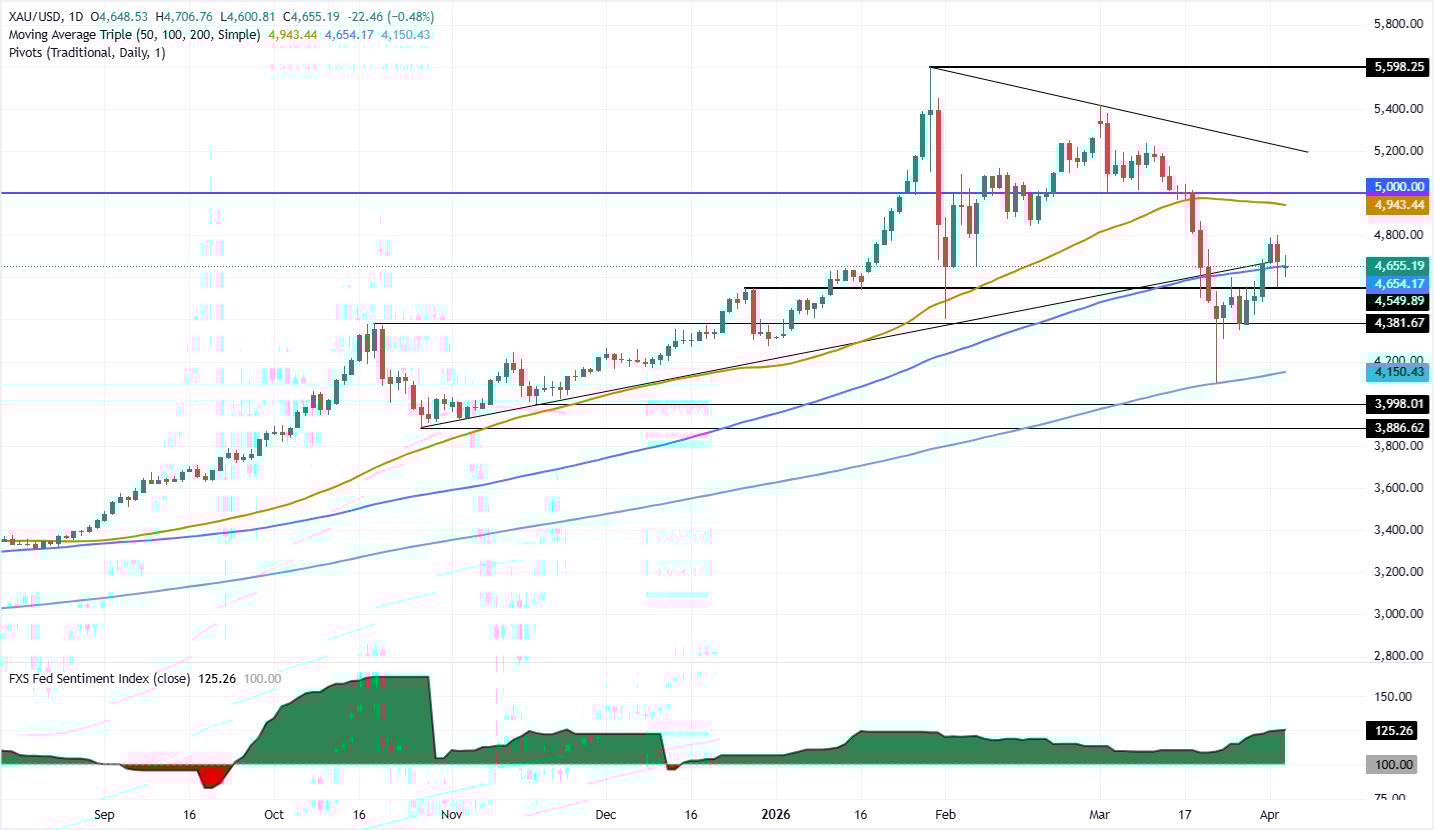
Gold (XAU/USD) price recoiled during the North American session on Monday after hitting a daily high of $4,706, but news that an agreement between the US and Iran seems unlikely, along with military preparations for potential strikes, drove the yellow metal lower.
Bullion eases as war risks persist and Fed hold bets stay firm
At the time of writing, XAU/USD trades at $4,652, weighed down by the rise in WTI, which is up 1,40% at $113.64 per barrel. In addition, the Greenback is trimming some of its earlier losses, back above the 100.00 handle, according to the US Dollar Index (DXY).
The DXY, which measures the US Dollar's performance against six others, falls 0.19%. US Treasury yields are trimming some of their earlier losses, with the 10-year T-note yielding 4.337%.
The Wall Street Journal revealed that the US military is “making preparations for potential strikes on energy targets in Iran,” according to multiple US officials. Recently, US President Donald Trump said that “Iran can be taken out in one night, might be Tuesday night.”
Trump’s initial deadline was April 6, but he delayed the attacks to April 7 at 8:00 PM ET if Iran fails to comply with US demands, which include the immediate reopening of the Strait of Hormuz.
Recently, Iran rejected ceasefire proposals, which included efforts by Pakistan, Egypt and Turkey to secure a 45-day pause of hostilities to set the stage for a full resolution of the conflict.
Fed expected to keep rates steady; services PMI in the US disappoints
Meanwhile, business activity in the US services sector slowed, according to the Institute for Supply Management (ISM). The ISM Services PMI in March eased to 54 in March from 56.1, missing expectations of 55. The prices paid sub-component of the PMI surged to its highest level since October 2022, to 70.7, due to higher energy costs, according to Steve Miller, Chair of the ISM Services Business Survey Committee.
Last Friday, the US Nonfarm Payrolls surprised markets, as the economy added 178K Americans to the workforce, exceeding estimates of 60K and February’s downwardly revised print of -133K. Based on all the data, the economy averaged 68K in the first three months.
Consequently, the Unemployment Rate edged down from 4.4% to 4.3%, beneath the Federal Reserve’s 4.5% target for 2026. This erased the Fed’s dovish bets as depicted by money markets, which now expect the US central bank to keep rates steady throughout the whole year, according to Prime Market Terminal data.
The US economic docket will be busy, as traders eye Durable Goods Orders, speeches by Fed officials, the minutes of the FOMC's last meeting, growth data, Initial Jobless Claims and inflation figures.
XAU/USD technical analysis: Gold struggles at $4,700, sellers target the 100-day SMA
Gold price faces key resistance at $4,700, and retreated towards the 100-day Simple Moving Average (SMA) at $4,639. Bulls seem to be losing traction, as indicated by the Relative Strength Index (RSI), which remains bearish and is approaching oversold territory.
If XAU/USD finishes on a daily basis below the 100-day SMA, this clears the path to challenge $4,600. Below here, the next area of interest is the April 2 daily low at $4,553, ahead of $4,500. Conversely, if Gold rallies past $4,700, the first area of supply overhead is the 20-day SMA at $4,755. On further strength, $4,800 lies up next.
Gold FAQs
Gold has played a key role in human’s history as it has been widely used as a store of value and medium of exchange. Currently, apart from its shine and usage for jewelry, the precious metal is widely seen as a safe-haven asset, meaning that it is considered a good investment during turbulent times. Gold is also widely seen as a hedge against inflation and against depreciating currencies as it doesn’t rely on any specific issuer or government.
Central banks are the biggest Gold holders. In their aim to support their currencies in turbulent times, central banks tend to diversify their reserves and buy Gold to improve the perceived strength of the economy and the currency. High Gold reserves can be a source of trust for a country’s solvency. Central banks added 1,136 tonnes of Gold worth around $70 billion to their reserves in 2022, according to data from the World Gold Council. This is the highest yearly purchase since records began. Central banks from emerging economies such as China, India and Turkey are quickly increasing their Gold reserves.
Gold has an inverse correlation with the US Dollar and US Treasuries, which are both major reserve and safe-haven assets. When the Dollar depreciates, Gold tends to rise, enabling investors and central banks to diversify their assets in turbulent times. Gold is also inversely correlated with risk assets. A rally in the stock market tends to weaken Gold price, while sell-offs in riskier markets tend to favor the precious metal.
The price can move due to a wide range of factors. Geopolitical instability or fears of a deep recession can quickly make Gold price escalate due to its safe-haven status. As a yield-less asset, Gold tends to rise with lower interest rates, while higher cost of money usually weighs down on the yellow metal. Still, most moves depend on how the US Dollar (USD) behaves as the asset is priced in dollars (XAU/USD). A strong Dollar tends to keep the price of Gold controlled, whereas a weaker Dollar is likely to push Gold prices up.
Author

Christian Borjon Valencia
FXStreet
Markets analyst, news editor, and trading instructor with over 14 years of experience across FX, commodities, US equity indices, and global macro markets.