Gold slips as US Dollar, yields rise on Oil-driven inflation fears
- Gold dips 0.37% to $5,170 as DXY climbs to 99.22.
- WTI jumps nearly 5% to $87.36 amid Strait of Hormuz disruptions.
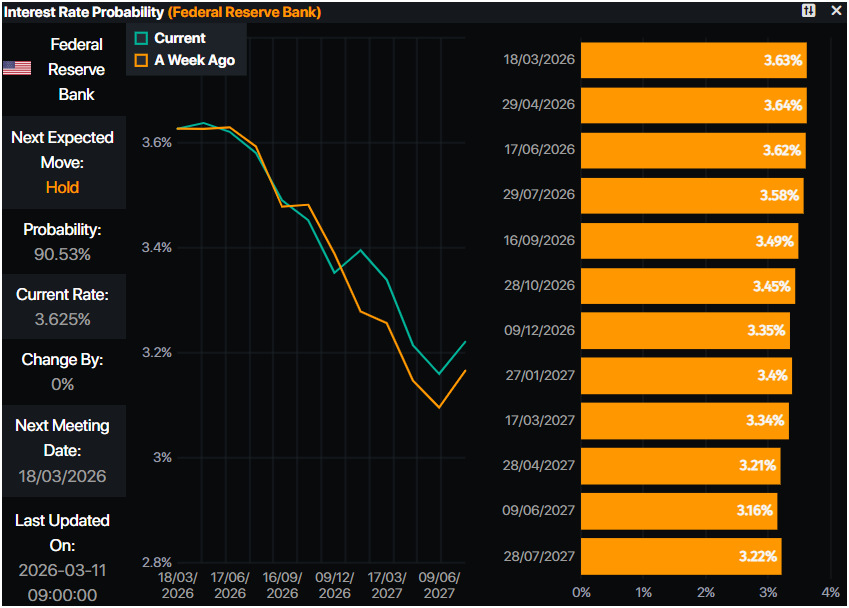
- Fed easing bets trimmed to 30 bps as US 10-year yield jumps to 4.21%.

Gold (XAU/USD) prices edge lower on Wednesday amid broad US Dollar (USD) strength following the release of US inflation data, which maintained the status quo. Hostilities between the US, Israel and Iran extended for the twelfth straight day, bolstering speculation of higher Oil prices, sparking inflationary concerns. At the time of writing, XAU/USD trades at $5,170, down 0.37%.
XAU/USD pressured amid geopolitical tensions, higher energy prices
Geopolitics are the main driver of Oil prices, which have risen sharply. The US Dollar remains correlated with Oil prices in the near term, as countries scramble to buy the Greenback to pay for high petrol prices. As of writing, WTI is trading up 4.76% at $87.36.
The US Dollar Index (DXY), which measures the buck's performance against a basket of six currencies, is up 0.32% to 99.22, a headwind for Gold prices.
Gold, which usually appreciates amid geopolitical uncertainty and inflation, is under pressure from high US Treasury yields. The release of the latest inflation report in the United States was benign, but the war in the Middle East and the jump in petrol prices forced traders to push back against the Federal Reserve's interest rate cut outlook.
Money markets had priced in 30 basis points of easing towards the year-end, according to Prime Market Terminal data.
Earlier, consumer inflation in the US remained broadly unchanged. The Consumer Price Index (CPI) came in line with estimates and January's print at 2.4% YoY in February. Core figures rose by 2.5%, as expected, for the same period.
US Treasury bond yields are rising as investors seem concerned about high gasoline prices. The US 10-year Treasury note yield surges by over 6 basis points to 4.218%.
To alleviate high Crude Oil prices, the International Energy Agency (IEA) agreed to release over 400 million barrels to temper price pressures spurred by the closure of the Strait of Hormuz.
Nevertheless, Iran said that the world should be ready for Oil to hit $200 a barrel, as it continues to attack vessels sailing through the Strait of Hormuz.
XAU/USD technical outlook: Gold to remain range-bound tilted upwards
Gold prices continued to consolidate, aiming steadily higher but failing to clear the latest cycle-high of $5,419 seen on March 2. Nevertheless, momentum is bullish, as indicated by the Relative Strength Index (RSI), which remains above its 50-neutral level while consolidating near it.
However, for a bullish resumption, Bullion should clear the March 10 high at $5,238. Once breached, it opens the door to test $5,300, followed by $5,350 and the March 2 peak. If those levels are taken out, the next resistance would be at $5,419.
Conversely, Gold's drop below $5,100 opens the path to challenge key demand levels, including the March 9 daily low at $5,014, followed by the 50-day Simple Moving Average (SMA) at $4,896.

Gold FAQs
Gold has played a key role in human’s history as it has been widely used as a store of value and medium of exchange. Currently, apart from its shine and usage for jewelry, the precious metal is widely seen as a safe-haven asset, meaning that it is considered a good investment during turbulent times. Gold is also widely seen as a hedge against inflation and against depreciating currencies as it doesn’t rely on any specific issuer or government.
Central banks are the biggest Gold holders. In their aim to support their currencies in turbulent times, central banks tend to diversify their reserves and buy Gold to improve the perceived strength of the economy and the currency. High Gold reserves can be a source of trust for a country’s solvency. Central banks added 1,136 tonnes of Gold worth around $70 billion to their reserves in 2022, according to data from the World Gold Council. This is the highest yearly purchase since records began. Central banks from emerging economies such as China, India and Turkey are quickly increasing their Gold reserves.
Gold has an inverse correlation with the US Dollar and US Treasuries, which are both major reserve and safe-haven assets. When the Dollar depreciates, Gold tends to rise, enabling investors and central banks to diversify their assets in turbulent times. Gold is also inversely correlated with risk assets. A rally in the stock market tends to weaken Gold price, while sell-offs in riskier markets tend to favor the precious metal.
The price can move due to a wide range of factors. Geopolitical instability or fears of a deep recession can quickly make Gold price escalate due to its safe-haven status. As a yield-less asset, Gold tends to rise with lower interest rates, while higher cost of money usually weighs down on the yellow metal. Still, most moves depend on how the US Dollar (USD) behaves as the asset is priced in dollars (XAU/USD). A strong Dollar tends to keep the price of Gold controlled, whereas a weaker Dollar is likely to push Gold prices up.
Author

Christian Borjon Valencia
FXStreet
Markets analyst, news editor, and trading instructor with over 14 years of experience across FX, commodities, US equity indices, and global macro markets.

















