Gold slips as US Dollar recovers despite softer US factory inflation
- Gold drops as Dollar pares losses despite softer US inflation and jobs data.
- US PPI cools, while jobless claims signal labor softness.
- Fed officials remain divided as traders price in a September hold.

Gold (XAU/USD) price declines on Thursday as the US Dollar (USD) trims some of its earlier losses, as economic data in the US showed that the disinflation process continues, amid a moderately softening jobs market. At the time of writing, the XAU/USD pair trades at $4,365, down 1%, after reaching a daily high of $4,449.
XAU/USD retreats as traders digest softer US inflation and Fed split
Strangely, the yellow metal fails to capitalize on early US Dollar weakness, which so far has trimmed its earlier losses and is almost flat, according to the US Dollar Index (DXY). The DXY, which tracks the performance of the buck versus six currencies, trades almost flat around the 100.00 milestone.
US Treasury yields edged lower as market participants trimmed their Federal Reserve (Fed) hawkish bets following the release of July’s Producer Price Index (PPI) data. The US 10-year Treasury yield is down four basis points at 4.647%.
US PPI edged lower from 5.5% to 4.7% YoY. The Core PPI, which excludes food and energy, expanded 4.2% YoY as expected, down from 4.7% registered in June. At the same time, the number of Americans filing for unemployment benefits rose from 200K to 209K in the week ending August 8, exceeding forecasts for a 202K print.
Money markets had adjusted their expectations for the Federal Reserve's interest rates. Now traders see a 40% chance of a 25-basis-point rate hike, while the odds of a hold have increased to 60%. Meanwhile, Federal Reserve officials remained split, with a camp seeking a rate increase and others, led by Fed Chair Kevin Warsh, calling for rates to remain steady.
Cleveland Fed Beth Hammack said the US should raise rates to curb growth and inflation. She noted businesses are eager to borrow for investment in "growth opportunities,” but a rapid economic reacceleration could hinder disinflation.
Richmond Fed President Thomas Barkin said it's an “open question” if a rate hike is needed to meet inflation targets, noting inflationary pressures are from shocks that “should pass.”
On Friday, the US economic docket will feature the release of July Retail Sales and the University of Michigan Consumer Sentiment.
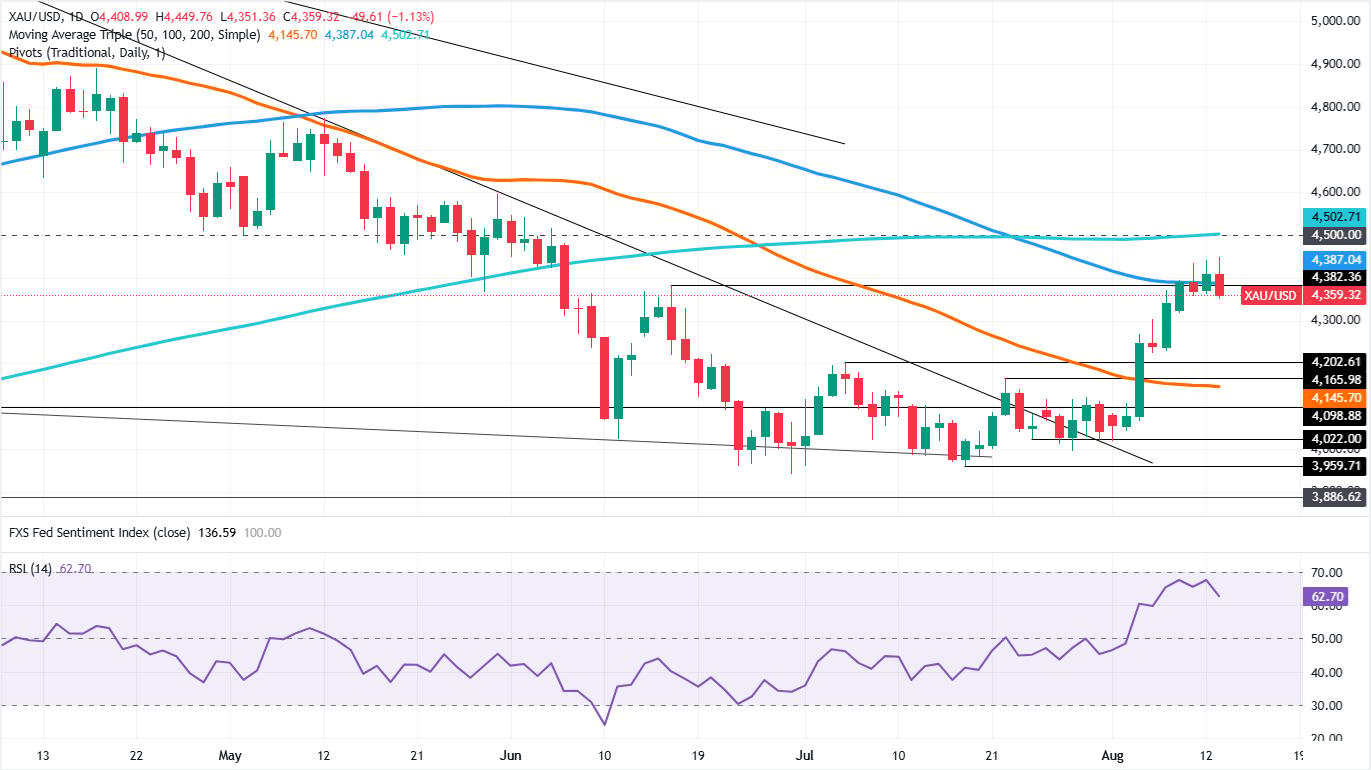
XAU/USD price forecast: Gold retreats below $4,400, eyes on 50-day SMA
Gold consolidates below the $4,400 threshold as traders rush to book profits, following the release of US data. Bullish momentum is fading, as indicated by the Relative Strength Index (RSI), which is edging towards its 50-neutral level, suggesting buyers are losing steam.
Worth noting that XAU/USD has fallen to new three-day lows of $4,351, which could exacerbate a move lower. The next area of interest would be $4,300. Once breached, the next stop is the July 6 high at $4,202. Once cleared, the next key support levels are the 50-day SMA at $4,145 and $4,100.
On the other hand, if the $4,400 mark is reclaimed, this paves the way to test the $4,450 psychological level. Breaking this could lead to the 200-day SMA at the $4,500 mark.
Gold FAQs
Gold has played a key role in human’s history as it has been widely used as a store of value and medium of exchange. Currently, apart from its shine and usage for jewelry, the precious metal is widely seen as a safe-haven asset, meaning that it is considered a good investment during turbulent times. Gold is also widely seen as a hedge against inflation and against depreciating currencies as it doesn’t rely on any specific issuer or government.
Central banks are the biggest Gold holders. In their aim to support their currencies in turbulent times, central banks tend to diversify their reserves and buy Gold to improve the perceived strength of the economy and the currency. High Gold reserves can be a source of trust for a country’s solvency. Central banks added 1,136 tonnes of Gold worth around $70 billion to their reserves in 2022, according to data from the World Gold Council. This is the highest yearly purchase since records began. Central banks from emerging economies such as China, India and Turkey are quickly increasing their Gold reserves.
Gold has an inverse correlation with the US Dollar and US Treasuries, which are both major reserve and safe-haven assets. When the Dollar depreciates, Gold tends to rise, enabling investors and central banks to diversify their assets in turbulent times. Gold is also inversely correlated with risk assets. A rally in the stock market tends to weaken Gold price, while sell-offs in riskier markets tend to favor the precious metal.
The price can move due to a wide range of factors. Geopolitical instability or fears of a deep recession can quickly make Gold price escalate due to its safe-haven status. As a yield-less asset, Gold tends to rise with lower interest rates, while higher cost of money usually weighs down on the yellow metal. Still, most moves depend on how the US Dollar (USD) behaves as the asset is priced in dollars (XAU/USD). A strong Dollar tends to keep the price of Gold controlled, whereas a weaker Dollar is likely to push Gold prices up.
Author

Christian Borjon Valencia
FXStreet
Markets analyst, news editor, and trading instructor with over 14 years of experience across FX, commodities, US equity indices, and global macro markets.