Gold edges lower as strong US Dollar and US-Iran peace talks uncertainty weigh
- Gold trades with a bearish bias as a firmer US Dollar caps upside.
- US-Iran talks remain in doubt ahead of the ceasefire deadline, keeping markets cautious.
- Technically, XAU/USD maintains a bearish bias on the 4-hour chart below $4,800.

Gold (XAU/USD) trades with a negative bias on Tuesday as fading hopes for US-Iran peace talks weigh on sentiment, following renewed tensions in the Strait of Hormuz over the weekend. At the time of writing, XAU/USD is trading around $4,700, down nearly 2.50% on the day, pressured by a modest rebound in the US Dollar (USD).
At the same time, firm US data released earlier in the day added to the pressure on Gold. Retail Sales rose by 1.7% MoM in March, beating expectations of 1.4% and accelerating from February’s 0.7% increase. In addition, the ADP Employment Change 4-week average increased to 54.8K from 39K.
US-Iran talks in doubt as ceasefire deadline approaches
Diplomatic efforts to end the US-Iran war remain uncertain, with mixed signals surrounding a potential second round of peace talks expected in Pakistan. Multiple media reports suggested that Iran is sending a delegation for the talks. However, Iran’s state broadcaster pushed back on these claims, stating in a Telegram post that “so far, no delegation from Iran has travelled to Islamabad, neither a primary nor a secondary, neither initial nor follow-up.”
Meanwhile, a White House official said that US Vice President JD Vance has not yet departed for the talks. With the current two-week ceasefire set to expire on Wednesday, markets remain cautious. US President Donald Trump said on Monday it is “highly unlikely” that he will extend the truce, adding, “We will not open the Strait of Hormuz until a deal is signed.” Trump has also warned that fighting could resume if no agreement is reached.
On the Iranian side, Mohammad Bagher Ghalibaf said Tehran has been “preparing to show new cards on the battlefield” and would “not accept negotiations under the shadow of threats.”
Higher Oil prices keep pressure on Gold
Meanwhile, ongoing disruptions in the Strait of Hormuz, which remains under a dual blockade by US naval forces and Iran, continue to support elevated Oil prices. This is keeping inflation risks in focus and reinforcing expectations that major central banks, including the Federal Reserve (Fed), may keep interest rates higher for longer.
While Gold is often seen as a hedge against inflation, higher borrowing costs tend to weigh on its appeal by increasing the opportunity cost of holding the non-yielding metal. As a result, the precious metal remains under pressure in the near term, even as geopolitical risks provide some support and keep prices largely range-bound.
Fed Chair nominee Kevin Warsh said during his Senate testimony that the Fed needs a new inflation framework and a broader “regime change” in the conduct of monetary policy.
Looking ahead, traders will closely monitor developments around US-Iran talks and the ceasefire deadline, as well as movements in the US Dollar and Oil prices for fresh directional cues.
Technical analysis: XAU/USD stuck in range as momentum weakens
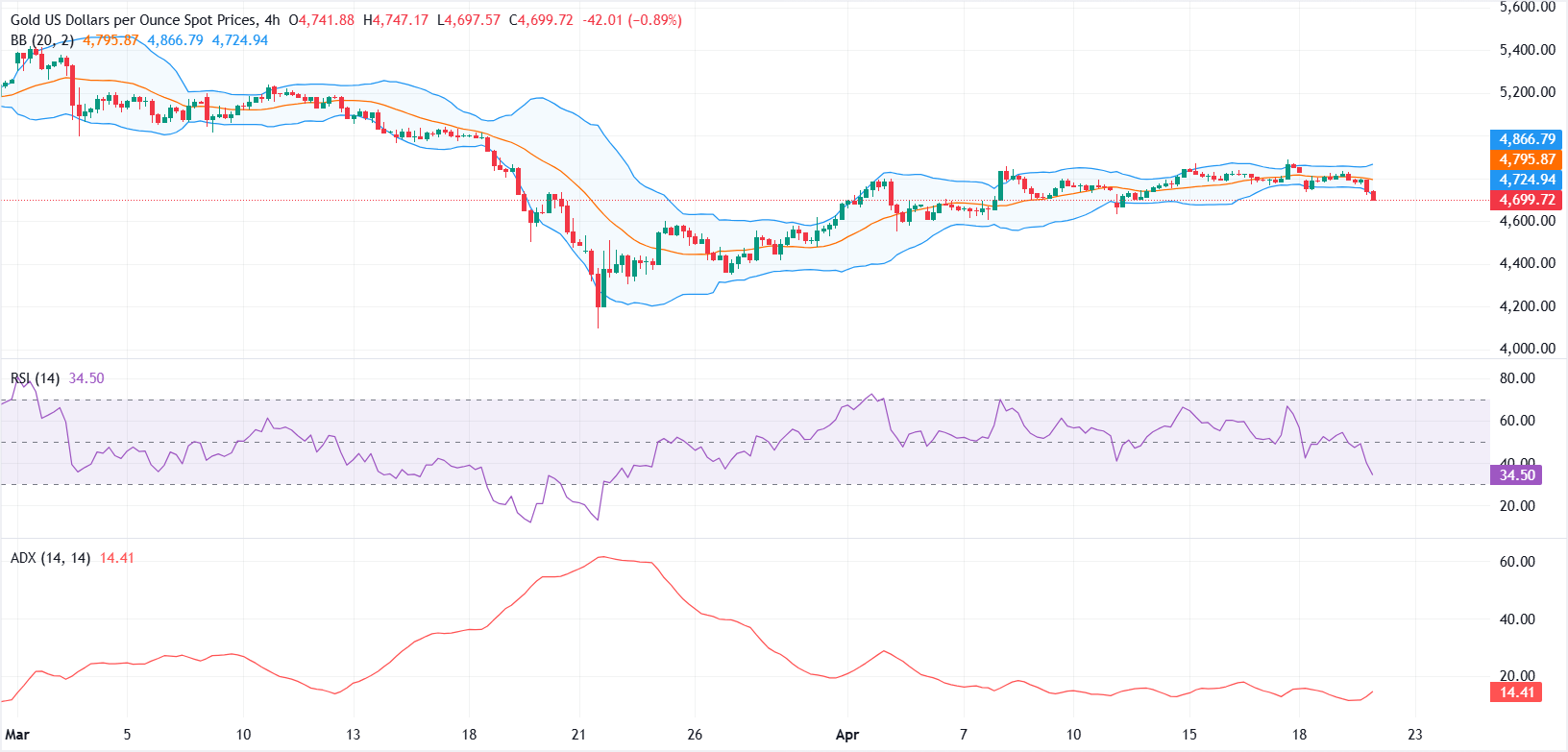
In the four-hour chart, XAU/USD maintains a bearish near-term bias, as price holds beneath the 20-period Bollinger simple moving average center line near $4,795.92 and even the lower band at roughly $4,725 now acts as immediate overhead supply. The pair is sliding along the lower side of the Bollinger envelope, while the 14-period Relative Strength Index has retreated to about 35, hinting at emerging oversold conditions but not yet signaling a decisive bullish reversal, and the Average Directional Index near 14 suggests the downtrend remains weak rather than impulsive.
On the topside, initial resistance is located at the lower Bollinger Band around $4,725, followed by the middle band near $4,796 and then the upper band close to $4,867, where any recovery is likely to face renewed selling pressure. With no meaningful four-hour support levels from the Bollinger framework below the market, sustained trading under the $4,725 area would leave XAU/USD vulnerable to further downside extension unless oversold momentum on the RSI triggers a corrective bounce back toward the mid-band region.
(The technical analysis of this story was written with the help of an AI tool.)
Gold FAQs
Gold has played a key role in human’s history as it has been widely used as a store of value and medium of exchange. Currently, apart from its shine and usage for jewelry, the precious metal is widely seen as a safe-haven asset, meaning that it is considered a good investment during turbulent times. Gold is also widely seen as a hedge against inflation and against depreciating currencies as it doesn’t rely on any specific issuer or government.
Central banks are the biggest Gold holders. In their aim to support their currencies in turbulent times, central banks tend to diversify their reserves and buy Gold to improve the perceived strength of the economy and the currency. High Gold reserves can be a source of trust for a country’s solvency. Central banks added 1,136 tonnes of Gold worth around $70 billion to their reserves in 2022, according to data from the World Gold Council. This is the highest yearly purchase since records began. Central banks from emerging economies such as China, India and Turkey are quickly increasing their Gold reserves.
Gold has an inverse correlation with the US Dollar and US Treasuries, which are both major reserve and safe-haven assets. When the Dollar depreciates, Gold tends to rise, enabling investors and central banks to diversify their assets in turbulent times. Gold is also inversely correlated with risk assets. A rally in the stock market tends to weaken Gold price, while sell-offs in riskier markets tend to favor the precious metal.
The price can move due to a wide range of factors. Geopolitical instability or fears of a deep recession can quickly make Gold price escalate due to its safe-haven status. As a yield-less asset, Gold tends to rise with lower interest rates, while higher cost of money usually weighs down on the yellow metal. Still, most moves depend on how the US Dollar (USD) behaves as the asset is priced in dollars (XAU/USD). A strong Dollar tends to keep the price of Gold controlled, whereas a weaker Dollar is likely to push Gold prices up.
Author

Vishal Chaturvedi
FXStreet
I am a macro-focused research analyst with over four years of experience covering forex and commodities market. I enjoy breaking down complex economic trends and turning them into clear, actionable insights that help traders stay ahead of the curve.














