Gold slides to a fresh monthly low ahead of the Fed decision
- Gold drops more than 2.0 % to its lowest level in a month.
- Markets scale back interest rate cut expectations amid Oil price surge.
- Technically, bearish momentum builds as Gold slips below the $5,000 mark and the 50-day SMA.

Gold (XAU/USD) trades with a downside bias on Wednesday as the US Dollar (USD) and Treasury yields rebound ahead of the Federal Reserve’s (Fed) interest rate decision due at 18:00 GMT. At the time of writing, XAU/USD is trading around $4,875 after briefly sliding to its lowest level since February 6 at $4,834.
US Producer Price Index (PPI) data surprised to the upside, pointing to persistent inflation pressure. Headline PPI rose 0.7% MoM in February, up from 0.5% in January and above the 0.3% forecast, while the annual rate accelerated to 3.4% YoY from 2.9%. Core PPI also beat forecasts, increasing 0.5% MoM and 3.9% YoY.
Higher-for-longer rates narrative gains traction ahead of Fed decision
The US central bank is expected to keep its benchmark interest rate unchanged at 3.50%-3.75% for a second consecutive meeting. However, the focus remains firmly on forward guidance rather than the decision itself, as markets have sharply trimmed rate-cut bets in recent weeks amid escalating Middle East tensions and the resulting rise in oil-driven inflation risks.
The Fed’s balancing act is becoming increasingly challenging as inflation remains sticky above the 2% target, with Consumer Price Index (CPI) rising 2.4% YoY in February, while the recent surge in Oil prices adds fresh upside risks.
At the same time, US labor market conditions remain soft, with the economy losing 92,000 jobs in February and the Unemployment Rate ticking up to 4.4%, despite earlier signs of stabilization.
With both sides of the central bank’s dual mandate under pressure, investors will closely watch Fed Chair Jerome Powell’s post-meeting remarks for signals on how policymakers assess the inflation outlook amid an uncertain geopolitical environment.
Attention will also turn to the updated Summary of Economic Projections (SEP), particularly the dot plot, to see whether the Fed maintains its earlier projection of one rate cut in 2026 or shifts toward a more restrictive stance.
A hawkish hold could exert further pressure on Gold by reinforcing higher-for-longer rate expectations and reducing the appeal of the non-yielding metal, while any signal that rate cuts remain on the table may help the metal stage a recovery.
Elsewhere, traders continue to monitor the US-Israel war with Iran, with no signs of easing tensions as strikes intensify across the Middle East. Iran’s targeting of energy infrastructure is heightening global supply concerns, while shipping through the Strait of Hormuz remains heavily disrupted, with most traffic still effectively halted.
Technical analysis: XAU/USD technical outlook turns bearish
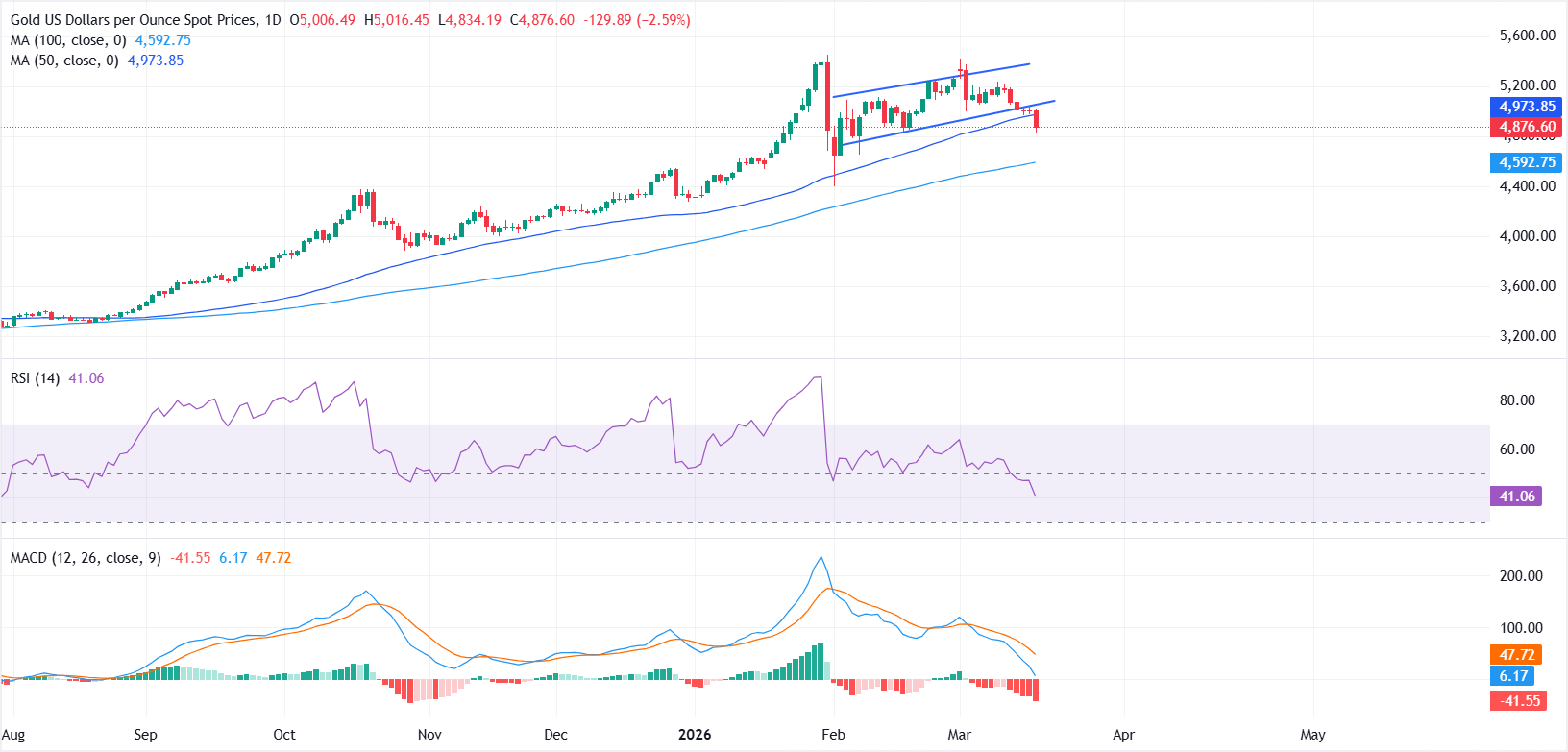
From a technical perspective, downside risks are building as Gold slips below the $5,000 mark following a breakdown from a bearish flag pattern on the daily chart. Prices have now moved below the 50-day Simple Moving Average (SMA) near $4,975, signaling a loss of near-term support and increasing downside pressure.
Despite this weakness, the broader uptrend remains intact as the metal continues to hold well above the rising 100-day SMA around $4,595.
Momentum indicators are turning negative. The Relative Strength Index (RSI) has slipped to around 45 and is trending lower from mid-range, suggesting building bearish pressure. Meanwhile, the Moving Average Convergence Divergence (MACD) remains below the Signal line in negative territory, with a widening negative histogram reinforcing fading upside momentum.
A sustained break below the 50-day SMA could accelerate losses toward the 100-day SMA. On the upside, the $4,975 level now acts as immediate resistance, followed by the $5,000-$5,100 region, while a clear move above $5,200 would be needed to revive the broader uptrend.
Economic Indicator
Fed Interest Rate Decision
The Federal Reserve (Fed) deliberates on monetary policy and makes a decision on interest rates at eight pre-scheduled meetings per year. It has two mandates: to keep inflation at 2%, and to maintain full employment. Its main tool for achieving this is by setting interest rates – both at which it lends to banks and banks lend to each other. If it decides to hike rates, the US Dollar (USD) tends to strengthen as it attracts more foreign capital inflows. If it cuts rates, it tends to weaken the USD as capital drains out to countries offering higher returns. If rates are left unchanged, attention turns to the tone of the Federal Open Market Committee (FOMC) statement, and whether it is hawkish (expectant of higher future interest rates), or dovish (expectant of lower future rates).
Read more.Next release: Wed Mar 18, 2026 18:00
Frequency: Irregular
Consensus: 3.75%
Previous: 3.75%
Source: Federal Reserve
Author

Vishal Chaturvedi
FXStreet
I am a macro-focused research analyst with over four years of experience covering forex and commodities market. I enjoy breaking down complex economic trends and turning them into clear, actionable insights that help traders stay ahead of the curve.