Gold slides as US-Iran uncertainty and global interest rate outlook weigh
- Gold edges lower on Thursday as uncertainty around US-Iran negotiations keeps markets on edge.
- Rising Oil prices are fueling inflation concerns, strengthening expectations of higher-for-longer interest rates.
- Technically, XAU/USD remains under pressure below the 100-day SMA, maintaining a short-term bearish bias.

Gold (XAU/USD) edges lower on Thursday, snapping a two-day winning streak as uncertainty surrounding US-Iran negotiations to end the conflict keeps markets on edge, with price action largely driven by hawkish global interest rate expectations stemming from an Oil-driven inflation shock.
At the time of writing, XAU/USD trades around $4,444, down roughly 1.38% on the day, retreating from Wednesday’s high near $4,602.
US-Iran talks remain unclear
While the United States (US) pushes for a diplomatic breakthrough, Iran has rejected a proposed 15-point plan, stating that any agreement would be on its own terms and only once its conditions are met, including security guarantees and recognition of its authority over the Strait of Hormuz.
Iran’s refusal of a proposed deal is increasing the risk of a prolonged conflict, especially with reports of additional US troop deployments to the region. Press TV cited the Iranian Army as warning that any ground incursion would be “more dangerous and costly” for the United States
Meanwhile, US President Donald Trump’s five-day pause on planned strikes is set to end later this week, keeping uncertainty high. Trump said in a Truth Social post that Iranian negotiators were “begging” for a deal and warned there may be “no turning back” if a diplomatic resolution is not reached.
Liquidity demand and higher rate expectations pressure Gold
Despite ongoing geopolitical tensions, Gold has struggled to attract sustained demand, with the metal currently down over 15% from the March peak of $5,419, after briefly falling more than 20% from that high earlier this week.
Analysts suggest that traders are increasingly selling Gold to move into cash, primarily US Dollars (USD), to cover losses or margin calls in other assets amid heightened volatility across global markets. This shift toward liquidity is adding pressure on the precious metal.
At the same time, rising Oil prices are fueling inflation concerns, prompting expectations that central banks may keep interest rates elevated for longer or even consider tightening if price pressure persists. Higher interest rates tend to weigh on Gold by reducing its appeal as a non-yielding asset.
Markets now expect the Federal Reserve (Fed) to keep rates on hold through 2026, rather than earlier expectations for at least two cuts. This repricing has pushed US Treasury yields higher, further limiting upside in the yellow metal.
Looking ahead, traders will continue to monitor geopolitical developments for any signs of progress in US-Iran negotiations. However, given the current backdrop, upside in Gold is likely to remain capped unless a clear breakthrough leads to lower Oil prices and eases expectations for higher-for-longer interest rates.
Technical analysis: Bearish bias persists below 100-day SMA
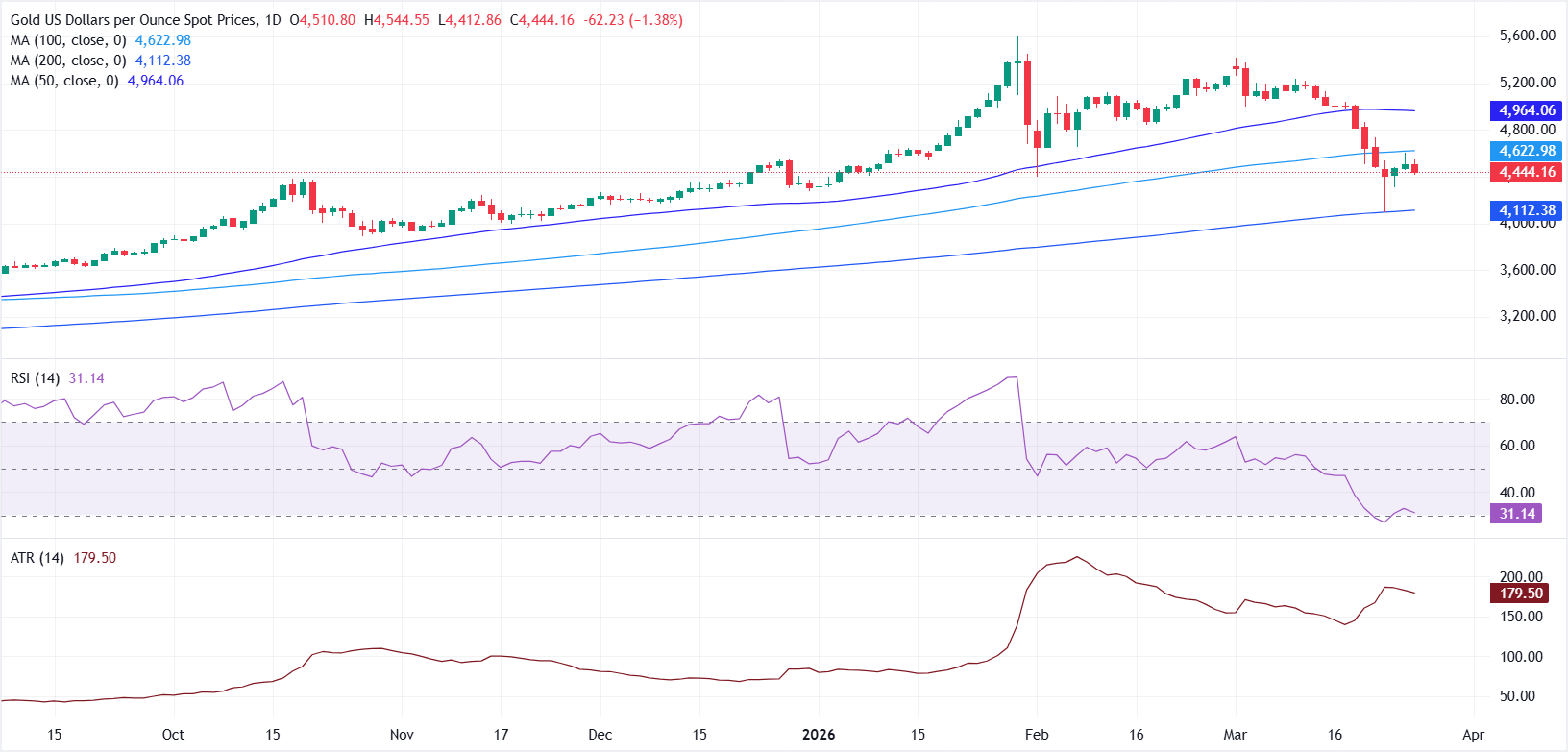
From a technical perspective, XAU/USD near-term bias remains bearish after facing rejection at the 100-day Simple Moving Average (SMA) on the daily chart, following a rebound from the 200-day SMA earlier this week, which keeps the broader uptrend intact.
The Relative Strength Index (RSI) hovers in the low 30s after slipping below this level on Monday, showing persistent bearish momentum with only tentative signs of stabilization. Average True Range (ATR) has picked up from earlier lows, indicating that the latest leg lower unfolds with expanding volatility, which reinforces the downside risk in the short term.
On the upside, a sustained move above the 100-day SMA near $4,622 could ease bearish pressure and allow XAU/USD to test the 50-day SMA around $4,964, ahead of the $5,000 psychological level. A break above $5,000 would signal a return to a bullish bias.
On the downside, immediate support lies at Tuesday’s low near $4,306, followed by the 200-day SMA around $4,112.
Gold FAQs
Gold has played a key role in human’s history as it has been widely used as a store of value and medium of exchange. Currently, apart from its shine and usage for jewelry, the precious metal is widely seen as a safe-haven asset, meaning that it is considered a good investment during turbulent times. Gold is also widely seen as a hedge against inflation and against depreciating currencies as it doesn’t rely on any specific issuer or government.
Central banks are the biggest Gold holders. In their aim to support their currencies in turbulent times, central banks tend to diversify their reserves and buy Gold to improve the perceived strength of the economy and the currency. High Gold reserves can be a source of trust for a country’s solvency. Central banks added 1,136 tonnes of Gold worth around $70 billion to their reserves in 2022, according to data from the World Gold Council. This is the highest yearly purchase since records began. Central banks from emerging economies such as China, India and Turkey are quickly increasing their Gold reserves.
Gold has an inverse correlation with the US Dollar and US Treasuries, which are both major reserve and safe-haven assets. When the Dollar depreciates, Gold tends to rise, enabling investors and central banks to diversify their assets in turbulent times. Gold is also inversely correlated with risk assets. A rally in the stock market tends to weaken Gold price, while sell-offs in riskier markets tend to favor the precious metal.
The price can move due to a wide range of factors. Geopolitical instability or fears of a deep recession can quickly make Gold price escalate due to its safe-haven status. As a yield-less asset, Gold tends to rise with lower interest rates, while higher cost of money usually weighs down on the yellow metal. Still, most moves depend on how the US Dollar (USD) behaves as the asset is priced in dollars (XAU/USD). A strong Dollar tends to keep the price of Gold controlled, whereas a weaker Dollar is likely to push Gold prices up.
Author

Vishal Chaturvedi
FXStreet
I am a macro-focused research analyst with over four years of experience covering forex and commodities market. I enjoy breaking down complex economic trends and turning them into clear, actionable insights that help traders stay ahead of the curve.

















