Gold retreats as Fed shock sends US Dollar to YTD highs
- Fed dot plot shows nearly half of policymakers favoring a year-end rate increase.
- Chair Warsh rejects forward guidance, prioritizing price stability over signals.
- Next week brings PMIs, GDP, jobs and Core PCE.

Gold (XAU/USD) price recoils by 0.70% on Thursday as traders continue to digest the Federal Reserve's (Fed) hawkish tilt, bolstering the Greenback and pushing it to a new year-to-date (YTD) high, a headwind for the yellow metal. The XAU/USD pair trades at $4,223 after reaching a high of $4,330.
XAU/USD slips as hawkish repricing lifts Dollar to highs
Financial markets are in a risk-on mood, boosted by optimism about the end of the Middle East war and a jump in technology shares, despite the Fed’s change of stance. The US central bank held rates at the 3.50%-3.75% range on Wednesday, and updated its economic projections, with the so-called dot plot showing that 9 of 19 policymakers expect a rate increase towards the end of the year.
The Fed Chair, Kevin Warsh, did not participate in the dot plot, though acknowledged that he respected his colleagues submitting their ‘dots.’ Warsh said that forward guidance is not “well suited” in the current economic conditions, though noted that the jobs market is moving in the right direction and that price stability is the priority for the Fed.
Markets are now pricing in an 85% chance of a US rate hike in December, according to the CME FedWatch Tool. This is higher than the 61% chance seen before the Fed's policy statement.
The Fed's hawkish stance weighed on Gold prices and strengthened the Greenback. The US Dollar Index (DXY), which tracks the USD against six other major currencies, rises on Thursday, hitting 100.81, its highest level since May, 2025.
US central bank policymakers' median forecast anticipates inflation will decline to 3.6% in 2026, hitting the Fed’s 2% goal by 2028. Economic growth is now forecasted to be marginally lower, with GDP expected to reach 2.2% by year's end, while the Unemployment Rate is projected to stay steady.
On the data front, US Initial Jobless Claims decreased from 230K to 226K, slightly above the estimated 225K, but still indicating a stronger labor market.
This week, the US economic docket will be absent due to the Juneteenth holiday. Next week, the US economic schedule will feature Flash PMIs, jobs data, the final reading of the Gross Domestic Product (GDP) for Q1 2026, and the Fed’s preferred inflation gauge, the Core Personal Consumption Expenditures (PCE) Price Index.
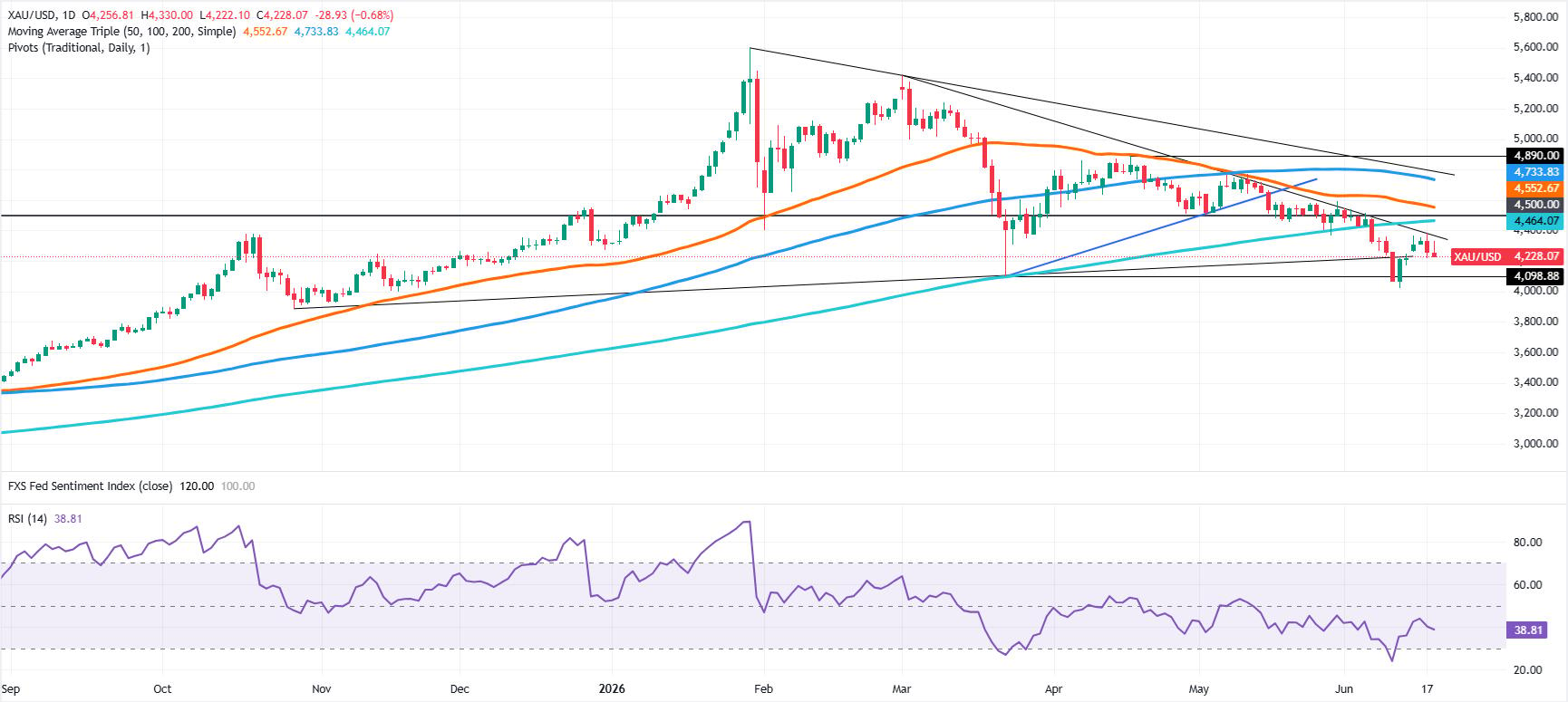
XAU/USD technical outlook: Gold stumbles below the $4,300 figure, on hawkish Fed
Gold prices turned bearish following the Fed’s decision, breaking below June 16 support of $4,306 and reaching a two-day low of $4,219 before rebounding somewhat. Although the recovery drove the yellow metal to $4,330, momentum faded and XAU remains below $4,300 at the time of writing.
The Relative Strength Index (RSI), which is moving in bearish territory, indicates that sellers are dominant. If XAU/USD falls below $4,200, it could test the June 11 swing low at $4,023, approaching the $4,000 level.
Going higher, Gold needs to rise above $4,300 for buyers to push prices higher. Breaking above this level and the significant psychological barriers at $4,350 and $4,400 would be necessary for further gains.
Gold FAQs
Gold has played a key role in human’s history as it has been widely used as a store of value and medium of exchange. Currently, apart from its shine and usage for jewelry, the precious metal is widely seen as a safe-haven asset, meaning that it is considered a good investment during turbulent times. Gold is also widely seen as a hedge against inflation and against depreciating currencies as it doesn’t rely on any specific issuer or government.
Central banks are the biggest Gold holders. In their aim to support their currencies in turbulent times, central banks tend to diversify their reserves and buy Gold to improve the perceived strength of the economy and the currency. High Gold reserves can be a source of trust for a country’s solvency. Central banks added 1,136 tonnes of Gold worth around $70 billion to their reserves in 2022, according to data from the World Gold Council. This is the highest yearly purchase since records began. Central banks from emerging economies such as China, India and Turkey are quickly increasing their Gold reserves.
Gold has an inverse correlation with the US Dollar and US Treasuries, which are both major reserve and safe-haven assets. When the Dollar depreciates, Gold tends to rise, enabling investors and central banks to diversify their assets in turbulent times. Gold is also inversely correlated with risk assets. A rally in the stock market tends to weaken Gold price, while sell-offs in riskier markets tend to favor the precious metal.
The price can move due to a wide range of factors. Geopolitical instability or fears of a deep recession can quickly make Gold price escalate due to its safe-haven status. As a yield-less asset, Gold tends to rise with lower interest rates, while higher cost of money usually weighs down on the yellow metal. Still, most moves depend on how the US Dollar (USD) behaves as the asset is priced in dollars (XAU/USD). A strong Dollar tends to keep the price of Gold controlled, whereas a weaker Dollar is likely to push Gold prices up.
Author

Christian Borjon Valencia
FXStreet
Markets analyst, news editor, and trading instructor with over 14 years of experience across FX, commodities, US equity indices, and global macro markets.