Gold reclaims $4,060 as Oil retreats ahead of crucial Fed decision
- Gold surges over 1% to $4,061 after testing $3,989.
- WTI retreats toward $100, offering relief from energy-driven inflation pressure.
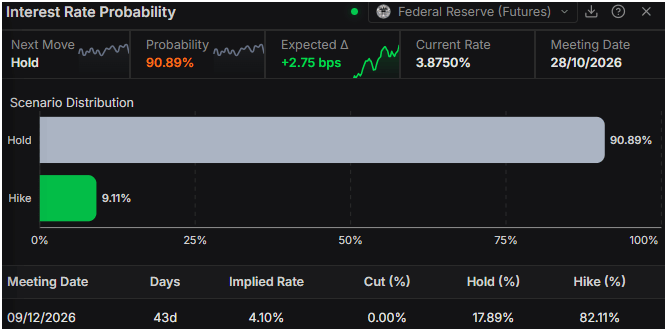
- December Fed hike odds stand at 83% ahead of Warsh's remarks.

Gold prices stage a rebound off a daily low of $3,989, rising over 1% on Tuesday even as the US Dollar and US Treasury yields rose. Falling Oil prices provide a leg up for the yellow metal, while investors brace for the Federal Reserve’s (Fed) decision on Wednesday. The XAU/USD trades at $4,061.
XAU/USD rebounds despite rising US yields as falling Oil prices ease inflation
Today’s US data failed to provide a meaningful signal for Gold’s direction, with the precious metal opening lower before turning green. Geopolitics are driving price action after West Texas Intermediate (WTI), the US Oil benchmark, fell more than 1% to $100.05 per barrel.
The Middle East conflict seems far from a swift resolution as talks between the US and Iran seem to have stalled. According to recent new reporting, the US and Israel are likely to resume their attack on Tehran following Israel and US midterm elections, which pushed WTI prices above the $100.00 threshold on Monday.
The US housing data was softer than expected, though it was mostly ignored by market participants. Consumer Confidence improved in October from 84.2 to 91.7, according to the Conference Board, as Americans grew optimistic about the labour market and business conditions. On the contrary, inflation expectations were unchanged from the previous figure of 5.8%.
Durable Goods Orders rose 1.8% in September, up from 0.1%, as business spending stayed strong amid AI infrastructure expansion. Meanwhile, the ADP Employment Change 4-week average eased to 16.8K from 17.5K, signaling modest labour-market cooling.
Traders' focus is on the Fed, not on the monetary policy statement, unless it shows an aggressive hawkish tilt. Money markets see a 9% chance of a hike, which would be a surprise ahead of the midterm US elections. Eyes are on Fed Chair Kevin Warsh's speech, which could delineate the next move for the December meeting.
Worth noting that alongside the Fed, two other central banks are expected to increase rates, amid fears that energy prices would continue to trend higher. The European Central Bank (ECB) decision arrives on Thursday, followed by the Bank of Japan (BoJ) on Friday. The ECB is expected to leave rates unchanged on Thursday.
Data from Prime Terminal shows an 83% chance of a 25-basis-point rate increase by the Fed in December. Although the odds are positive, they continue to trend lower compared to last week’s 90%.
Besides this, traders are also eyeing the release of US Gross Domestic Product (GDP) figures and the Fed’s preferred inflation gauge, the core Personal Consumption Expenditures (PCE) Price Index on Thursday.
XAU/USD technical analysis: Gold buyers defend $4,000, eyes on $4,100
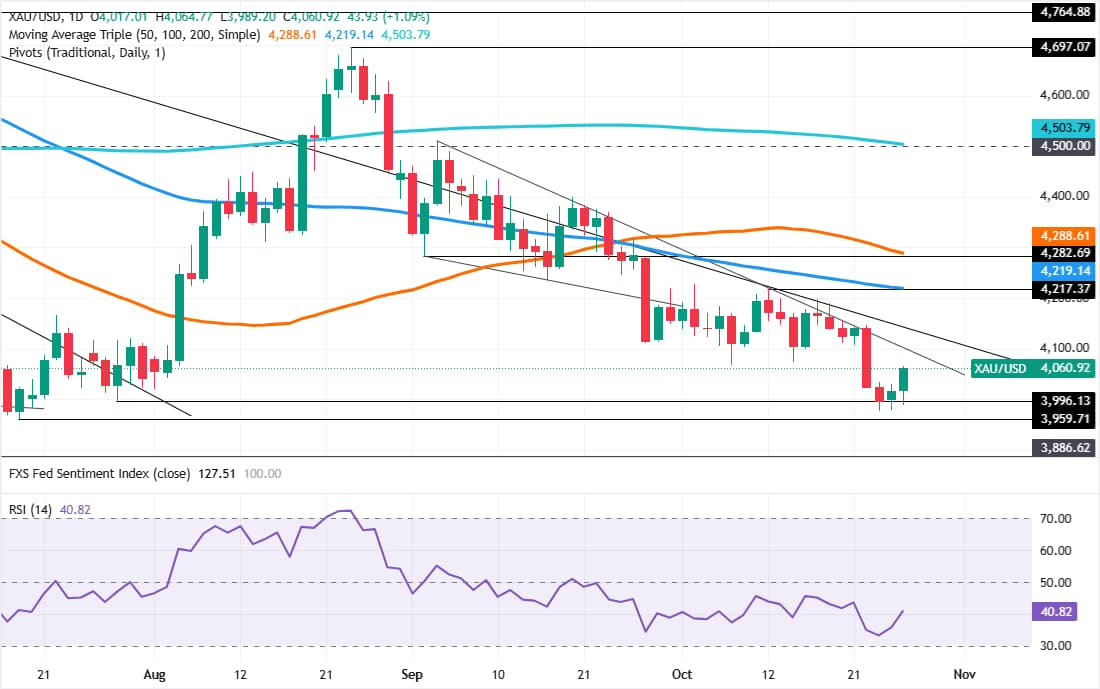
From a technical standpoint, Gold formed a "bullish harami" candle pattern, which was confirmed today as XAU/USD rises above October’s 23-day high of $4,034. Although momentum favors buyers in the short term, the Relative Strength Index (RSI) is bearish, so caution is warranted.
On the upside, the next area of interest is a resistance trendline drawn from around September highs, near $4,100. A breach of the latter will result in an exposure of $4,200. The next key resistance levels are the 100-day Simple Moving Average (SMA) at $4,219 and the 50-day SMA at $4,288.
If XAU/USD tumbles below $4,000, this opens the door for testing last Friday’s low of $3,975. The next key support levels are the July 17 low of $3,959 and the year-to-date (YTD) low of $3,941.
(This story was corrected on October 27 at 18:00 GMT to state in the fifth paragraph that the ADP Employment Change 4-week average was previously 17.5K not 18.5K)

Gold FAQs
Gold has played a key role in human’s history as it has been widely used as a store of value and medium of exchange. Currently, apart from its shine and usage for jewelry, the precious metal is widely seen as a safe-haven asset, meaning that it is considered a good investment during turbulent times. Gold is also widely seen as a hedge against inflation and against depreciating currencies as it doesn’t rely on any specific issuer or government.
Central banks are the biggest Gold holders. In their aim to support their currencies in turbulent times, central banks tend to diversify their reserves and buy Gold to improve the perceived strength of the economy and the currency. High Gold reserves can be a source of trust for a country’s solvency. Central banks added 1,136 tonnes of Gold worth around $70 billion to their reserves in 2022, according to data from the World Gold Council. This is the highest yearly purchase since records began. Central banks from emerging economies such as China, India and Turkey are quickly increasing their Gold reserves.
Gold has an inverse correlation with the US Dollar and US Treasuries, which are both major reserve and safe-haven assets. When the Dollar depreciates, Gold tends to rise, enabling investors and central banks to diversify their assets in turbulent times. Gold is also inversely correlated with risk assets. A rally in the stock market tends to weaken Gold price, while sell-offs in riskier markets tend to favor the precious metal.
The price can move due to a wide range of factors. Geopolitical instability or fears of a deep recession can quickly make Gold price escalate due to its safe-haven status. As a yield-less asset, Gold tends to rise with lower interest rates, while higher cost of money usually weighs down on the yellow metal. Still, most moves depend on how the US Dollar (USD) behaves as the asset is priced in dollars (XAU/USD). A strong Dollar tends to keep the price of Gold controlled, whereas a weaker Dollar is likely to push Gold prices up.
Author

Christian Borjon Valencia
FXStreet
Markets analyst, news editor, and trading instructor with over 14 years of experience across FX, commodities, US equity indices, and global macro markets.