Gold rebounds from two-month lows as Iran deal hopes weaken USD
- Gold rallies after Axios reports tentative US-Iran ceasefire agreement.
- A softer US Dollar and weaker GDP data support a bullion recovery.
- Fed hike odds ease, but sticky inflation remains problematic.

Gold (XAU/USD) stages a comeback, surging over 1.20% on Thursday after rebounding from two-month lows near $4,366, as market sentiment improves on speculation of a peace deal between the US and Iran. At the time of writing, XAU/USD trades at $4,500.
XAU/USD jumps as ceasefire hopes offset hot PCE inflation
Axios reported that Washington and Tehran reached a peace deal to extend the ceasefire for 60 days, as both parties aim to discuss an agreement regarding Iran’s uranium enrichment program. The news outlet cited two US officials and a regional source mediator, though the deal needs the approval of US President Donald Trump and Iranian senior officials.
Worth noting that the news broke amid a slight escalation as the US and Iran exchanged fire, with the latter launching strikes against Kuwait.
The US Dollar Index (DXY), which measures the Greenback's strength against other currencies, has decreased by 0.19% to 98.97 as risk appetite improves.
Data-wise, the core PCE Price Index, the Federal Reserve’s (Fed) preferred inflation gauge, increased by 3.3% YoY in April, up from 3.2% in March, spurred by high energy prices. Headline PCE expanded by 3.8% YoY as foreseen, up from March’s 3.5%.
The US economy expanded more slowly than anticipated in Q1 2026, with GDP rising by just 1.6%, revised downward from the previous estimate of 2%, according to the US Bureau of Economic Analysis. At the same time, the US Department of Labor reported that Initial Jobless Claims increased to 215K for the week ending May 23, surpassing the forecast of 211K.
After the data, expectations that the Federal Reserve will increase rates in 2026 were trimmed. Now the odds stand at 45% for a 25-basis-point rate hike, according to Prime Terminal data.
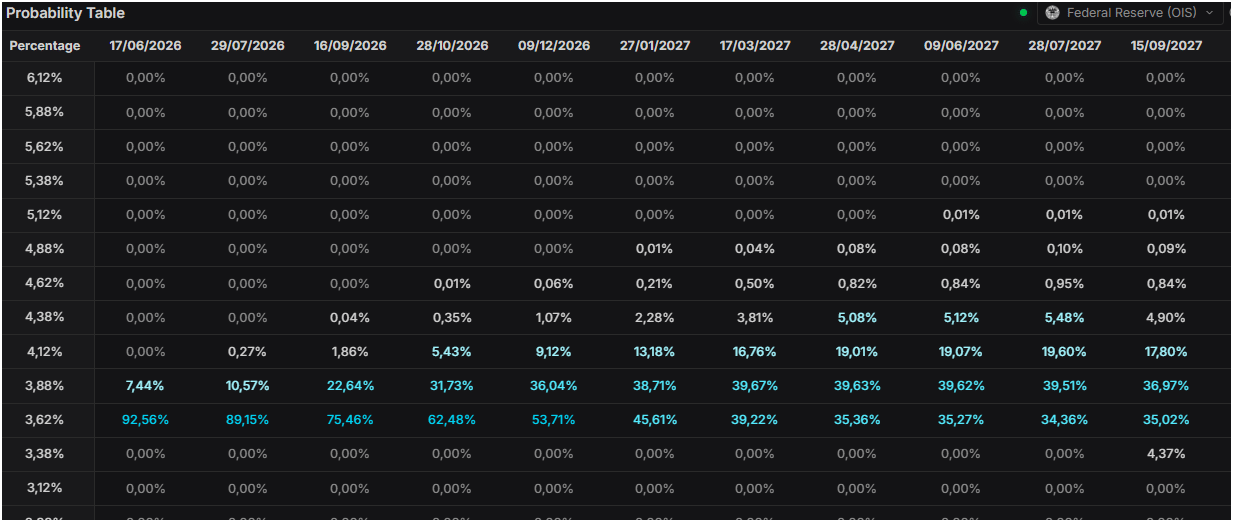
Fed commentary remained mixed. St. Louis Fed President Alberto Musalem warned that a rate hike could be needed if inflation fails to cool. At the same time, New York Fed President John Williams said policy is appropriately positioned given the outlook.
In the US, traders await speeches by Federal Reserve officials ahead of entering their blackout period.
XAU/USD technical analysis: Gold price to test key resistance near $4,500
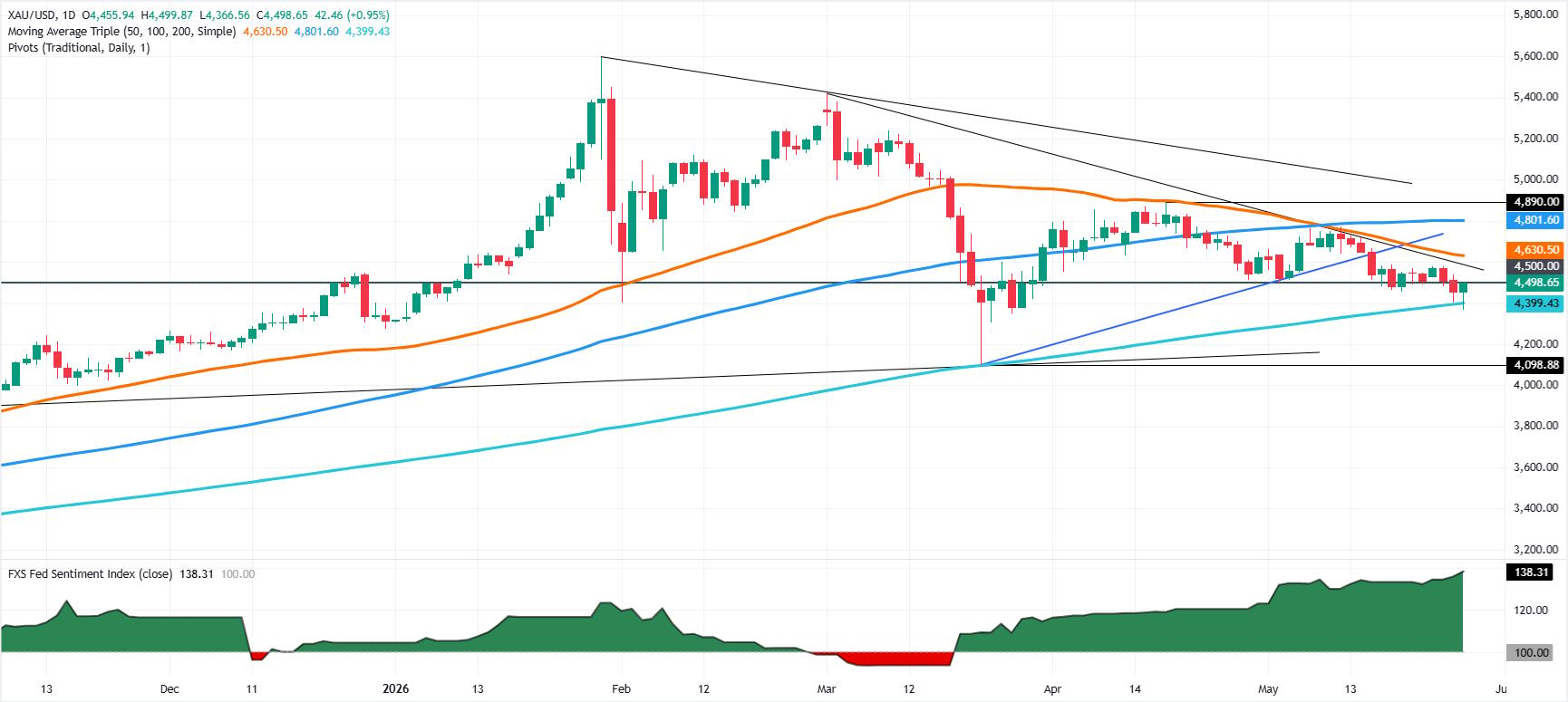
Gold price seems poised to extend its losses, with the yellow metal trending below a resistance trendline drawn from around March’s highs, which has held over the last nine trading days, an indication that sellers are in control.
The Relative Strength Index (RSI) is bearish, but it shows that further upside is expected in the near term.
If XAU/USD clears the psychological $4,500 level, the next stop would be the downtrend resistance trendline near $4,575-$4,600. On further strength, the next stop would be the 50-day Simple Moving Average (SMA) at $4,630, ahead of the 100-day SMA at $4,801.
Conversely, if Gold drops below $4,450, it would clear the path to challenge the 200-day SMA at $4,399, followed by the current day low of $4,366.
Gold FAQs
Gold has played a key role in human’s history as it has been widely used as a store of value and medium of exchange. Currently, apart from its shine and usage for jewelry, the precious metal is widely seen as a safe-haven asset, meaning that it is considered a good investment during turbulent times. Gold is also widely seen as a hedge against inflation and against depreciating currencies as it doesn’t rely on any specific issuer or government.
Central banks are the biggest Gold holders. In their aim to support their currencies in turbulent times, central banks tend to diversify their reserves and buy Gold to improve the perceived strength of the economy and the currency. High Gold reserves can be a source of trust for a country’s solvency. Central banks added 1,136 tonnes of Gold worth around $70 billion to their reserves in 2022, according to data from the World Gold Council. This is the highest yearly purchase since records began. Central banks from emerging economies such as China, India and Turkey are quickly increasing their Gold reserves.
Gold has an inverse correlation with the US Dollar and US Treasuries, which are both major reserve and safe-haven assets. When the Dollar depreciates, Gold tends to rise, enabling investors and central banks to diversify their assets in turbulent times. Gold is also inversely correlated with risk assets. A rally in the stock market tends to weaken Gold price, while sell-offs in riskier markets tend to favor the precious metal.
The price can move due to a wide range of factors. Geopolitical instability or fears of a deep recession can quickly make Gold price escalate due to its safe-haven status. As a yield-less asset, Gold tends to rise with lower interest rates, while higher cost of money usually weighs down on the yellow metal. Still, most moves depend on how the US Dollar (USD) behaves as the asset is priced in dollars (XAU/USD). A strong Dollar tends to keep the price of Gold controlled, whereas a weaker Dollar is likely to push Gold prices up.
Author

Christian Borjon Valencia
FXStreet
Markets analyst, news editor, and trading instructor with over 14 years of experience across FX, commodities, US equity indices, and global macro markets.