Gold stalls below $4,200 as Fed rate-hike bets limit upside
- Gold struggles to extend early gains as the US Dollar and Treasury yields regain some ground.
- Persistent inflation risks keep another Fed interest rate hike on the table before year-end.
- The technical outlook is mixed, with XAU/USD trading below its 20-day SMA while the MACD turns positive.

Gold (XAU/USD) struggles after opening the week higher. The US Dollar (USD) and US Treasury yields find some footing following last week’s pullback as traders assess the Federal Reserve’s (Fed) interest rate path and geopolitical developments. At the time of writing, XAU/USD trades around $4,170 after reaching an intraday high of $4,190.
The US Dollar and yields corrected sharply lower last week, driven by an AI-led equity sell-off that prompted traders to rotate into government bonds and safe-haven Gold. However, the metal’s gains were modest as expectations of additional interest rate hikes by the Federal Reserve (Fed) continued to weigh on the non-yielding metal while cushioning the downside in the US Dollar and Treasury yields.
The US Dollar Index (DXY), which tracks the Greenback’s value against a basket of six major currencies, trades around 101.90, up 0.10% on the day. Weakness in the Euro (EUR) amid mounting fiscal concerns and political unrest in France provides additional support to the USD. Meanwhile, the benchmark 10-year US Treasury yield stands near 5.08%, holding close to recent lows.
Elevated energy prices linked to the war in the Middle East continue to feed into inflation, with both September’s Consumer Price Index (CPI) and Producer Price Index (PPI) reports coming in hotter than expected. This reinforces expectations of another rate hike by year-end as the Fed seeks to bring inflation back to its 2% target.
Analysts at Nordea say they are leaving their Federal Reserve outlook unchanged, stressing that “we keep our Fed forecast unchanged” and “still expect one more hike this year and another next year, with the risks tilted to the upside.” In their view, “monetary policy still does not look restrictive enough for an economy in this shape,” particularly as “inflation is still clearly above target, and the September CPI shows it moving up, not down.”
Against that backdrop, Nordea argues that “long-term yields above 5% are not particularly restrictive,” and concludes that “all in all, our view is unchanged. A strong economy and above-target inflation still call for tighter policy. Higher long-term yields do not change that call. They mostly reflect the same strong economy that keeps the Fed hiking.”
Recent remarks from Fed officials also suggest they remain open to further tightening, although they have not strongly signaled a hike at the October 27-28 meeting. Speaking in Bangkok on Friday, Fed Chair Kevin Warsh stuck to his stance of avoiding forward guidance, saying, “I don't prejudge meetings.” The CME FedWatch Tool shows traders pricing in a 15% chance of a rate hike this month and an 89% chance of a hike in December.
On the geopolitical front, Iran has renewed its offer to reopen the Strait of Hormuz within seven days if Washington accepts its conditions, although negotiations remain stalled over Tehran’s nuclear programme. Meanwhile, continued attacks on vessels in the Strait of Hormuz and fighting between Saudi Arabia and the Houthis keep supply risks elevated. However, US President Donald Trump’s decision to temporarily waive sanctions on Russia has raised expectations of increased energy supplies.
Technical analysis: Mixed technical signals keep bulls cautious below $4,200
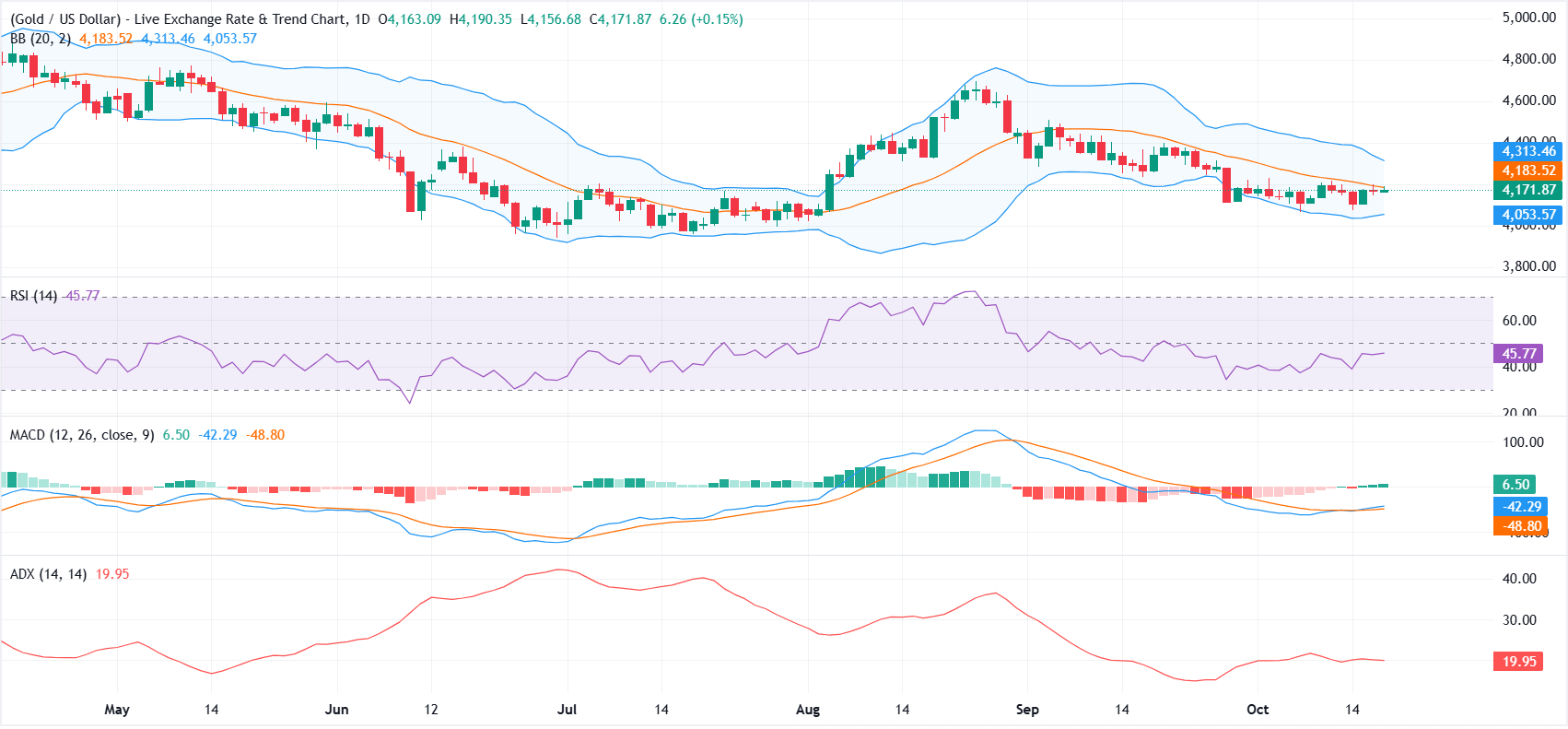
On the daily chart, XAU/USD holds a mildly bearish near-term bias as price sits just under the 20-day simple moving average (SMA) embedded in the Bollinger Bands at $4,183. The failed recovery through this middle band hints that recent gains are losing traction, even as the Moving Average Convergence Divergence (MACD) indicator turns positive and extends higher, suggesting only tentative upside momentum, while the Relative Strength Index (RSI) near 45 keeps the broader tone slightly soft and the Average Directional Index (ADX) below 20 signals a weak underlying trend.
On the topside, the Bollinger middle band and 20-day SMA at $4,183 act as immediate resistance. A daily close above this pivot would be needed to ease the current downside pressure. On the downside, initial support is seen at the lower Bollinger Band near $4,053, where buyers may look to defend the recent range floor if the pullback accelerates.
(The technical analysis of this story was written with the help of an AI tool. Know more.)
Gold FAQs
Gold has played a key role in human’s history as it has been widely used as a store of value and medium of exchange. Currently, apart from its shine and usage for jewelry, the precious metal is widely seen as a safe-haven asset, meaning that it is considered a good investment during turbulent times. Gold is also widely seen as a hedge against inflation and against depreciating currencies as it doesn’t rely on any specific issuer or government.
Central banks are the biggest Gold holders. In their aim to support their currencies in turbulent times, central banks tend to diversify their reserves and buy Gold to improve the perceived strength of the economy and the currency. High Gold reserves can be a source of trust for a country’s solvency. Central banks added 1,136 tonnes of Gold worth around $70 billion to their reserves in 2022, according to data from the World Gold Council. This is the highest yearly purchase since records began. Central banks from emerging economies such as China, India and Turkey are quickly increasing their Gold reserves.
Gold has an inverse correlation with the US Dollar and US Treasuries, which are both major reserve and safe-haven assets. When the Dollar depreciates, Gold tends to rise, enabling investors and central banks to diversify their assets in turbulent times. Gold is also inversely correlated with risk assets. A rally in the stock market tends to weaken Gold price, while sell-offs in riskier markets tend to favor the precious metal.
The price can move due to a wide range of factors. Geopolitical instability or fears of a deep recession can quickly make Gold price escalate due to its safe-haven status. As a yield-less asset, Gold tends to rise with lower interest rates, while higher cost of money usually weighs down on the yellow metal. Still, most moves depend on how the US Dollar (USD) behaves as the asset is priced in dollars (XAU/USD). A strong Dollar tends to keep the price of Gold controlled, whereas a weaker Dollar is likely to push Gold prices up.
Author

Vishal Chaturvedi
FXStreet
I am a macro-focused research analyst with over four years of experience covering forex and commodities market. I enjoy breaking down complex economic trends and turning them into clear, actionable insights that help traders stay ahead of the curve.