Gold price wilts as Oil shock puts CPI in Fed crosshairs
- WTI rises above $92 as Middle East attacks fuel inflation worries.
- Strong NFP keeps September Fed hike odds near 63%.
- US PPI, CPI and jobless claims steer Gold’s next move.
Gold (XAU/USD) registers losses of over 0.44% on Tuesday amid a light economic docket in the US, due to a narrative dominated by the US-Iran conflict, higher Oil prices and traders bracing for the release of US inflation reports, with the PPI expected on Thursday, followed by the next day’s CPI. At the time of writing, XAU/USD trades at $4,393.
XAU/USD falls as energy risks sharpen Fed hike fears
Energy prices continued to climb as attacks in the Middle East sent West Texas Intermediate (WTI) up 1% to $92.10 per barrel. A scarce US economic docket on Tuesday and Wednesday keeps investors focused on US inflation data, which could prompt a repricing of short-term interest rates set by the Federal Reserve (Fed).
Last week’s outstanding Nonfarm Payrolls report gave the green light to Fed Chair Kevin Warsh and company to increase rates. If July’s data – particularly the Consumer Price Index (CPI) expected at 0.4% MoM or 3.4% YoY, along with core figures seen at 0.2% MoM and 2.4% YoY – are exceeded, it opens the door for further tightening. This would push bullion prices lower, which tend to fare well in a lower-interest-rate environment.
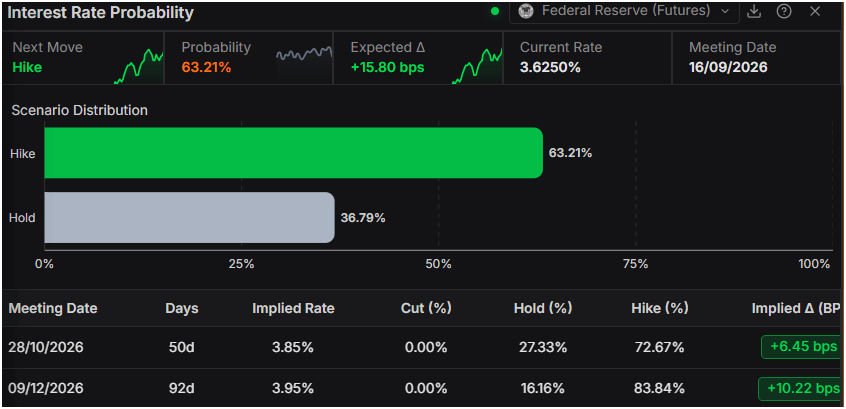
Money markets have priced in a 63% chance of a 25-basis-point rate hike by the Fed at next week's meeting, according to Prime Terminal.
Alongside the release of US inflation data, traders would be keen to assess the status of the labor market, as the US Department of Labor will feature Initial Jobless Claims for the week ending September 5.
So far, Gold’s fall has not been triggered by US bond yields or the Dollar. The US 10-year Treasury yield is flat at 4.788%. At the same time, the US Dollar Index (DXY), which measures the performance of the buck’s value against a basket of six currencies, is down 0.04% at 98.86.
XAU/USD technical outlook: Gold falls towards the 100-day SMA, eyes on $4,300
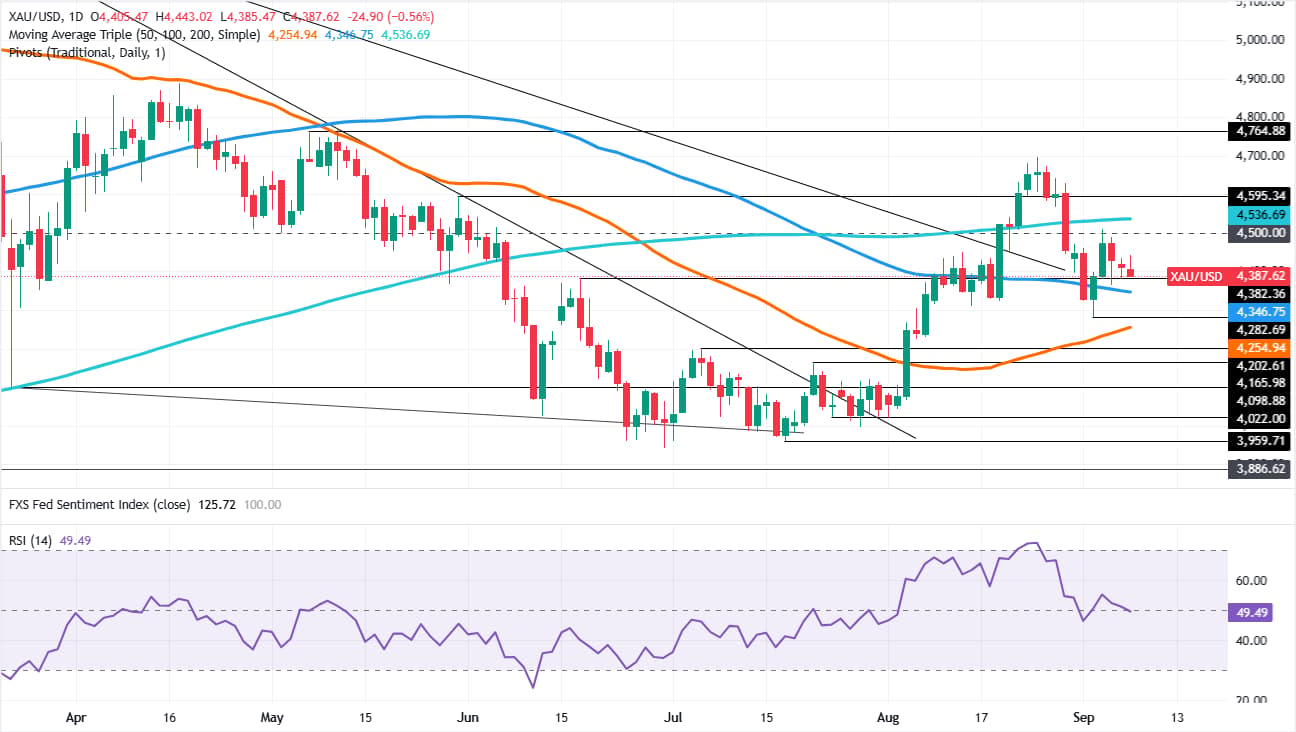
Gold price extended its losses for the third straight day, approaching the 100-day Simple Moving Average (SMA) at $4,346, with the next target seen at $4,300 as the path of least resistance shifted downward in the near term.
The Relative Strength Index (RSI) currently leans downward after piercing the 50-neutral level, indicating further downside.
The first downside support level is at $4,300. A strong breakout below the figure could test the September 2 swing low at $4,282, followed by the 50-day SMA at $4,254. On further weakness, the next area of interest will be $4,200.
On the upside, once prices surpass $4,400, it opens the door to challenge the psychological $4,450, followed by $4,500. A breach of the latter will expose the 200-day SMA at $4,535. Breaking above this level could open the way to $4,600 and, eventually, to the daily high from August 25 at $4,697.
Gold FAQs
Gold has played a key role in human’s history as it has been widely used as a store of value and medium of exchange. Currently, apart from its shine and usage for jewelry, the precious metal is widely seen as a safe-haven asset, meaning that it is considered a good investment during turbulent times. Gold is also widely seen as a hedge against inflation and against depreciating currencies as it doesn’t rely on any specific issuer or government.
Central banks are the biggest Gold holders. In their aim to support their currencies in turbulent times, central banks tend to diversify their reserves and buy Gold to improve the perceived strength of the economy and the currency. High Gold reserves can be a source of trust for a country’s solvency. Central banks added 1,136 tonnes of Gold worth around $70 billion to their reserves in 2022, according to data from the World Gold Council. This is the highest yearly purchase since records began. Central banks from emerging economies such as China, India and Turkey are quickly increasing their Gold reserves.
Gold has an inverse correlation with the US Dollar and US Treasuries, which are both major reserve and safe-haven assets. When the Dollar depreciates, Gold tends to rise, enabling investors and central banks to diversify their assets in turbulent times. Gold is also inversely correlated with risk assets. A rally in the stock market tends to weaken Gold price, while sell-offs in riskier markets tend to favor the precious metal.
The price can move due to a wide range of factors. Geopolitical instability or fears of a deep recession can quickly make Gold price escalate due to its safe-haven status. As a yield-less asset, Gold tends to rise with lower interest rates, while higher cost of money usually weighs down on the yellow metal. Still, most moves depend on how the US Dollar (USD) behaves as the asset is priced in dollars (XAU/USD). A strong Dollar tends to keep the price of Gold controlled, whereas a weaker Dollar is likely to push Gold prices up.
Author

Christian Borjon Valencia
FXStreet
Markets analyst, news editor, and trading instructor with over 14 years of experience across FX, commodities, US equity indices, and global macro markets.

















