Gold price rises as Iran talks knock Oil lower
- US-Iran diplomacy pressures crude, easing inflation-linked Fed risks.
- Fed hike bets remain elevated before PMIs and Core PCE.
- Banks see 2026 tightening, limiting Gold’s upside momentum.

Gold (XAU/USD) price posts modest gains of 0.50% on Monday as talks between the US and Iran began on a positive note, driving Oil prices lower and reducing inflation expectations. At the time of writing, the XAU/USD pair trades at $4,179, after bouncing off daily lows of $4,136.
XAU/USD gains as lower Oil cools inflation expectations
Investors’ mood shows some improvement yet, US equities are fluctuating between gains and losses. Negotiations between Washington and Tehran provided a “good foundation” for a deal, according to US Vice President JD Vance, despite high tensions in the Middle East.
Over the weekend, Iran threatened to shut the Strait of Hormuz but refrained after US President Donald Trump said that he would resume the war if Tehran opted to close the strait.
Oil prices extended their losses, a tailwind for the non-yielding metal, which tends to fare well in lower interest-rate environments. West Texas Intermediate (WTI) is down in the day by 2.40% at $73.67, hinting that gasoline prices could be heading south.
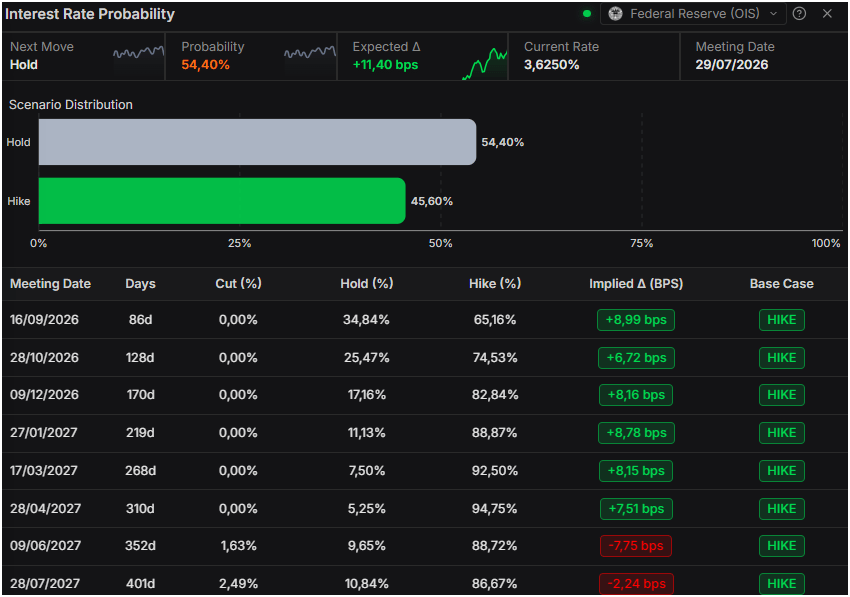
The lack of news in the US economic docket keeps traders adrift to the Federal Reserve's (Fed) hawkish tilt. Money markets had priced in a nearly 90% chance of a rate hike in December, after nearly half of the Federal Open Market Committee (FOMC) members supported a rate increase in 2026.
Some commercial banks, such as Bank of America (BoFA) and Deutsche Bank, expect a US central bank rate hike at the September meeting. BoFA expects three 25-basis-point rate hikes in 2026, with one in September, October, and December, while the German bank sees two 25-basis-point rate increases, one in September and the last in December.
As of writing, money markets see a 45% chance of a rate hike by the Fed at the July 29 meeting, according to Prime Terminal.
Ahead, the US economic schedule will feature S&P Global Flash PMIs, followed by housing data. On Thursday, the docket is busy with GDP figures for Q1 2026, the Fed’s preferred inflation gauge, the Core Personal Consumption Expenditures (PCE) Price Index, and Initial Jobless Claims data.
XAU/USD technical outlook: Gold is bearish, despite lying near daily highs
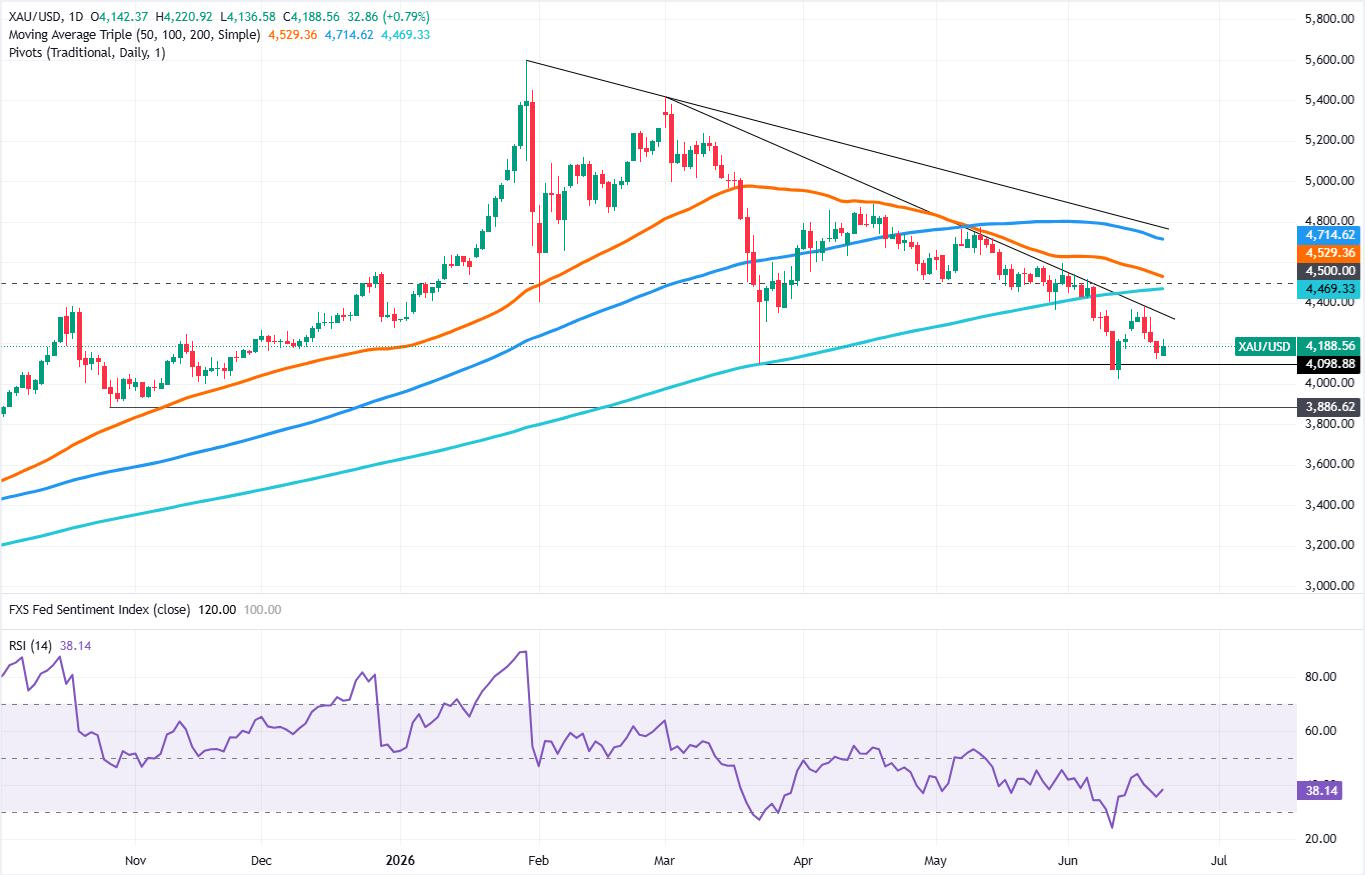
Gold trend is downwards, despite posting a bullish day, as of writing. Key technical Simple Moving Averages (SMAs) are above XAU spot prices, with buyers poised to clash at a downward resistance trendline drawn from the March highs, which lies at around the $4,335-$4,350 area.
Momentum is bearish as indicated by the Relative Strength Index (RSI), but in the near term, some upside is seen. Nevertheless, if XAU/USD ends the day below the June 19 high of $4,213, this would pave the way for testing the psychological $4,000 milestone.
Below this level is the October 28, 2025 swing low of $3,605.
On the upside, XAU's first resistance is the $4,200 milestone, which sits above the June 19 high. Once those levels are taken out, the next resistance is $4,300 and the 200-day SMA at $4,469.
Gold FAQs
Gold has played a key role in human’s history as it has been widely used as a store of value and medium of exchange. Currently, apart from its shine and usage for jewelry, the precious metal is widely seen as a safe-haven asset, meaning that it is considered a good investment during turbulent times. Gold is also widely seen as a hedge against inflation and against depreciating currencies as it doesn’t rely on any specific issuer or government.
Central banks are the biggest Gold holders. In their aim to support their currencies in turbulent times, central banks tend to diversify their reserves and buy Gold to improve the perceived strength of the economy and the currency. High Gold reserves can be a source of trust for a country’s solvency. Central banks added 1,136 tonnes of Gold worth around $70 billion to their reserves in 2022, according to data from the World Gold Council. This is the highest yearly purchase since records began. Central banks from emerging economies such as China, India and Turkey are quickly increasing their Gold reserves.
Gold has an inverse correlation with the US Dollar and US Treasuries, which are both major reserve and safe-haven assets. When the Dollar depreciates, Gold tends to rise, enabling investors and central banks to diversify their assets in turbulent times. Gold is also inversely correlated with risk assets. A rally in the stock market tends to weaken Gold price, while sell-offs in riskier markets tend to favor the precious metal.
The price can move due to a wide range of factors. Geopolitical instability or fears of a deep recession can quickly make Gold price escalate due to its safe-haven status. As a yield-less asset, Gold tends to rise with lower interest rates, while higher cost of money usually weighs down on the yellow metal. Still, most moves depend on how the US Dollar (USD) behaves as the asset is priced in dollars (XAU/USD). A strong Dollar tends to keep the price of Gold controlled, whereas a weaker Dollar is likely to push Gold prices up.
Author

Christian Borjon Valencia
FXStreet
Markets analyst, news editor, and trading instructor with over 14 years of experience across FX, commodities, US equity indices, and global macro markets.















