|

Gold Price Analysis: XAU/USD tops critical resistance, $1,732 eyed – Confluence Detector

Gold has been showing signs of strength, initially resisting the increase in bond yields and holding above $1,700. As returns on US debt subsided – following weak US inflation figures – XAU/USD moved higher and may now extend its gains.

How is the precious metal positioned on the charts?

The Technical Confluences Detector is showing that gold has topped the critical level of $1,715, which now turns into support. A dense cluster of technical levels awaits there, including the Simple Moving Average 5-4h, the SMA 10-1h, the Bollinger Band 1h-Middle, the SMA 5-1h, the SMA 100-15m, and the all-important Fibonacci 38.2% one-week.

If the upward swing is confirmed, the next near-term target is $1,718, which is where the previous month's low meets the SMA 10-15m. 

The upside target for XAU/USD is $1,732, which is where the Pivot Point one-day Resistance 1 and the Fibonacci 61.8% one-week converge.

Below $1,715, the next cushion is at $1,706, which is the confluence of the Fibonacci 23.6% one-week and the Fibonacci 38.2% one-day. 

XAU/USD resistance and support levels
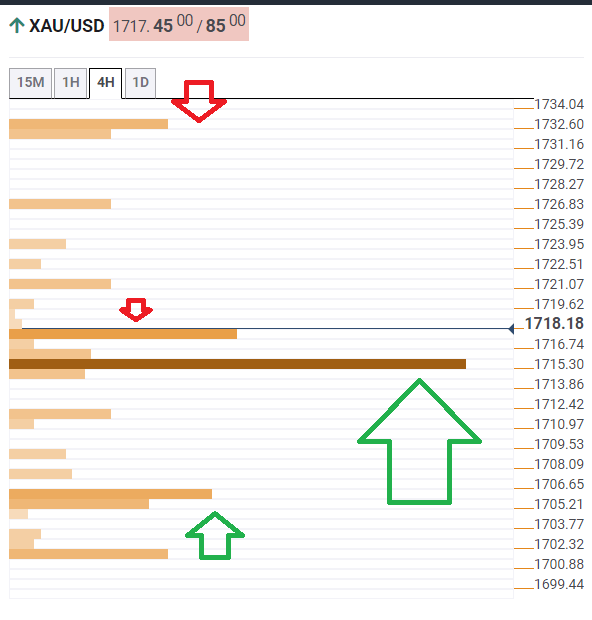
Confluence Detector

The Confluence Detector finds exciting opportunities using Technical Confluences. The TC is a tool to locate and point out those price levels where there is a congestion of indicators, moving averages, Fibonacci levels, Pivot Points, etc. Knowing where these congestion points are located is very useful for the trader, and can be used as a basis for different strategies.

Learn more about Technical Confluence

Author

Yohay Elam

Yohay Elam

FXStreet

Yohay is in Forex since 2008 when he founded Forex Crunch, a blog crafted in his free time that turned into a fully-fledged currency website later sold to Finixio.


More from Yohay Elam
Share:

Editor's Picks

AUD/USD defies gravity; focus is back to 0.7000

AUD/USD has maintained its bid bias around 0.6970 ahead of the opening bell in Asia on Tuesday. The pair has added to Friday’s rebound, retargeting the 0.7000 hurdle despite another day of firm gains in the Greenback. Looking ahead, Westpac will publish its Consumer Confidence gauge on the domestic calendar.

USD/JPY retakes 158.00 amid hawkish BoJ bets, firmer USD

USD/JPY erases losses and retakes 158.00 in the Asian session on Monday, trading within a one-week-old range. Geopolitical uncertainty continues to underpin the US Dollar, despite fading Fed rate hike hopes, supporting the pair's rebound. However, further upside could be capped by hawkish BoJ expectations and looming intervention risks that could support the Japanese Yen.

Gold treads water around $4,150

Gold now regains some composure and approaches the $4,150 mark per troy ounce late on Monday. The precious metal’s vacillating price action comes in response to the persistent advance in the US Dollar in combination with the resurgence of the upside momentum in US Treasury yields across the curve.

Bitcoin and Gold Outlook: BTC slips, XAU downtrend persists as US Services PMI misses forecasts
Bitcoin (BTC) faces growing headwinds on Monday, as it trades lower below $86,000. Despite the ongoing pullback, the Crypto King remains in a broad range with the lower limit near $84,000 and the upper limit at $88,000. A break on either side of this zone would influence BTC's direction. Gold (XAU/USD), meanwhile, retains a dominant bearish outlook as price action continues downward toward $4,100.
Eurozone inflation just hit 3.8%, its highest in three years. This chart shows why the ECB can’t simply hike its way out

The ECB would normally have a relatively straightforward answer to inflation running almost twice its target: raise interest rates. But these are not normal circumstances. This time, the bond market is already doing part of the tightening for it, leaving the ECB facing an increasingly difficult dilemma.

Eurozone inflation just hit 3.8%, its highest in three years. This chart shows why the ECB can’t simply hike its way out

The ECB would normally have a relatively straightforward answer to inflation running almost twice its target: raise interest rates. But these are not normal circumstances. This time, the bond market is already doing part of the tightening for it, leaving the ECB facing an increasingly difficult dilemma.