Gold price faces rejection near $2,600; bulls remain on the sidelines despite softer USD
- Gold price gains some positive traction on Monday and snaps a six-day losing streak.
- Geopolitical risks benefit the safe-haven XAU/USD amid a modest USD downtick.
- Bets for less aggressive Fed rate cuts and elevated US bond yields cap further gains.

Gold price (XAU/USD) struggles to capitalize on its modest intraday gains to the $2,600 neighborhood, though it manages to hold in positive territory through the early part of the European session on Monday. Concerns about escalating geopolitical tensions, along with a softer US Dollar (USD), turn out to be a key factor acting as a tailwind for the safe-haven precious metal. That said, expectations for a less dovish Federal Reserve (Fed) cap the upside for the non-yielding yellow metal.
Investors remain hopeful that US President-elect Donald Trump's touted expansionary policies will boost inflation and limit the scope for further interest rate cuts by the Fed. This remains supportive of elevated US Treasury bond yields and favors the USD bulls, which, in turn, holds back traders from placing bullish bets around the Gold price. Hence, it will be prudent to wait for strong follow-through buying before positioning for any further recovery from a two-month low set last week.
Gold price struggles to build on modest gains amid bets for less aggressive Fed rate cuts
- Gold price registered its biggest weekly decline since September 2023 and dropped to over a two-month low last week amid the recent strong US Dollar rally to over a one-year high.
- Geopolitical developments over the weekend drove some haven flows and assisted the precious metal to gain strong positive traction during the Asian session at the start of a new week.
- US President Joe Biden authorized Ukraine to use US-supplied long-range missiles to strike deeper inside Russia, which has deployed North Korean troops to reinforce its war.
- A Russian attack on a nine-story building killed at least eight people in the northern city of Sumy. Russia also launched a massive drone and missile attack targeting energy infrastructure.
- Israeli forces killed at least 111 Palestinians in the Gaza Strip on Saturday and continued military operations in Lebanon after assassinating Hezbollah’s top media relations officer, Mohammad Afif.
- Investors now seem convinced that President-elect Donald Trump's tariff plans and debt-funded tax cuts would stoke inflation, potentially slowing the Federal Reserve's rate easing cycle.
- Fed Chair Jerome Powell said last Thursday that there’s no need to hurry into cutting interest rates amid a resilient economy, a strong job market, and inflation still above the 2% target.
- Boston Fed President Susan Collins said in an interview that another rate cut in December is on the table, but it is not a "done deal" and that there's no preset path for monetary policy.
- Separately, Chicago Fed President Austan Goolsbee noted that as long as we keep making progress toward the 2% inflation goal, rates will be a lot lower than where they are now.
- The yield on the benchmark 10-year US government bond stands firm near a multi-month peak, which favors the USD bulls and might cap gains for the non-yielding yellow metal.
Gold price bears have the upper hand while below the $2,620-$2,625 supply zone
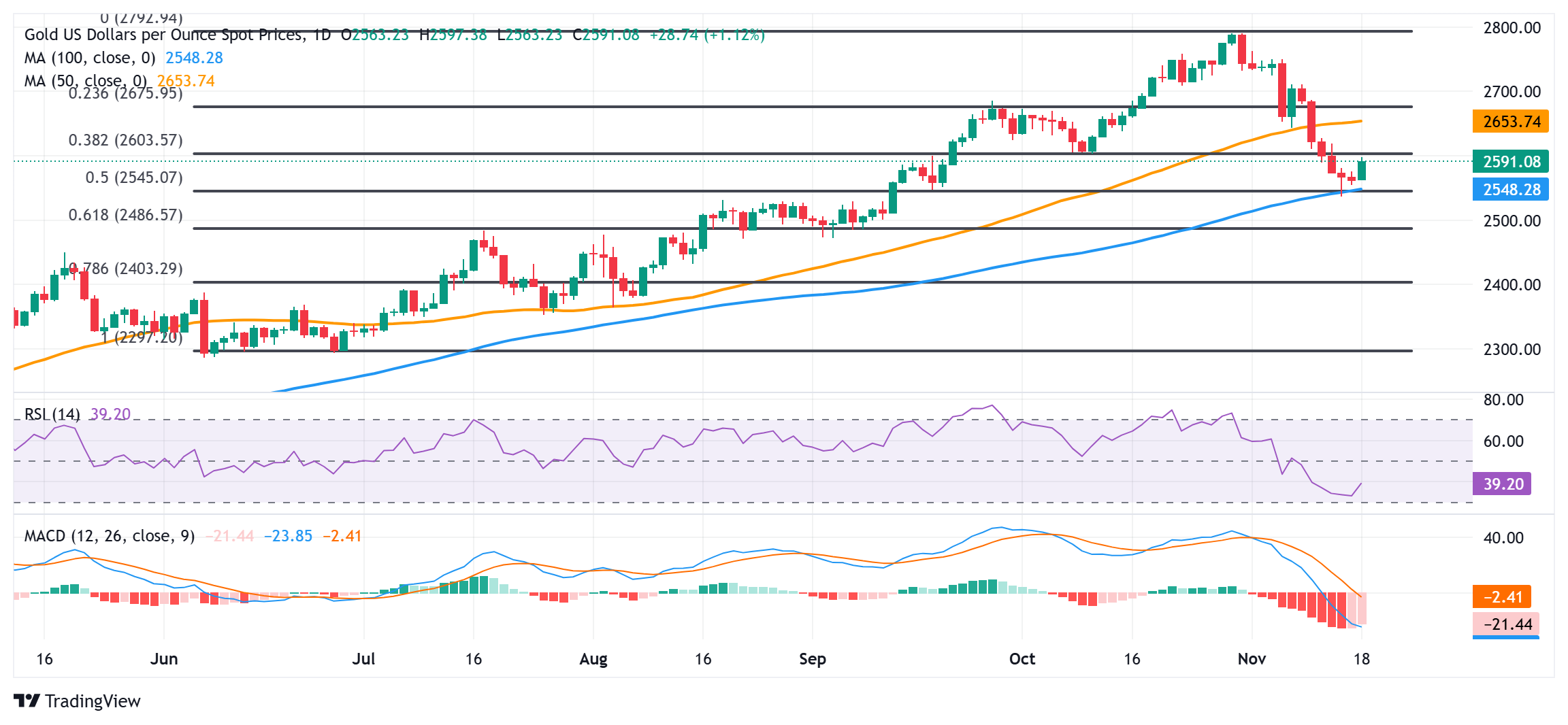
From a technical perspective, the recent sharp pullback from the all-time peak stalled near the 50% retracement level of the June-October rally. The said support, around the $2,536-2,535 area, coincided with the 100-day Simple Moving Average and should now act as a key pivotal point. A convincing break below will be seen as a fresh trigger for bearish traders and pave the way for further losses. The subsequent downfall could drag the Gold price further towards the $2,500 psychological mark en route to the 61.8% Fibo. level, around the $2,480 region.
On the flip side, any subsequent strength above the $2,600 mark (38% Fibo. level) is likely to confront stiff resistance and remain capped near the $2,620-2,622 region. Some follow-through buying, however, could trigger a short-covering rally towards the $2,655-2,657 congestion zone, or the 50-day SMA, en route to the $2,672-2,673 region (23.6% Fibo. level). A sustained move beyond the latter might shift the bias in favor of bulls and allow the Gold price to reclaim the $2,700 round figure.
Fed FAQs
Monetary policy in the US is shaped by the Federal Reserve (Fed). The Fed has two mandates: to achieve price stability and foster full employment. Its primary tool to achieve these goals is by adjusting interest rates. When prices are rising too quickly and inflation is above the Fed’s 2% target, it raises interest rates, increasing borrowing costs throughout the economy. This results in a stronger US Dollar (USD) as it makes the US a more attractive place for international investors to park their money. When inflation falls below 2% or the Unemployment Rate is too high, the Fed may lower interest rates to encourage borrowing, which weighs on the Greenback.
The Federal Reserve (Fed) holds eight policy meetings a year, where the Federal Open Market Committee (FOMC) assesses economic conditions and makes monetary policy decisions. The FOMC is attended by twelve Fed officials – the seven members of the Board of Governors, the president of the Federal Reserve Bank of New York, and four of the remaining eleven regional Reserve Bank presidents, who serve one-year terms on a rotating basis.
In extreme situations, the Federal Reserve may resort to a policy named Quantitative Easing (QE). QE is the process by which the Fed substantially increases the flow of credit in a stuck financial system. It is a non-standard policy measure used during crises or when inflation is extremely low. It was the Fed’s weapon of choice during the Great Financial Crisis in 2008. It involves the Fed printing more Dollars and using them to buy high grade bonds from financial institutions. QE usually weakens the US Dollar.
Quantitative tightening (QT) is the reverse process of QE, whereby the Federal Reserve stops buying bonds from financial institutions and does not reinvest the principal from the bonds it holds maturing, to purchase new bonds. It is usually positive for the value of the US Dollar.
Author

Haresh Menghani
FXStreet
Haresh Menghani is a detail-oriented professional with 10+ years of extensive experience in analysing the global financial markets.

















