Gold sticks to recovery gains; lacks bullish conviction ahead of FOMC Minutes
- Gold price recovers slightly from a nearly three-week low amid reviving safe-haven demand.
- Diminishing odds for a jumbo Fed rate cut underpin the USD and might cap the commodity.
- Hopes for a Russia-Ukraine peace deal could also act as a headwind for the XAU/USD pair.

Gold (XAU/USD) sticks to its modest intraday gains through the first half of the European session, though the lack of follow-through buying warrants caution before positioning for a further recovery from a three-week low set earlier this Wednesday. A slight deterioration in the global risk sentiment – as depicted by a generally weaker tone around the equity markets – is seen as a key factor lending some support to the safe-haven commodity.
However, hopes for a Russia-Ukraine peace deal act as a headwind for the precious metal. Furthermore, diminishing odds for a more aggressive policy easing by the Federal Reserve (Fed) assist the US Dollar (USD) to preserve its gains registered over the past two days and contribute to capping the non-yielding Gold. Traders also seem reluctant and opt to move to the sidelines ahead of the release of the FOMC Minutes later during the US session.
Daily Digest Market Movers: Gold bulls seem non-committed as reduced Fed rate cut bets underpin USD
- Traders continue to price out the possibility of a jumbo interest rate cut by the Federal Reserve in September, pushing the US Dollar to its highest level in more than a week and dragging the Gold price to a three-week low on Wednesday. This follows last Thursday's release of hotter US Producer Price Index, which rose in July at the fastest monthly pace since 2022 and indicated a gain of momentum in price pressures.
- Diplomatic efforts to end the protracted Russia-Ukraine war picked up pace this week and further seem to undermine the safe-haven bullion. In fact, White House press secretary Karoline Leavitt said on Tuesday that plans for a bilateral meeting between Russian President Vladimir Putin and Ukrainian President Volodymyr Zelensky are underway. Earlier, US President Donald Trump hosted Zelenskyy, the EU, and UK leaders for talks.
- Zelenskiy described the summit as a "major step forward" towards ending Europe's deadliest conflict in 80 years and praised the White House for setting up a trilateral meeting with Putin and Trump. Meanwhile, Trump ruled out deploying ground troops to Ukraine but suggested air support could be part of a deal to end the war in the region. Russia, on the other hand, launched 270 drones and 10 missiles at Ukraine.
- Minutes of the Fed's July policy meeting will be released later today. This, along with Fed Chair Jerome Powell's speech at the Jackson Hole Symposium, could offer more insights into the central bank's policy stance. According to the CME Group's FedWatch Tool, traders are pricing in a greater chance that the Fed will start its rate-cutting cycle in September and lower borrowing costs by 25 basis points twice by the year-end.
- Meanwhile, Trump once again criticized Powell on Tuesday for being too late in cutting rates and demanded that the Fed lower borrowing costs immediately. Trump claimed that Powell’s unwillingness to cut rates now stood to hurt the housing market. Powell, however, has remained largely non-committed towards any future rate cuts despite increasing political pressure from the Trump administration.
Gold setup backs the case for further near-term fall; 100-day SMA holds the key
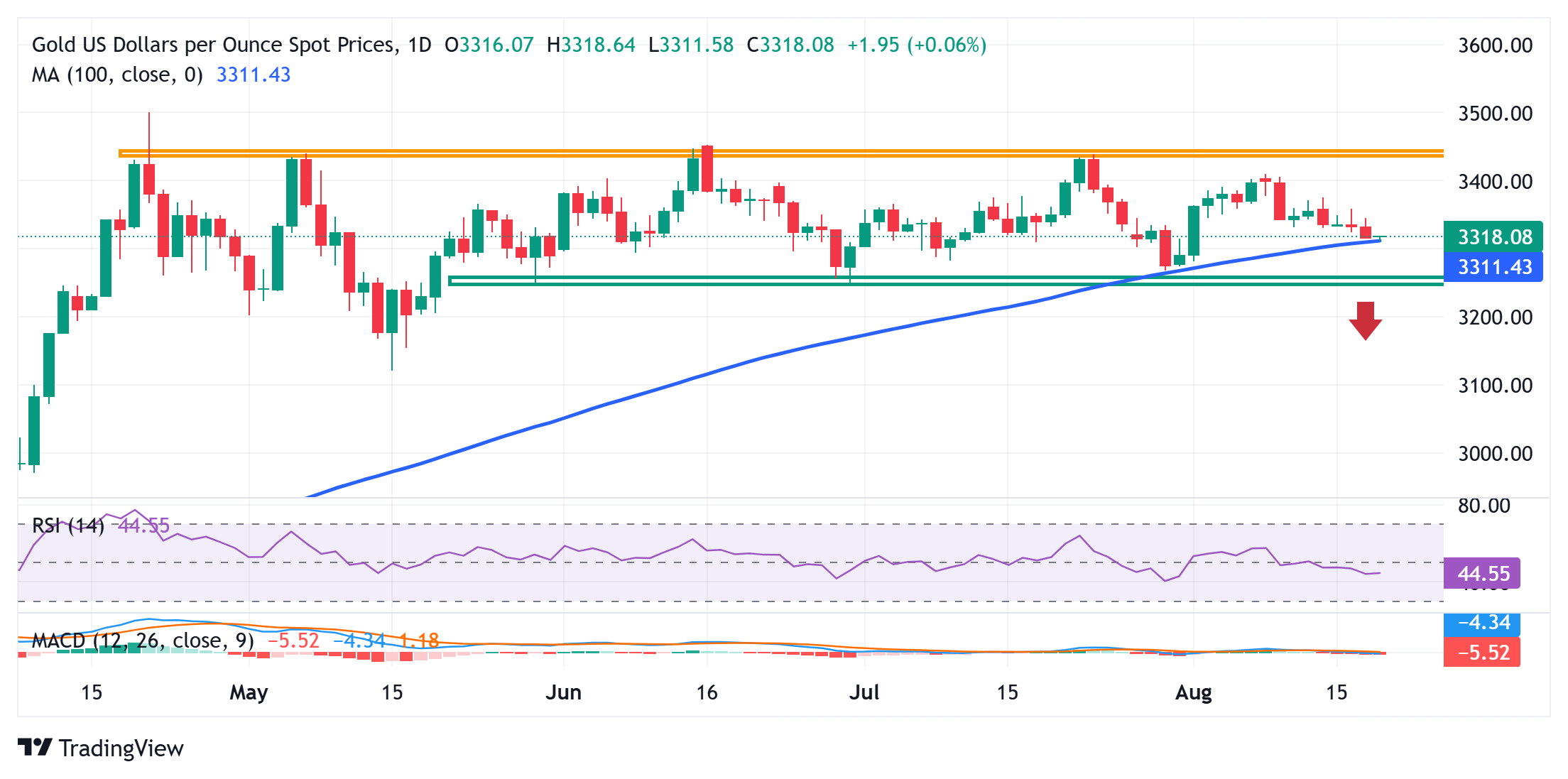
A further slide below the 100-day SMA for the first time since December 2024 will be seen as a fresh trigger for the XAU/USD bears. Given that oscillators on the daily chart have just started gaining negative traction, the Gold price might then accelerate the fall below the $3,300 mark and test the $3,270-3,265 strong horizontal support. The latter represents the lower boundary of a three-month-old trading range and should act as a key pivotal point. A convincing break below will suggest that the commodity has topped out and pave the way for a further near-term depreciating move.
On the flip side, any attempted recovery might now confront an immediate hurdle near the $3,335 region. This is followed by the weekly peak, around the $3,358 zone, which, if cleared, might trigger a short-covering rally and lift the Gold price to the $3,375 intermediate hurdle en route to the $3,400 mark. Some follow-through buying would set the stage for an extension of the momentum towards challenging the $3,434-3,435 heavy supply zone, also marking the top boundary of a multi-month-old trading range.
Economic Indicator
FOMC Minutes
FOMC stands for The Federal Open Market Committee that organizes 8 meetings in a year and reviews economic and financial conditions, determines the appropriate stance of monetary policy and assesses the risks to its long-run goals of price stability and sustainable economic growth. FOMC Minutes are released by the Board of Governors of the Federal Reserve and are a clear guide to the future US interest rate policy.
Next release: Wed Aug 20, 2025 18:00
Frequency: Irregular
Consensus: -
Previous: -
Source: Federal Reserve
Minutes of the Federal Open Market Committee (FOMC) is usually published three weeks after the day of the policy decision. Investors look for clues regarding the policy outlook in this publication alongside the vote split. A bullish tone is likely to provide a boost to the greenback while a dovish stance is seen as USD-negative. It needs to be noted that the market reaction to FOMC Minutes could be delayed as news outlets don’t have access to the publication before the release, unlike the FOMC’s Policy Statement.
Author

Haresh Menghani
FXStreet
Haresh Menghani is a detail-oriented professional with 10+ years of extensive experience in analysing the global financial markets.