Gold price stays near $2,150 on falling US yields, Fed Powell’s comments
- Gold price surges to historic $2,152.24 level, underpinned by Fed Chair Powell's hints at rate cuts this year.
- Declining US Treasury yields bolster bullion’s appeal with the market pricing in a higher likelihood of a June rate reduction.
- Escalating tensions between Israel and Hamas contribute to Gold's safe-haven demand amidst uncertain geopolitical climate.

Gold rallied for the fifth straight day and reached an all-time high (ATH) at $2,152.24 during the North American session amid US Federal Reserve Chair Jerome Powell's congressional testimony at Capitol Hill. At the time of writing, XAU/USD trades at $2,146.27, gains 0.87% ahead of Wall Street’s close.
The yellow metal rose sharply amid remarks by Jerome Powell, who said that the US central bank is ready to lower borrowing costs “at some point this year.” He added that the US economy is nowhere near falling into recession and expects inflation to continue to trend toward the 2% goal. Powell commented that the Fed would remain data-dependent and wouldn’t reduce rates until they [the Fed] are convinced that inflation moves sustainably to 2%.
Therefore, US Treasury bond yields are dropping, a tailwind for bullion. US Treasury yields along the short and long end of the curve dive, as seen on the 10-year benchmark note rate at 4.108%, down four basis points (bps). After Powell’s words, the swaps market shows odds at 67% for a 25-basis-point rate cut in June, up from 58% at the end of February.
Besides that, geopolitical tensions escalating in the Middle East between Israel and Hamas are a tailwind for the safe-haven status of Gold.
Daily digest market movers: Gold price skyrockets as US yields drop despite mixed US jobs data
- Private companies hired less than forecast but exceeded January’s reading at 111K as they added 140K jobs to the workforce, below estimates of 150K, according to ADP Employment Change report.
- The US Job Openings and Labor Turnover Survey (JOLTS) for January showed that there were 8.863 million job openings, a figure that fell short of expectations and was marginally lower than the previous month's report of 8.9 million and 8.889 million, respectively.
- US economic data previously released during the week:
- The S&P Global Services PMI experienced a slight decrease to 52.3, falling from January's 52.5, while the Composite PMI, which includes both manufacturing and service sectors, registered at 53.8. This figure did not meet expectations and was lower than the previous reading of 54.2.
- Additionally, the ISM Services PMI reported a decline to 52.6 from 53.4, coming in below the anticipated consensus of 53. This resulted in a negative impact on the US Dollar.
- Factory Orders in January fell more than expected, from 0.2% to -3.6% MoM.
- Gold prices remain supported by strong central bank buying in emerging markets.
- The near-term demand for Gold will be influenced by Fed Chair Jerome Powell’s testimony before Congress on Wednesday and an array of United States economic data released later this week.
- On Monday, Atlanta Fed Bank President Raphael Bostic said a strong labor market and decent economic growth have bought time for the Federal Open Market Committee (FOMC) to decide on when rate cuts will be optimal. Bostic added that the Fed is having a “rebounding success” as inflation slowly returns to the desired target without hurting labor demand.
- The US Dollar Index (DXY), which gauges the Greenback’s value against six major currencies, fell 0.38% to 103.38.
Technical analysis: Gold surges to all-time highs amid Powell’s comments
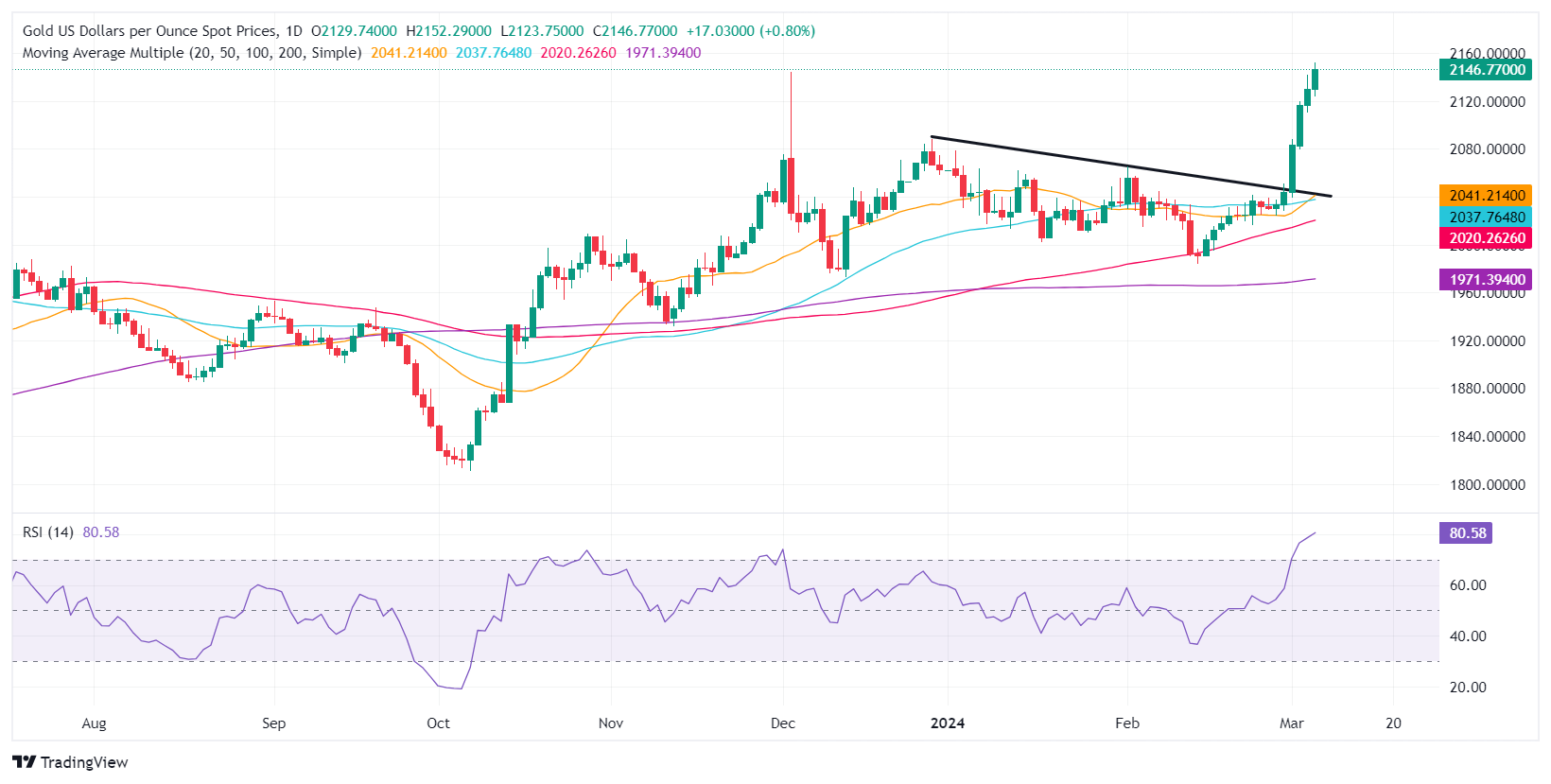
Gold is rallying sharply, though it appears that buying bullion near the current level is a hard decision due to the move's extent of around 5%. A decisive breach of the $2,150.00 mark could pave the way to challenge $2,200.00, but caution is warranted. For buyers, it’s better to wait for a pullback that could offer a better risk-reward ratio.
On the other hand, if XAU/USD drops below March’s 6 low of $2,123.80, that would pave the way for a correction toward $2,100.00. If that level is surpassed, the next supports would be the December 28 high at $2,088.48 and the February 1 high at $2,065.60.
Gold FAQs
Gold has played a key role in human’s history as it has been widely used as a store of value and medium of exchange. Currently, apart from its shine and usage for jewelry, the precious metal is widely seen as a safe-haven asset, meaning that it is considered a good investment during turbulent times. Gold is also widely seen as a hedge against inflation and against depreciating currencies as it doesn’t rely on any specific issuer or government.
Central banks are the biggest Gold holders. In their aim to support their currencies in turbulent times, central banks tend to diversify their reserves and buy Gold to improve the perceived strength of the economy and the currency. High Gold reserves can be a source of trust for a country’s solvency. Central banks added 1,136 tonnes of Gold worth around $70 billion to their reserves in 2022, according to data from the World Gold Council. This is the highest yearly purchase since records began. Central banks from emerging economies such as China, India and Turkey are quickly increasing their Gold reserves.
Gold has an inverse correlation with the US Dollar and US Treasuries, which are both major reserve and safe-haven assets. When the Dollar depreciates, Gold tends to rise, enabling investors and central banks to diversify their assets in turbulent times. Gold is also inversely correlated with risk assets. A rally in the stock market tends to weaken Gold price, while sell-offs in riskier markets tend to favor the precious metal.
The price can move due to a wide range of factors. Geopolitical instability or fears of a deep recession can quickly make Gold price escalate due to its safe-haven status. As a yield-less asset, Gold tends to rise with lower interest rates, while higher cost of money usually weighs down on the yellow metal. Still, most moves depend on how the US Dollar (USD) behaves as the asset is priced in dollars (XAU/USD). A strong Dollar tends to keep the price of Gold controlled, whereas a weaker Dollar is likely to push Gold prices up.
Author

Christian Borjon Valencia
FXStreet
Markets analyst, news editor, and trading instructor with over 14 years of experience across FX, commodities, US equity indices, and global macro markets.