Gold consolidates below fresh record highs as traders brace for Fed interest rate decision
- Gold extends record-breaking rally as safe-haven demand and Dollar weakness persist.
- Traders stay cautious ahead of the Fed decision, with Chair Powell’s guidance in focus.
- Technicals remain firmly bullish, though momentum indicators are deeply overbought.

Gold (XAU/USD) pushes deeper into uncharted territory on Wednesday, extending its gains for eight consecutive days as safe-haven demand and a softer US Dollar (USD) fuel the ongoing rally. At the time of writing, XAU/USD is trading around $5,280, easing slightly after touching a fresh all-time high near $5,311 earlier in the European session.
Traders appear reluctant to chase prices aggressively higher ahead of the Federal Reserve’s (Fed) interest rate decision due later at 19:00 GMT. While no change in rates is expected, markets will closely scrutinize Chair Jerome Powell’s tone and forward guidance for clues on the monetary policy path.
Any hint of a gradual easing bias would likely reinforce the broader bullish structure in Gold. By contrast, a more cautious or hawkish message could trigger near-term profit-taking, potentially offering the US Dollar (USD) some relief and slowing Bullion’s ascent.
Market movers: Dollar weakness, Fed uncertainty and geopolitics weigh on sentiment
- The precious metal is up nearly 22% so far this month amid fading confidence in the US economic policy outlook. US President Donald Trump’s disruptive trade agenda, renewed tariff threats and repeated attacks on the Fed’s independence have unsettled markets. With these factors in play, investors are increasingly rotating out of the Greenback and seeking refuge in Gold as doubts grow over the US Dollar’s status as the world’s dominant reserve currency.
- On Tuesday, President Donald Trump told reporters he was not concerned about the recent decline in the US Dollar, saying “No, I think it’s great,” and adding that the currency should “just seek its own level, which is the fair thing to do.”
- The US Dollar Index (DXY), which tracks the Greenback’s value against a basket of six major currencies, is trading around 96.24, stabilizing modestly after hitting a four-year low of 95.56 on Tuesday.
- Attention is also turning to a Fed leadership change after Trump said on Tuesday that he would soon announce his pick for the next Fed Chair and signaled expectations of lower interest rates. Speaking during a speech in Iowa, Trump said, “When we have a great Fed chairman, I think we’re going to have one. I’ll announce it pretty soon. You’ll see rates come down a lot.”
- Geopolitical tensions remain a key pillar of support, with US-Iran frictions back in focus and the Russia-Ukraine war far from resolution. Meanwhile, strong central bank buying and sustained ETF inflows continue to underscore Gold’s growing role as a strategic reserve asset and portfolio hedge.
Technical analysis: Bulls remain in control despite overbought signals
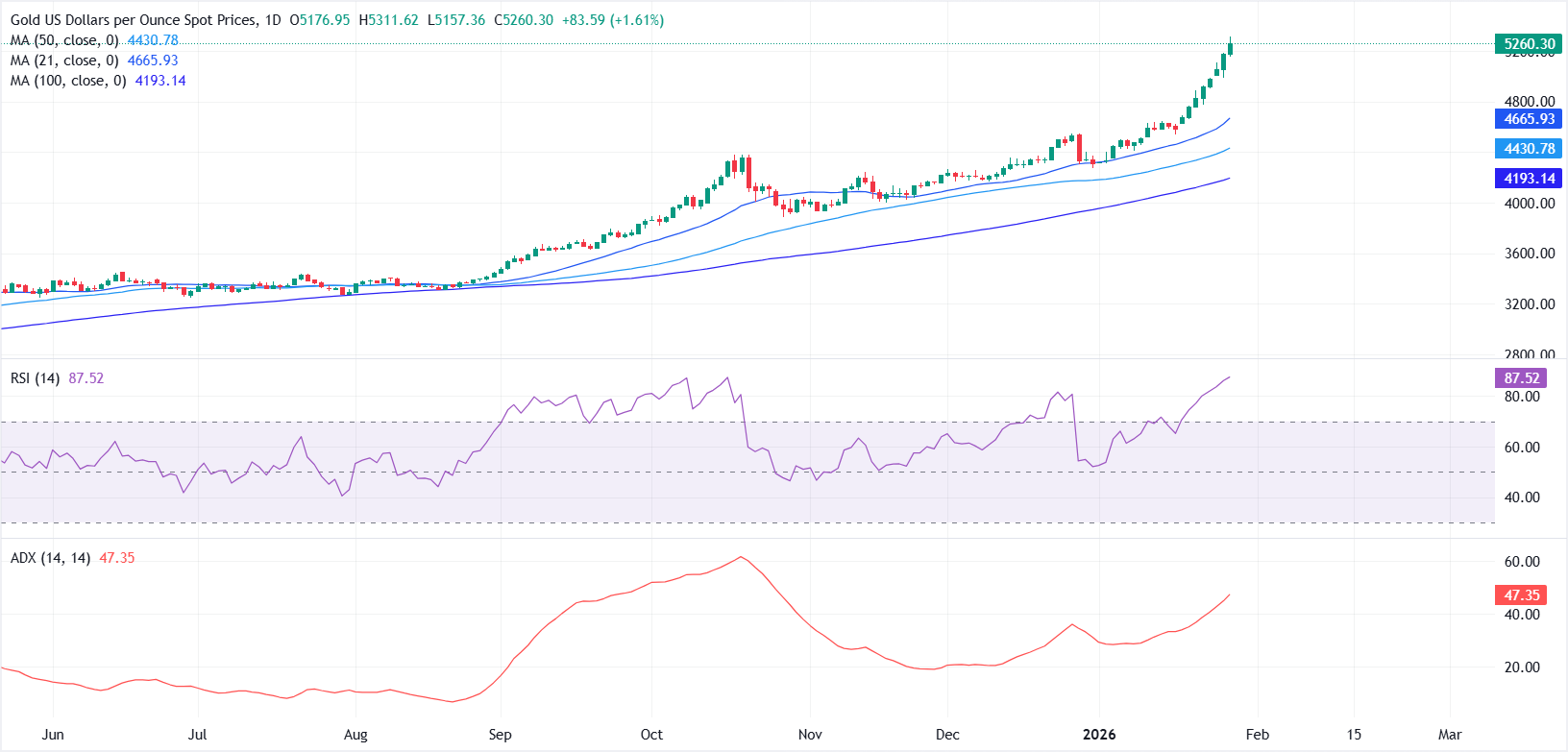
From a technical perspective, XAU/USD remains firmly bullish on the daily chart, with consecutive green candles and price action holding well above the 21-day, 50-day and 100-day Simple Moving Averages (SMAs), highlighting strong upside pressure.
Momentum is clearly stretched, with the Relative Strength Index (RSI) near 87, deep in overbought territory. However, there are no clear signs of reversal or slowing momentum yet, suggesting the broader uptrend remains intact. The Average Directional Index (ADX) at 47.35 reinforces this view, confirming strong trend conditions.
On the downside, $5,150 marks initial support, followed by the $5,000 psychological level. A sustained break below $5,000 could weaken the near-term structure, though dip-buying interest should limit deeper pullbacks.
On the upside, a decisive break above $5,300 would expose $5,400 and $5,500 as the next bullish targets.
(This story was corrected on January 28 at 14:35 GMT to say that XAU/USD was trading around $5,280 after touching a fresh all-time high near $5,311, not $4,280 and $4,311 as previously stated.)
Fed FAQs
Monetary policy in the US is shaped by the Federal Reserve (Fed). The Fed has two mandates: to achieve price stability and foster full employment. Its primary tool to achieve these goals is by adjusting interest rates. When prices are rising too quickly and inflation is above the Fed’s 2% target, it raises interest rates, increasing borrowing costs throughout the economy. This results in a stronger US Dollar (USD) as it makes the US a more attractive place for international investors to park their money. When inflation falls below 2% or the Unemployment Rate is too high, the Fed may lower interest rates to encourage borrowing, which weighs on the Greenback.
The Federal Reserve (Fed) holds eight policy meetings a year, where the Federal Open Market Committee (FOMC) assesses economic conditions and makes monetary policy decisions. The FOMC is attended by twelve Fed officials – the seven members of the Board of Governors, the president of the Federal Reserve Bank of New York, and four of the remaining eleven regional Reserve Bank presidents, who serve one-year terms on a rotating basis.
In extreme situations, the Federal Reserve may resort to a policy named Quantitative Easing (QE). QE is the process by which the Fed substantially increases the flow of credit in a stuck financial system. It is a non-standard policy measure used during crises or when inflation is extremely low. It was the Fed’s weapon of choice during the Great Financial Crisis in 2008. It involves the Fed printing more Dollars and using them to buy high grade bonds from financial institutions. QE usually weakens the US Dollar.
Quantitative tightening (QT) is the reverse process of QE, whereby the Federal Reserve stops buying bonds from financial institutions and does not reinvest the principal from the bonds it holds maturing, to purchase new bonds. It is usually positive for the value of the US Dollar.
Author

Vishal Chaturvedi
FXStreet
I am a macro-focused research analyst with over four years of experience covering forex and commodities market. I enjoy breaking down complex economic trends and turning them into clear, actionable insights that help traders stay ahead of the curve.