Gold slips as risk appetite grows amid Russia-Ukraine peace talks
- Gold starts the week lower, weighed by improved risk appetite and optimism over potential progress in Russia-Ukraine peace talks.
- Fed rate cut expectations firm, with markets pricing in an 87% chance of a 25 bps September cut.
- Uncertainty surrounding Gold markets eases after the White House said it will issue an executive order to address what it described as “misinformation” about tariffs.

Gold (XAU/USD) kicks off the week on the back foot, trading with a negative tone on Monday as diminished safe-haven demand and improved risk appetite weigh on the precious metal. Hopes for progress in diplomatic efforts to ease Russia-Ukraine tensions, alongside firmer equity markets, have curbed demand for bullion, with investors shifting toward riskier assets.
At the time of writing, the metal is trading around $3,345 during the American trading session, down nearly 1.50% on the day, after last week’s buyers repeatedly failed to clear the $3,400 psychological hurdle.
There’s a cautious sense of optimism after fresh diplomatic moves over the weekend. US President Donald Trump announced on Friday that he will meet with Russian President Vladimir Putin on August 15 in Alaska to negotiate an end to the war in Ukraine.
Still, any downside in Gold may be limited due to firm expectations of a September interest rate cut by the Federal Reserve (Fed). These expectations keep the US Dollar (USD) and US Treasury yields subdued, offering potential support to Gold.
According to the CME FedWatch Tool, markets are currently pricing in an 88% probability of a 25 basis-point cut next month, reflecting growing confidence in a more accommodative policy stance amid signs of a cooling labor market.
Market movers: Geopolitical tensions, inflation data and Fed in focus
- The US Dollar Index (DXY), which tracks the value of the Greenback against a basket of six major currencies, is hovering close to a two-week low, with little change in recent days. The Index is holding steady above 98.00, last seen around 98.60.
- US Treasury yields steadies on Monday, pausing a four-day advance, with the benchmark 10-year yield hovering near 4.262%. The 30-year yield slips to around 4.825%, snapping a three-day winning streak.
- Global equities trade firmer on Monday, supported by optimism over potential progress in US-Russia peace talks and upbeat corporate earnings. Japan’s Nikkei 225 jumped 1.85% on Friday, with futures nearing record highs, while European stocks opened higher on Monday but quickly gave up gains as investors braced for trade and geopolitical risks. In the UK, the FTSE 100 rose 0.26% to around 9,118. India’s Sensex ended 746 points higher at 80,604.
- On the trade front, US reciprocal tariffs officially took effect on August 7, raising the overall US tariff rate to the highest level since 1934 at an estimated 18.6%, targeting more than 60 trading partners. Meanwhile, the US-China 90-day tariff truce is set to expire on Tuesday, with markets awaiting President Trump’s decision on whether to extend the current agreement to give more room to negotiations.
- Last week, market jitters arose after reports suggested new US tariffs could apply to widely traded Swiss Gold bars, including 1-kg and 100-ounce bars. The news caused uncertainty in the bullion market, raising concerns around supply chain disruptions. However, markets soon received a lifeline as the White House said it would issue an executive order to clarify that Gold bars would be exempt from such duties, with investors now awaiting the formal announcement for confirmation.
- Ahead of the August 15 Trump-Putin summit, Moscow wants recognition of annexed territories, Ukrainian neutrality, and sanctions relief, while Kyiv is calling for a full ceasefire, return of all its land, and firm security guarantees. The wide gap in positions could complicate the peace talks despite recent diplomatic optimism. A White House official said President Trump is open to a trilateral summit in Alaska with Putin and Ukrainian President Volodymyr Zelenskyy, but for now, the US is planning a bilateral meeting as requested by Putin.
- Over the past week, Fed officials flagged signs of a cooling economy and a softening labor market. On Saturday, Vice Chair Michelle Bowman said she supports a September rate cut and favors a total of three cuts this year, calling the July hold a missed opportunity. Minneapolis Fed President Neel Kashkari and San Francisco Fed President Mary Daly have also backed the case for around two cuts this year.
- With no major economic releases on Monday, attention shifts to a busy week ahead. The Consumer Price Index (CPI) is due Tuesday, followed by the Producer Price Index (PPI) on Thursday, and Retail Sales along with the preliminary August reading of the Michigan Consumer Sentiment Index on Friday. These figures will be closely watched for clues on inflation and could help shape expectations for a potential rate cut in September.
Technical analysis: XAU/USD under pressure, key support at $3,350 in focus
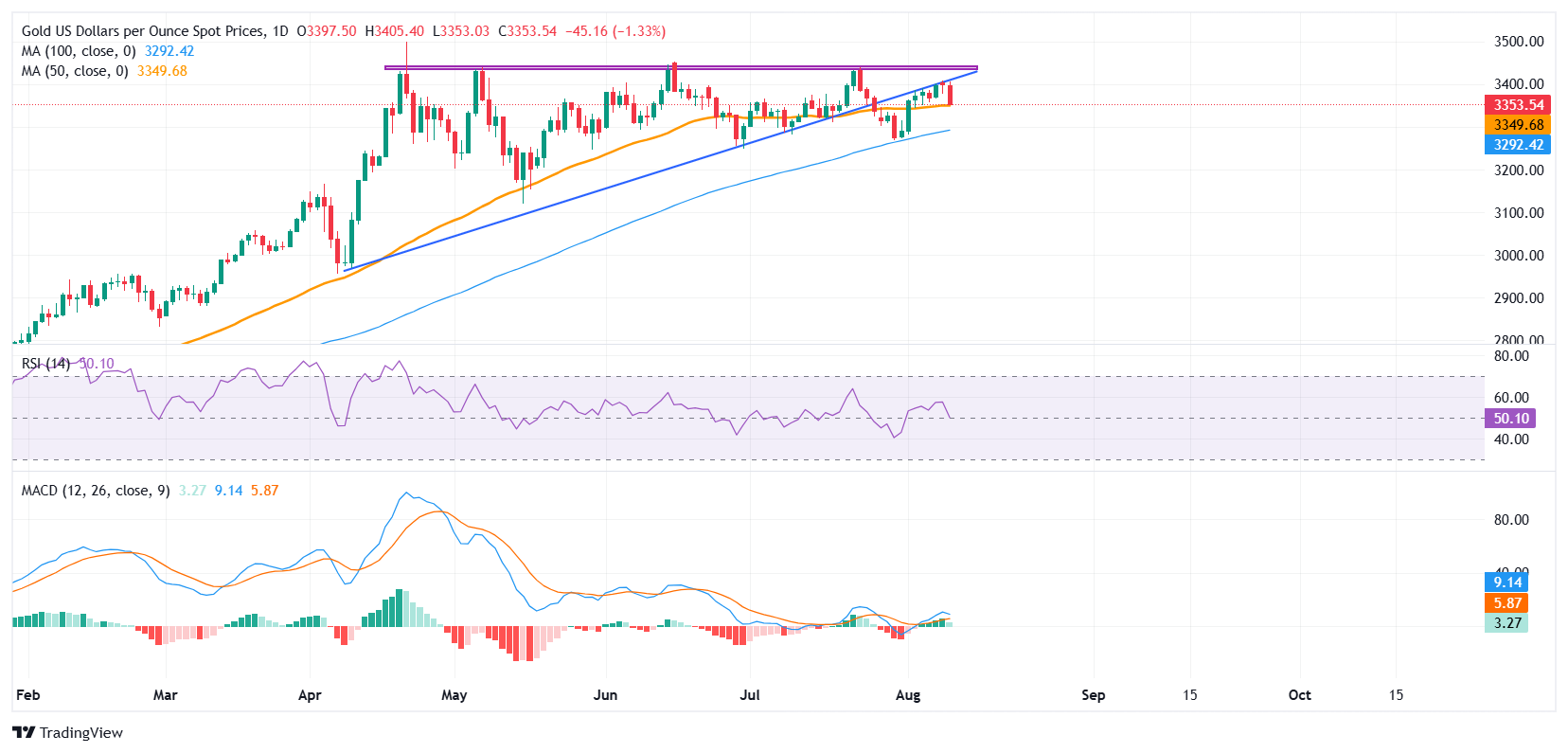
Gold (XAU/USD) is trading under pressure on Monday, extending losses after failing to break above the key $3,400 psychological barrier last week.
On the daily chart, the metal is encountering selling pressure at the rising trendline of the ascending triangle pattern. This trendline was briefly broken to the downside in late July, but the lack of follow-through left the broader bullish structure intact. The current rejection from this area suggests that bulls are struggling to regain control.
Immediate support is seen at the 50-day Simple Moving Average (SMA) near $3,350. A decisive break below this level could expose the 100-day SMA at $3,292, followed by stronger horizontal support near $3,250.
On the upside, $3,400 remains the first hurdle for buyers, with a sustained break above opening the door toward the all-time high around $3,500.
The Relative Strength Index (RSI) has slipped to the neutral 50 level, indicating a lack of strong directional momentum. Meanwhile, the Moving Average Convergence Divergence (MACD) maintains a slight bullish bias, though narrowing histogram bars suggest that buying pressure is beginning to fade.
Gold FAQs
Gold has played a key role in human’s history as it has been widely used as a store of value and medium of exchange. Currently, apart from its shine and usage for jewelry, the precious metal is widely seen as a safe-haven asset, meaning that it is considered a good investment during turbulent times. Gold is also widely seen as a hedge against inflation and against depreciating currencies as it doesn’t rely on any specific issuer or government.
Central banks are the biggest Gold holders. In their aim to support their currencies in turbulent times, central banks tend to diversify their reserves and buy Gold to improve the perceived strength of the economy and the currency. High Gold reserves can be a source of trust for a country’s solvency. Central banks added 1,136 tonnes of Gold worth around $70 billion to their reserves in 2022, according to data from the World Gold Council. This is the highest yearly purchase since records began. Central banks from emerging economies such as China, India and Turkey are quickly increasing their Gold reserves.
Gold has an inverse correlation with the US Dollar and US Treasuries, which are both major reserve and safe-haven assets. When the Dollar depreciates, Gold tends to rise, enabling investors and central banks to diversify their assets in turbulent times. Gold is also inversely correlated with risk assets. A rally in the stock market tends to weaken Gold price, while sell-offs in riskier markets tend to favor the precious metal.
The price can move due to a wide range of factors. Geopolitical instability or fears of a deep recession can quickly make Gold price escalate due to its safe-haven status. As a yield-less asset, Gold tends to rise with lower interest rates, while higher cost of money usually weighs down on the yellow metal. Still, most moves depend on how the US Dollar (USD) behaves as the asset is priced in dollars (XAU/USD). A strong Dollar tends to keep the price of Gold controlled, whereas a weaker Dollar is likely to push Gold prices up.
Author

Vishal Chaturvedi
FXStreet
I am a macro-focused research analyst with over four years of experience covering forex and commodities market. I enjoy breaking down complex economic trends and turning them into clear, actionable insights that help traders stay ahead of the curve.