Gold falls as Fed rate hike bets lift US Dollar to two-month high
- Gold loses ground as the US Dollar extends its gains following last week’s Fed rate hike.
- Lower Oil prices offer little relief as inflation concerns keep US Treasury yields elevated.
- XAU/USD tests the lower Bollinger Band near $4,305, with $4,350 as initial resistance.

Gold (XAU/USD) trades on the back foot on Wednesday as expectations of further Federal Reserve (Fed) interest rate hikes lift the US Dollar (USD) and weigh on the non-yielding metal. At the time of writing, XAU/USD trades around $4,315, down 1.0% on the day.
The US Dollar extends its gains since last week’s Fed decision and climbs to a two-month high despite a drop in Oil prices on positive Middle East developments. The US Dollar Index (DXY), which tracks the Greenback against a basket of six major currencies, trades around 100.85.
The Fed raised rates by 25 basis points (bps) last week, lifting the federal funds rate to the 3.75%-4.00% range. The central bank said the move would help bring inflation back to its 2% target. Its updated projections pointed to one more hike this year. Richmond Fed President Thomas Barkin struck a hawkish tone on Tuesday, saying that “economic conditions are, if anything, firming” and warning that passing shocks from tariffs and energy are not fading. Barkin added that high inflation today risks affecting future inflation. The CME FedWatch Tool puts the chance of an October hike at around 53%.
On the Middle East front, US President Donald Trump told reporters at the United Nations General Assembly in New York on Tuesday that US officials had a very good, three-hour meeting with Iranian representatives. Iranian state media said Foreign Minister Abbas Araghchi had conveyed Tehran’s conditions for reopening the Strait of Hormuz to US envoy Steve Witkoff. These include lifting the US naval blockade, releasing frozen Iranian assets and ending the war across all “resistance” fronts.
West Texas Intermediate (WTI) Oil hovers near a more-than two-week low around $89.50. Despite the pullback, Oil prices are still well above pre-war levels, and the renewed diplomatic efforts have yet to produce a meaningful breakthrough. That leaves inflation concerns in play and keeps US Treasury yields elevated, with the 2-year yield around 4.77%, near levels last seen in 2024.
The combination of a strong US Dollar, rising Treasury yields and expectations of higher borrowing costs leaves Gold vulnerable to further losses. Looking ahead, traders will watch preliminary US S&P Global Purchasing Managers’ Index (PMI) data later on Wednesday for clues on the strength of the economy.
Technical analysis: XAU/USD tests lower Bollinger Band
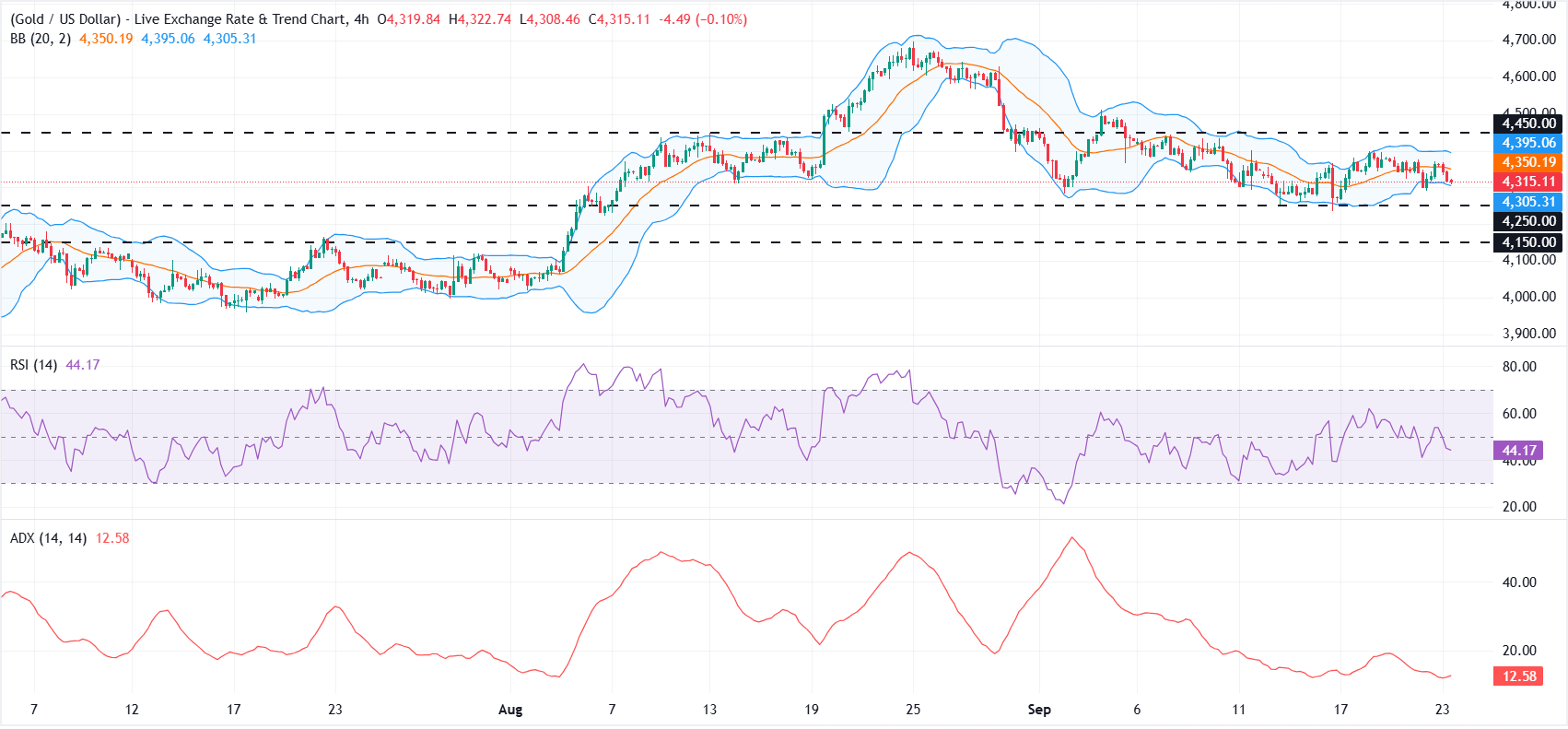
On the 4-hour chart, XAU/US remains under near-term bearish pressure as it holds below the Bollinger Bands’ 20-period Simple Moving Average (SMA) at $4,350 and the upper band at $4,395, highlighting persistent overhead supply. The lower band at $4,304 offers immediate technical cushioning just beneath spot, but the Relative Strength Index (RSI) around 44 and a subdued Average Directional Index (ADX) near 13 suggest weak momentum.
On the topside, initial resistance is aligned with the Bollinger middle band SMA at $4,350, followed by the upper band near $4,395, while a more significant barrier emerges at the horizontal resistance level of $4,450. On the downside, first support is seen at the Bollinger lower band around $4,304, ahead of the horizontal floor at $4,250. A deeper slide toward the $4,150 support zone would reinforce the bearish bias if the current band support gives way.
(The technical analysis of this story was written with the help of an AI tool. Know more.)
Gold FAQs
Gold has played a key role in human’s history as it has been widely used as a store of value and medium of exchange. Currently, apart from its shine and usage for jewelry, the precious metal is widely seen as a safe-haven asset, meaning that it is considered a good investment during turbulent times. Gold is also widely seen as a hedge against inflation and against depreciating currencies as it doesn’t rely on any specific issuer or government.
Central banks are the biggest Gold holders. In their aim to support their currencies in turbulent times, central banks tend to diversify their reserves and buy Gold to improve the perceived strength of the economy and the currency. High Gold reserves can be a source of trust for a country’s solvency. Central banks added 1,136 tonnes of Gold worth around $70 billion to their reserves in 2022, according to data from the World Gold Council. This is the highest yearly purchase since records began. Central banks from emerging economies such as China, India and Turkey are quickly increasing their Gold reserves.
Gold has an inverse correlation with the US Dollar and US Treasuries, which are both major reserve and safe-haven assets. When the Dollar depreciates, Gold tends to rise, enabling investors and central banks to diversify their assets in turbulent times. Gold is also inversely correlated with risk assets. A rally in the stock market tends to weaken Gold price, while sell-offs in riskier markets tend to favor the precious metal.
The price can move due to a wide range of factors. Geopolitical instability or fears of a deep recession can quickly make Gold price escalate due to its safe-haven status. As a yield-less asset, Gold tends to rise with lower interest rates, while higher cost of money usually weighs down on the yellow metal. Still, most moves depend on how the US Dollar (USD) behaves as the asset is priced in dollars (XAU/USD). A strong Dollar tends to keep the price of Gold controlled, whereas a weaker Dollar is likely to push Gold prices up.
Author

Vishal Chaturvedi
FXStreet
I am a macro-focused research analyst with over four years of experience covering forex and commodities market. I enjoy breaking down complex economic trends and turning them into clear, actionable insights that help traders stay ahead of the curve.