Gold under pressure as Fed hawkish outlook weighs
- Gold drops more than 4% on Thursday to its lowest level since February 2, extending the previous day’s decline.
- Gold’s safe-haven appeal takes a back seat as traders focus on energy-driven inflation risks.
- Technically, bearish momentum strengthens with RSI nearing oversold and MACD signaling downside pressure.

Gold (XAU/USD) extends its decline on Thursday, slipping to over a one-month low as shifting near-term macroeconomic dynamics overshadow its traditional safe-haven appeal, despite heightened geopolitical tensions from the ongoing US-Israel war with Iran.
At the time of writing, XAU/USD is trading around $4,605 after briefly dipping to a low near $4,502, as the US Dollar and Treasury yields retreat and limit the downside, though the metal remains on the back foot for a seventh consecutive day.
Gold has remained under sustained downside pressure since Middle East tensions escalated, as the surge in Oil prices triggered fresh inflation concerns, reinforcing the global “higher-for-longer” interest rate narrative, which reduces the appeal of the non-yielding metal. This view was further supported by the Federal Reserve’s (Fed) hawkish monetary policy stance on Wednesday, driving the latest leg lower in bullion.
Fed maintains interest rates, flags inflation risks
The Fed kept its benchmark interest rate unchanged at 3.50%-3.75%, as widely expected, and maintained a data-dependent approach going forward while highlighting risks to both sides of its dual mandate. However, the updated dot plot still points to one rate cut in 2026, while inflation forecasts were revised higher, with US Personal Consumption Expenditures (PCE) inflation projected at 2.7% by December 2026, up from 2.4% previously.
According to the FOMC statement, job gains have remained modest, the unemployment rate has changed little in recent months, and inflation is still somewhat elevated. The committee also noted that the economic impact of Middle East developments is uncertain.
Fed Chair Jerome Powell struck a hawkish tone, warning that elevated inflation largely reflects goods prices, which have been boosted by tariffs. He said higher energy costs could lift inflation in the near term and inflation expectations have risen amid the war in Middle East. While the median rate path was unchanged, Powell pointed to a shift toward fewer rate cuts and said the Fed needs to see progress on inflation before cutting rates again.
Against this backdrop, traders scaled back Fed rate-cut expectations, with markets no longer fully pricing in even a 25-basis-point (bps) cut by year-end.
Meanwhile, rising Oil prices have also supported the Greenback, as crude is priced in USD, encouraging demand for cash and weighing on Gold.
Energy infrastructure targeted as Middle East conflict deepens
Geopolitical tensions escalated after Iran launched missile strikes on a site in Qatar, one of the world’s largest LNG facilities, following an Israeli attack on Iran’s South Pars gas field. Saudi Arabia, the UAE and Kuwait also reported Iranian strikes on energy infrastructure.
US President Donald Trump said Israel acted out of “anger” and would not target the South Pars gas field again. However, he warned that the US could “blow up the entirety of the South Pars gas field” if Iran launches further attacks on Qatar’s LNG facilities.
A joint statement from the UK, France, Germany, Italy, the Netherlands and Japan on Thursday said they are ready to take steps to stabilise energy markets, including working with major oil-producing countries to increase supply. The statement also said they are prepared to help ensure safe passage through the Strait of Hormuz
Technical analysis: XAU/USD slides toward 100-day SMA as bearish signals strengthen
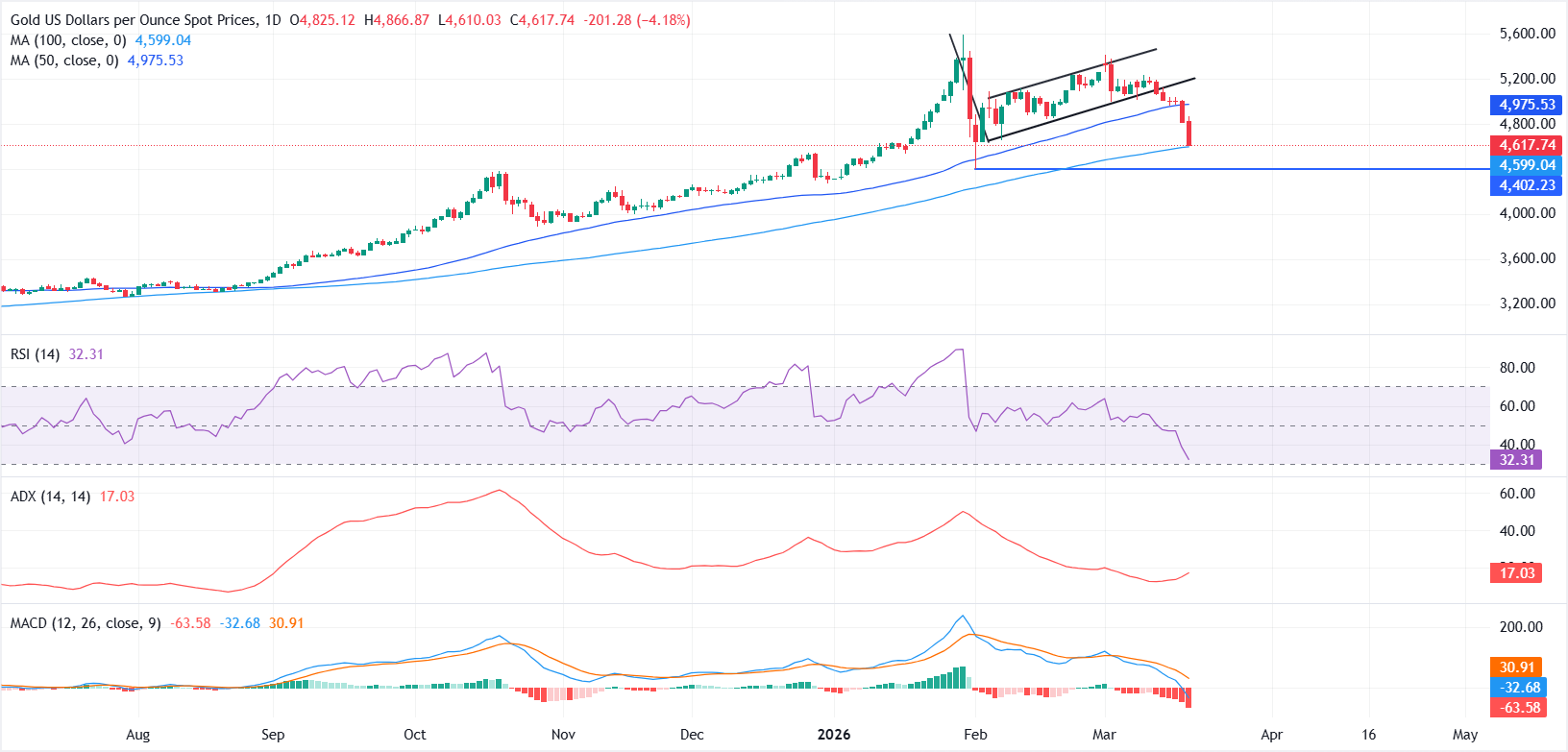
Sellers have taken control of the near-term trend after prices decisively broke below the $5,000 psychological level and the 50-day Simple Moving Average (SMA) at $4,976, following a breakdown from a bearish flag pattern on the daily chart. This has accelerated downside momentum, pushing XAU/USD toward the 100-day SMA around $4,600.
Momentum indicators reinforce the bearish outlook. The Relative Strength Index (RSI) is approaching oversold territory near 33, suggesting strong selling pressure. The Moving Average Convergence Divergence (MACD) remains in negative territory with a widening histogram, pointing to increasing downside momentum, while the Average Directional Index (ADX) near 17 indicates the trend is still developing.
A sustained break below the 100-day SMA could strengthen selling pressure further, exposing the next downside targets at the February low near $4,400, followed by the $4,000 psychological level.
On the upside, the 50-day SMA at $4,976 now acts as immediate resistance, followed by the $5,000-$5,100 zone. A recovery above $5,200 would be needed to invalidate the current bearish structure.
Gold FAQs
Gold has played a key role in human’s history as it has been widely used as a store of value and medium of exchange. Currently, apart from its shine and usage for jewelry, the precious metal is widely seen as a safe-haven asset, meaning that it is considered a good investment during turbulent times. Gold is also widely seen as a hedge against inflation and against depreciating currencies as it doesn’t rely on any specific issuer or government.
Central banks are the biggest Gold holders. In their aim to support their currencies in turbulent times, central banks tend to diversify their reserves and buy Gold to improve the perceived strength of the economy and the currency. High Gold reserves can be a source of trust for a country’s solvency. Central banks added 1,136 tonnes of Gold worth around $70 billion to their reserves in 2022, according to data from the World Gold Council. This is the highest yearly purchase since records began. Central banks from emerging economies such as China, India and Turkey are quickly increasing their Gold reserves.
Gold has an inverse correlation with the US Dollar and US Treasuries, which are both major reserve and safe-haven assets. When the Dollar depreciates, Gold tends to rise, enabling investors and central banks to diversify their assets in turbulent times. Gold is also inversely correlated with risk assets. A rally in the stock market tends to weaken Gold price, while sell-offs in riskier markets tend to favor the precious metal.
The price can move due to a wide range of factors. Geopolitical instability or fears of a deep recession can quickly make Gold price escalate due to its safe-haven status. As a yield-less asset, Gold tends to rise with lower interest rates, while higher cost of money usually weighs down on the yellow metal. Still, most moves depend on how the US Dollar (USD) behaves as the asset is priced in dollars (XAU/USD). A strong Dollar tends to keep the price of Gold controlled, whereas a weaker Dollar is likely to push Gold prices up.
Author

Vishal Chaturvedi
FXStreet
I am a macro-focused research analyst with over four years of experience covering forex and commodities market. I enjoy breaking down complex economic trends and turning them into clear, actionable insights that help traders stay ahead of the curve.