Gold explodes as US-Iran breakthrough crushes Oil prices
- US-Iran accord reopens Hormuz, easing global energy supply risks.
- Weaker US Dollar supports XAU/USD ahead of Warsh’s first Fed decision.
- Falling WTI reduces pressure for further central-bank tightening.

Gold (XAU/USD) rallies by more than 3% on Monday after the US and Iran reached a deal to end their conflict, easing inflationary pressures amid falling Oil prices. At the time of writing, the XAU/USD pair trades at $4,351, after bouncing off daily lows of $4,218.
Bullion jumps as Oil rout cools inflation and weakens Dollar
Risk appetite improved, as depicted by US equities edging higher, while the safe-haven appeal of the Greenback weakened, dragged down by Oil prices. The US Dollar Index (DXY), which measures the performance of the buck’s value against six currencies, is down 0.23% at 99.57, a tailwind for Gold’s price.
The US-Iran deal would end the conflict, reopen the Strait of Hormuz and begin 60 days of negotiations regarding Tehran’s nuclear program. Regarding uranium, the US agreed that Iran will dilute its highly enriched stockpile inside the country, with a mechanism for doing so to be discussed during the 60-day talks.
Newswires reported that the Memorandum of Understanding (MOU) would be signed on Friday in Switzerland, according to both sides.
Consequently, Oil prices are sinking, with WTI ─ the US crude Oil benchmark ─down 4.46% to $80.51 per barrel.
Last week’s US inflation figures for both consumer and producer prices remained above the Federal Reserve’s (Fed) 2% target, potentially prompting the central bank to take action. However, an end to the war might lead to maintaining current rates for the rest of the year, whereas last week, investors anticipated a rate increase.
On Wednesday, the Fed will announce its monetary policy decision, the first under Kevin Warsh's leadership, followed by his press conference. Markets will be watching how he communicates, his approach to the balance sheet, and the stance he adopts as he starts his four-year term at the central bank.
Earlier, Industrial Production in the US slowed from 0.9% to 0.1% in May, but the upward revision in April, from 0.7% to 0.9%, indicated a Federal Reserve report that AI investment is supporting manufacturing activity.
This week, the US economic docket will feature Initial Jobless Claims, Retail Sales, and the Federal Reserve’s monetary policy meeting.
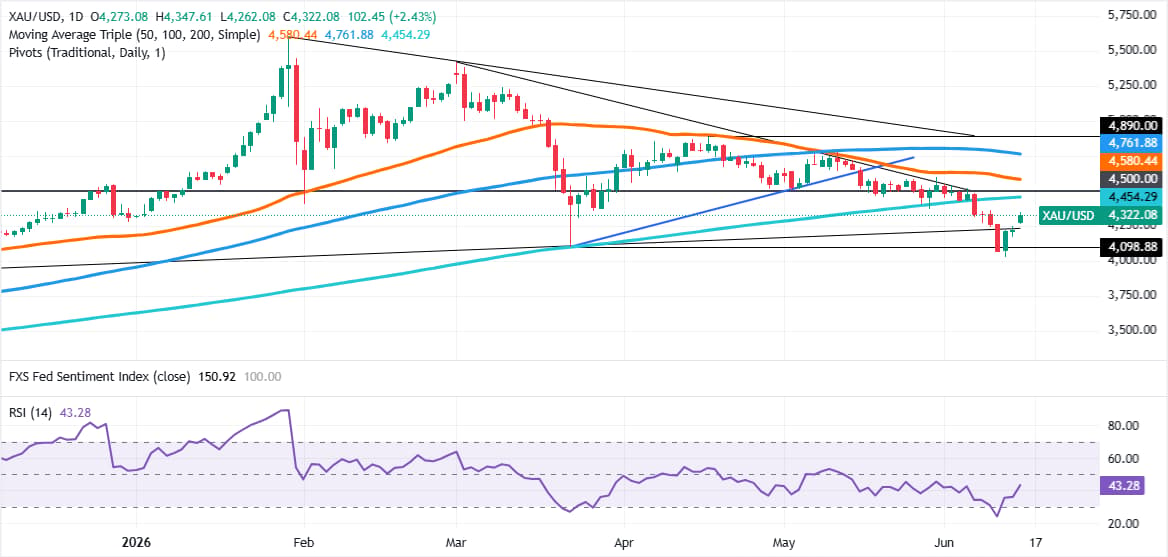
XAU/USD technical outlook: Gold rallies, as bulls target $4,400
Gold price seems poised to consolidate, yet near key technical resistance levels as the US-Iran deal eased inflationary pressures and the need to hold interest rates higher-for-longer.
Momentum shifted slightly bullishly, even though the Relative Strength Index (RSI) is below its 50-neutral level, an indication that sellers are in charge. Still, the index jumped from around 20ish levels to above 43, an indication that buyers are gaining momentum.
If XAU/USD climbs above $4,400, this opens the door to test the 200-day Simple Moving Average (SMA) at $4,454. Above this area, the next stop is $4,500, followed by testing the 50-day SMA at $4,580.
Downwards, if Gold slips below $4,300, the immediate support would be the psychological level of $4,250. A break below and the next support would be $4,200, followed by the June 11 swing low of $4,023.
Gold FAQs
Gold has played a key role in human’s history as it has been widely used as a store of value and medium of exchange. Currently, apart from its shine and usage for jewelry, the precious metal is widely seen as a safe-haven asset, meaning that it is considered a good investment during turbulent times. Gold is also widely seen as a hedge against inflation and against depreciating currencies as it doesn’t rely on any specific issuer or government.
Central banks are the biggest Gold holders. In their aim to support their currencies in turbulent times, central banks tend to diversify their reserves and buy Gold to improve the perceived strength of the economy and the currency. High Gold reserves can be a source of trust for a country’s solvency. Central banks added 1,136 tonnes of Gold worth around $70 billion to their reserves in 2022, according to data from the World Gold Council. This is the highest yearly purchase since records began. Central banks from emerging economies such as China, India and Turkey are quickly increasing their Gold reserves.
Gold has an inverse correlation with the US Dollar and US Treasuries, which are both major reserve and safe-haven assets. When the Dollar depreciates, Gold tends to rise, enabling investors and central banks to diversify their assets in turbulent times. Gold is also inversely correlated with risk assets. A rally in the stock market tends to weaken Gold price, while sell-offs in riskier markets tend to favor the precious metal.
The price can move due to a wide range of factors. Geopolitical instability or fears of a deep recession can quickly make Gold price escalate due to its safe-haven status. As a yield-less asset, Gold tends to rise with lower interest rates, while higher cost of money usually weighs down on the yellow metal. Still, most moves depend on how the US Dollar (USD) behaves as the asset is priced in dollars (XAU/USD). A strong Dollar tends to keep the price of Gold controlled, whereas a weaker Dollar is likely to push Gold prices up.
Author

Christian Borjon Valencia
FXStreet
Markets analyst, news editor, and trading instructor with over 14 years of experience across FX, commodities, US equity indices, and global macro markets.