Gold eases as traders await clearer signals on the Fed interest rate path
- Gold gives up earlier gains as buyers turn cautious after a strong August rally.
- A firmer US Dollar and sticky US inflation keep the upside in check ahead of Fed Chair Kevin Warsh’s Jackson Hole speech.
- XAU/USD retains a bullish technical bias above key daily SMAs, although RSI and MACD point to easing upside momentum.

Gold (XAU/USD) remains on the back foot at the start of American trading hours on Thursday after reversing its earlier intraday gains. At the time of writing, XAU/USD trades around $4,577, after reaching an intraday high of $4,643.
The precious metal climbed to $4,697 earlier this week, its highest level since May 14, but buyers appear hesitant to chase prices higher amid uncertainty over the Federal Reserve’s (Fed) interest rate path. Wednesday’s US Personal Consumption Expenditures (PCE) Price Index also showed that inflation remains sticky and well above the Fed’s 2% target.
Following the figures, the US Dollar (USD) staged a modest recovery as they reinforced expectations that the Fed may need to keep interest rates higher for longer. Gold is often viewed as a hedge against inflation, but higher interest rates reduce the appeal of the non-yielding metal. As a result, Gold ended Wednesday with a loss of around 1.40%.
Even so, the latest PCE figures, along with recent Consumer Price Index (CPI) and Producer Price Index (PPI) data, suggest inflation is no longer accelerating sharply. This reduces the chances of an immediate Fed rate hike and could help limit the downside in Gold. According to CME FedWatch Tool, markets currently see a near 62% chance that the central bank will keep borrowing costs unchanged in September.
Meanwhile, the weekly US labour-market data also offered some support to the Greenback. Initial Jobless Claims fell to 203K in the week ending August 22, below market expectations of 208K and the previous reading of 207K (revised from 206K).
Kansas City Fed President Jeff Schmid said on Thursday the energy shock is leaking into the economy and stressed that the Fed needs to return inflation to 2%. Chicago Fed President Austan Goolsbee said, “The biggest short-run fear is that inflation is not under control,” while describing the current “low hire and low fire” labour market as unusual. Goolsbee added that “the economy on balance has been stable.”
Traders now look ahead to Fed Chair Kevin Warsh’s speech at the Jackson Hole Symposium on Friday for greater clarity on the interest rate outlook. Middle East tensions also remain an important factor as elevated energy prices continue to pose upside risks to inflation, while there are still no clear signs that normal vessel traffic through the Strait of Hormuz will resume soon.
Iran and Oman recently said they had reached an agreement on the strait. However, a senior Iranian official told Reuters that the deal has not been finalised and that details are still being negotiated. Meanwhile, Qatar’s Prime Minister is visiting Tehran on Thursday for talks aimed at de-escalation and restoring US-Iran dialogue.
Technical analysis: XAU/USD bulls pause below $4,700 resistance
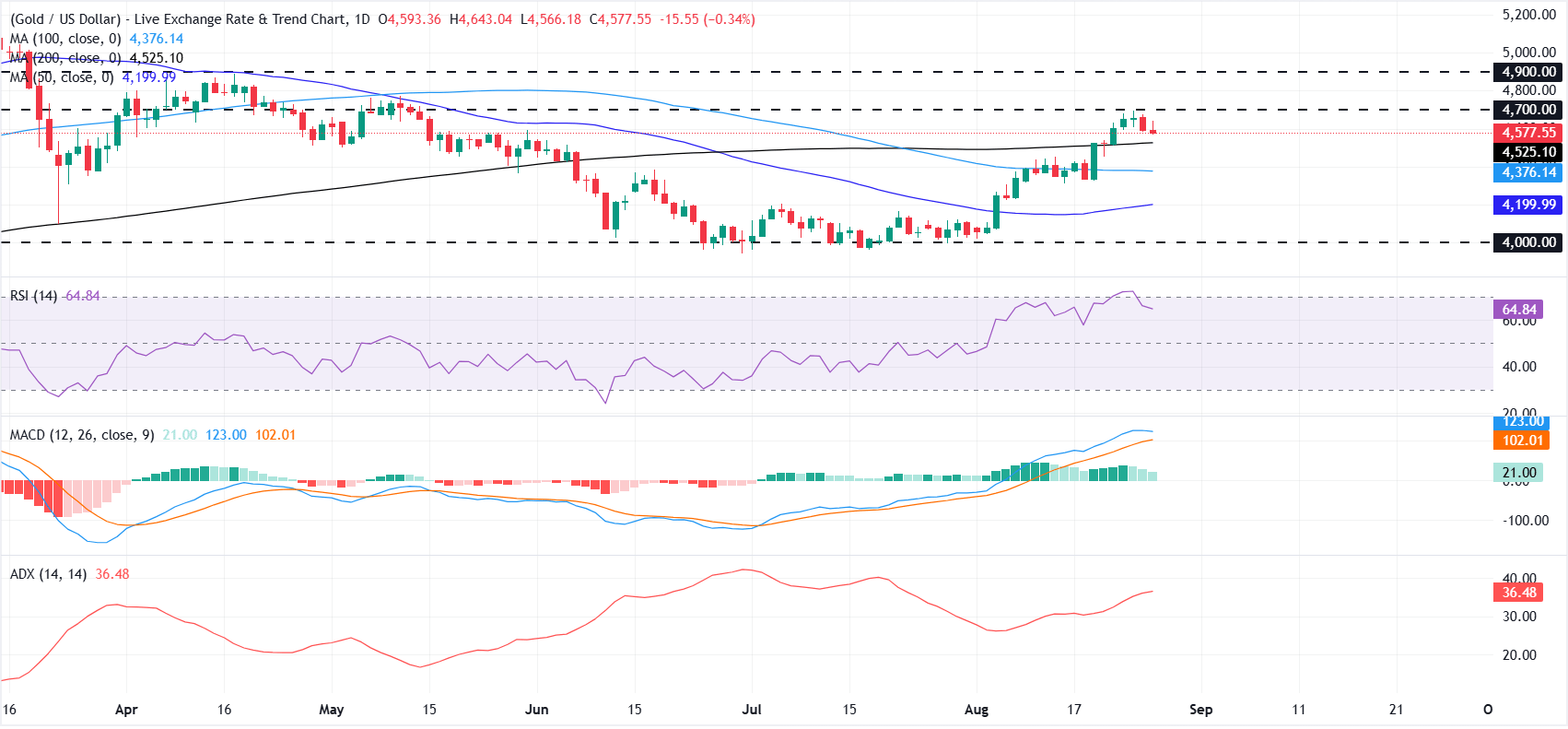
From a technical perspective, XAU/USD retains a bullish bias, although momentum indicators point to waning upside strength on the daily chart. The metal holds above the 50-day, 100-day and 200-day Simple Moving Averages (SMAs), supporting the broader uptrend.
Meanwhile, the Relative Strength Index (RSI) has eased to the mid-60s after climbing into overbought territory, while the Moving Average Convergence Divergence (MACD) remains positive but is losing momentum, suggesting that upside pressure is moderating rather than reversing.
On the upside, initial resistance is seen at the $4,700 psychological mark, followed by the $4,900 level. On the downside, the 200-day SMA at around $4,525 offers immediate support, followed by the 100-day SMA near $4,376 and the 50-day SMA around $4,200. A broader support zone is seen at the $4,000 psychological level.
(The technical analysis of this story was written with the help of an AI tool. Know more.)
Gold FAQs
Gold has played a key role in human’s history as it has been widely used as a store of value and medium of exchange. Currently, apart from its shine and usage for jewelry, the precious metal is widely seen as a safe-haven asset, meaning that it is considered a good investment during turbulent times. Gold is also widely seen as a hedge against inflation and against depreciating currencies as it doesn’t rely on any specific issuer or government.
Central banks are the biggest Gold holders. In their aim to support their currencies in turbulent times, central banks tend to diversify their reserves and buy Gold to improve the perceived strength of the economy and the currency. High Gold reserves can be a source of trust for a country’s solvency. Central banks added 1,136 tonnes of Gold worth around $70 billion to their reserves in 2022, according to data from the World Gold Council. This is the highest yearly purchase since records began. Central banks from emerging economies such as China, India and Turkey are quickly increasing their Gold reserves.
Gold has an inverse correlation with the US Dollar and US Treasuries, which are both major reserve and safe-haven assets. When the Dollar depreciates, Gold tends to rise, enabling investors and central banks to diversify their assets in turbulent times. Gold is also inversely correlated with risk assets. A rally in the stock market tends to weaken Gold price, while sell-offs in riskier markets tend to favor the precious metal.
The price can move due to a wide range of factors. Geopolitical instability or fears of a deep recession can quickly make Gold price escalate due to its safe-haven status. As a yield-less asset, Gold tends to rise with lower interest rates, while higher cost of money usually weighs down on the yellow metal. Still, most moves depend on how the US Dollar (USD) behaves as the asset is priced in dollars (XAU/USD). A strong Dollar tends to keep the price of Gold controlled, whereas a weaker Dollar is likely to push Gold prices up.
Author

Vishal Chaturvedi
FXStreet
I am a macro-focused research analyst with over four years of experience covering forex and commodities market. I enjoy breaking down complex economic trends and turning them into clear, actionable insights that help traders stay ahead of the curve.