Gold crashes below $4,100 as hot CPI revives October Fed hike bets
- Gold tumbles below $4,100 after failing to hold $4,170.
- US headline inflation accelerates to 3.7%, while core CPI reaches 2.6%.
- October Fed hike odds jump to 42%, pressuring non-yielding bullion.

Gold (XAU/USD) price collapses nearly 2% on Wednesday after the latest inflation report in the US was hotter than foreseen, resurrecting bets that the Federal Reserve (Fed) could increase rates at the October 27-28 meeting. At the time of writing, XAU/USD trades at $4,078, after peaking near $4,170.
XAU/USD plunges nearly 2% as accelerating US inflation sends Treasury yields higher
The US Consumer Price Index (CPI) for September came in above estimates. Monthly inflation was 0.6%, as expected, while the annual rate rose from 3.4% to 3.7%, exceeding forecasts. Core CPI, which excludes volatile items such as energy and food, rose 0.3% month over month, exceeding projections. Over the twelve months to September, it increased from 2.4% to 2.6%, also above expectations.
Higher gasoline, diesel, and food prices drove headline inflation. Core CPI rose on higher shelter, owner-equivalent rent, recreation, and education costs, plus a jump in used-car and truck prices.
As a result, traders raised the odds of a Fed rate hike at the October meeting. A day earlier, the probability was about 22%; at the time of writing, it had climbed to 42%. For 2027, investors are pricing in 54 basis points of tightening.
A day ago, New York Fed President John Williams said that he sees another rate hike in 2026 and none in 2027. The September CPI reading trumps Williams' remarks, as money markets see further tightening ahead.
In the meantime, Fed Governor Michelle Bowman said the Fed is in wait-and-see mode, monitoring how financial markets and the economy digest September’s rate hike.
US Treasury yields drift higher, with the 10-year Treasury note yield rising one basis point to 5.209%. Meanwhile, the 2-year Treasury yield, which is most sensitive to changes in short-term interest rates, climbed nearly 3.5 basis points to 4.829%.
The US economic calendar will feature the Fed’s Beige Book, the Producer Price Index (PPI), Retail Sales, Initial Jobless Claims, and further Fed speeches.
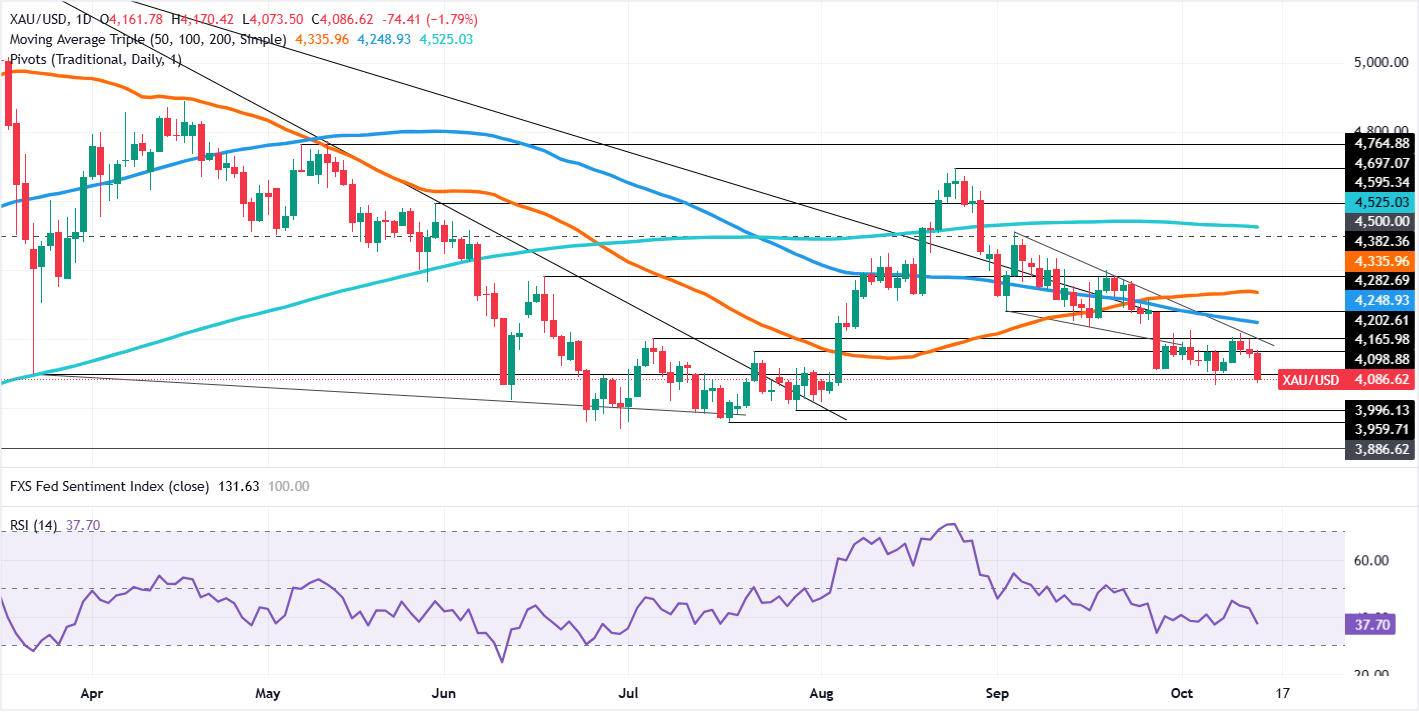
XAU/USD technical analysis: Gold collapses below $4,100; sellers eye breakout below $4,000
Gold shifted bearish after clearing $4,150 and falling below $4,100, reaching a new five-day low of $4,073. Momentum favors sellers, and according to the Relative Strength Index (RSI), they’re gaining traction as the index tumbles and approaches the 30 oversold level.
For a bearish continuation, if XAU/USD falls below $4,050, the non-yielding metal could trade below the $4,000 mark. The next area of interest is the July 29 cycle low at $3,996, followed by the July 17 low at $3,959. Below is the yearly low at $3,941.
For a bullish reversal, Gold must clear $4,200 to have a chance of testing the 100-day Simple Moving Average (SMA) at $4,248 and the 50-day SMA at $4,333.
Gold FAQs
Gold has played a key role in human’s history as it has been widely used as a store of value and medium of exchange. Currently, apart from its shine and usage for jewelry, the precious metal is widely seen as a safe-haven asset, meaning that it is considered a good investment during turbulent times. Gold is also widely seen as a hedge against inflation and against depreciating currencies as it doesn’t rely on any specific issuer or government.
Central banks are the biggest Gold holders. In their aim to support their currencies in turbulent times, central banks tend to diversify their reserves and buy Gold to improve the perceived strength of the economy and the currency. High Gold reserves can be a source of trust for a country’s solvency. Central banks added 1,136 tonnes of Gold worth around $70 billion to their reserves in 2022, according to data from the World Gold Council. This is the highest yearly purchase since records began. Central banks from emerging economies such as China, India and Turkey are quickly increasing their Gold reserves.
Gold has an inverse correlation with the US Dollar and US Treasuries, which are both major reserve and safe-haven assets. When the Dollar depreciates, Gold tends to rise, enabling investors and central banks to diversify their assets in turbulent times. Gold is also inversely correlated with risk assets. A rally in the stock market tends to weaken Gold price, while sell-offs in riskier markets tend to favor the precious metal.
The price can move due to a wide range of factors. Geopolitical instability or fears of a deep recession can quickly make Gold price escalate due to its safe-haven status. As a yield-less asset, Gold tends to rise with lower interest rates, while higher cost of money usually weighs down on the yellow metal. Still, most moves depend on how the US Dollar (USD) behaves as the asset is priced in dollars (XAU/USD). A strong Dollar tends to keep the price of Gold controlled, whereas a weaker Dollar is likely to push Gold prices up.
Author

Christian Borjon Valencia
FXStreet
Markets analyst, news editor, and trading instructor with over 14 years of experience across FX, commodities, US equity indices, and global macro markets.

















