Gold slides as US PPI reinforces Fed hike expectations, US Dollar and yields rise
- Gold trades under pressure as rising yields and Fed rate-hike bets favour the US Dollar.
- US CPI takes centre stage after producer inflation offers little relief.
- The daily chart points to neutral momentum, while XAU/USD remains capped below its 200-day SMA.

Gold (XAU/USD) trades with a downside bias on Thursday as a steady US Dollar (USD), rising US Treasury yields and Federal Reserve (Fed) rate-hike expectations weigh on the precious metal, while traders also assess the latest US Producer Price Index (PPI) data. At the time of writing, XAU/USD trades around $4,368 after reaching an intraday high of $4,324, down 0.75% on the day.
US PPI rose 0.4% MoM in August, matching market expectations and accelerating from the 0.1% increase recorded in July. Annual producer inflation climbed to 5.4%, slightly above the 5.3% forecast and up from 4.8%.
Core PPI, which excludes food and energy prices, offered a softer reading. The index rose 0.2% MoM, below the 0.3% forecast and the previous 0.3% increase. On an annual basis, core producer inflation increased to 4.6% from 4.3%, in line with expectations.
The figures kept the possibility of a Fed rate hike firmly on the table. At the same time, rising Oil prices due to tensions in the Middle East add to inflation concerns and strengthen the case for tighter policy. Attention now turns to Friday’s US Consumer Price Index (CPI) data, which could settle the debate over whether policymakers move ahead with a hike.
According to the CME FedWatch Tool, traders price in around a 64% probability of a rate hike next week. However, most economists surveyed by Reuters expect the central bank to keep interest rates unchanged through the end of the year. As a non-yielding asset, Gold tends to benefit when interest rates are low, as this reduces the opportunity cost of holding the precious metal.
Strategists at DBS caution that an "energy-driven squeeze represents a harder choice, potentially requiring the Fed to contain inflation expectations while adding pressure on growth," but add that "a credible Fed response could support the USD and ease longer-term inflation concerns."
The US Dollar Index (DXY), which tracks the Greenback against six major currencies, trades around 98.96 after briefly rising above 99, while staying above its intraday low of 98.71. Meanwhile, the benchmark 10-year yield trades around 4.92%, its highest level since November 2023, after the Treasury’s larger bond buyback plan failed to impress markets.
In the near term, Gold remains vulnerable to rising Fed rate-hike expectations and elevated Treasury yields, while tensions in the Middle East are offering little direct support.
Technical analysis: Bears retain control below 200-day SMA
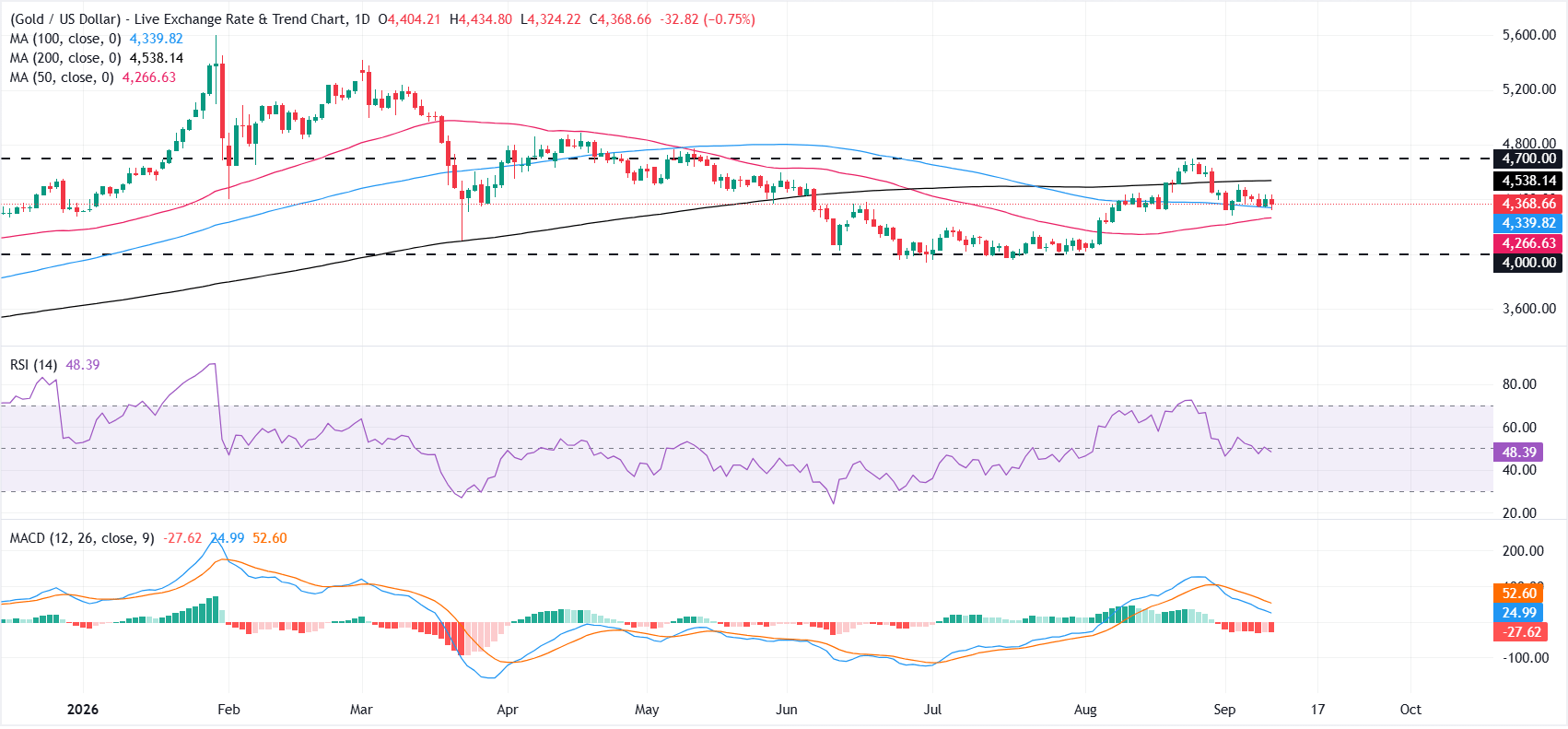
On the daily chart, XAU/USD holds above the 50-day and 100-day Simple Moving Averages (SMAs), suggesting underlying trend support, yet it remains below the 200-day SMA near $4,538, which caps the broader topside.
The Relative Strength Index (RSI) around 47 points to neutral momentum, while the Moving Average Convergence Divergence (MACD) indicator stays below zero with a negative reading and subdued histogram, hinting that rallies could still face selling pressure despite the constructive underlying structure.
On the topside, initial resistance is seen at the 200-day SMA around $4,538, with a break there exposing the next key barrier at the horizontal resistance level near $4,700. On the downside, immediate support emerges from the nearby price pivot zone around the latest close, followed by the 100-day SMA at about $4,339 and the 50-day SMA near $4,266. A deeper slide would bring the major horizontal floor at $4,000 into view as the next significant demand area.
(The technical analysis of this story was written with the help of an AI tool. Know more.)
Inflation FAQs
Inflation measures the rise in the price of a representative basket of goods and services. Headline inflation is usually expressed as a percentage change on a month-on-month (MoM) and year-on-year (YoY) basis. Core inflation excludes more volatile elements such as food and fuel which can fluctuate because of geopolitical and seasonal factors. Core inflation is the figure economists focus on and is the level targeted by central banks, which are mandated to keep inflation at a manageable level, usually around 2%.
The Consumer Price Index (CPI) measures the change in prices of a basket of goods and services over a period of time. It is usually expressed as a percentage change on a month-on-month (MoM) and year-on-year (YoY) basis. Core CPI is the figure targeted by central banks as it excludes volatile food and fuel inputs. When Core CPI rises above 2% it usually results in higher interest rates and vice versa when it falls below 2%. Since higher interest rates are positive for a currency, higher inflation usually results in a stronger currency. The opposite is true when inflation falls.
Although it may seem counter-intuitive, high inflation in a country pushes up the value of its currency and vice versa for lower inflation. This is because the central bank will normally raise interest rates to combat the higher inflation, which attract more global capital inflows from investors looking for a lucrative place to park their money.
Formerly, Gold was the asset investors turned to in times of high inflation because it preserved its value, and whilst investors will often still buy Gold for its safe-haven properties in times of extreme market turmoil, this is not the case most of the time. This is because when inflation is high, central banks will put up interest rates to combat it. Higher interest rates are negative for Gold because they increase the opportunity-cost of holding Gold vis-a-vis an interest-bearing asset or placing the money in a cash deposit account. On the flipside, lower inflation tends to be positive for Gold as it brings interest rates down, making the bright metal a more viable investment alternative.
Author

Vishal Chaturvedi
FXStreet
I am a macro-focused research analyst with over four years of experience covering forex and commodities market. I enjoy breaking down complex economic trends and turning them into clear, actionable insights that help traders stay ahead of the curve.

















