Gold collapses as US-Iran strikes send Oil, US yields higher
- Gold plunges as US-Iran strikes send Oil and yields higher.
- WTI nears $90 as Hormuz escalation revives inflation fears.
- Warsh remarks and Fed hike bets deepen bullion pressure.

Gold (XAU/USD) price collapses over 2.30% on Tuesday as the Middle East conflict escalates, with the US and Iran exchanging strikes, while US economic data was mixed but moved to the back seat amid geopolitical tensions. At the time of writing, XAU/USD trades at $4,342 after reaching a high of $4,461.
XAU/USD slides as Hormuz escalation fuels Oil, yields and Fed risks
Recently, newswires reported explosions in Southern Iran, while US President Donald Trump confirmed that the US Air Force launched strikes aimed at trimming Tehran’s capabilities to launch missiles and to add sea mines to the Strait of Hormuz, which, according to Trump, “currently has no mines (They have been completely removed or detonated!).“
This pushed US Treasury yields higher, particularly the 10-year benchmark note, which rose nearly four basis points to 4.792%. This is due to the jump in Oil prices, as West Texas Intermediate hit a high of the day near $90.00 per barrel and currently sits with gains of over 4.20%.
Last week, bullion prices edged lower following hawkish remarks by Federal Reserve (Fed) Chair Kevin Warsh at his Jackson Hole speech, in which he reassured that if inflation remains stubbornly high, then the central bank has “work to do.”
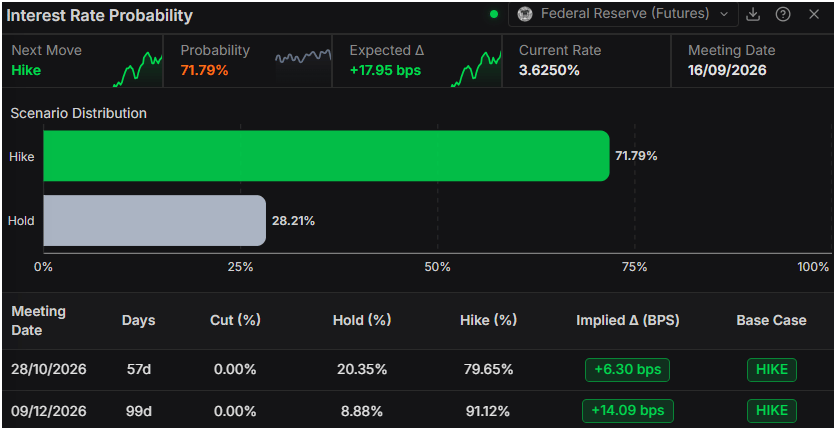
That statement triggered a U-turn on money markets. Before Warsh’s speech, the odds for a rate hike at the September meeting were below 40%. At the time of writing, Prime Terminal data indicate a 71% chance of an interest rate increase and a 29% chance of rates remaining unchanged.
Earlier, US data showed that business activity in the manufacturing sector cooled, as the ISM Manufacturing PMI in August was 54.6, down from 55.6 in July and below estimates of 55.2. Other data included the Job Openings and Labor Turnover Survey (JOLTS) report for July, which showed steady hiring, with vacancies increasing to 7.217 million, below forecasts of 7.3 million.
Ahead, the US economic docket will feature the release of the Fed’s Beige Book, jobs data, the ISM Services PMI for August, followed by the Nonfarm Payrolls report on Friday.
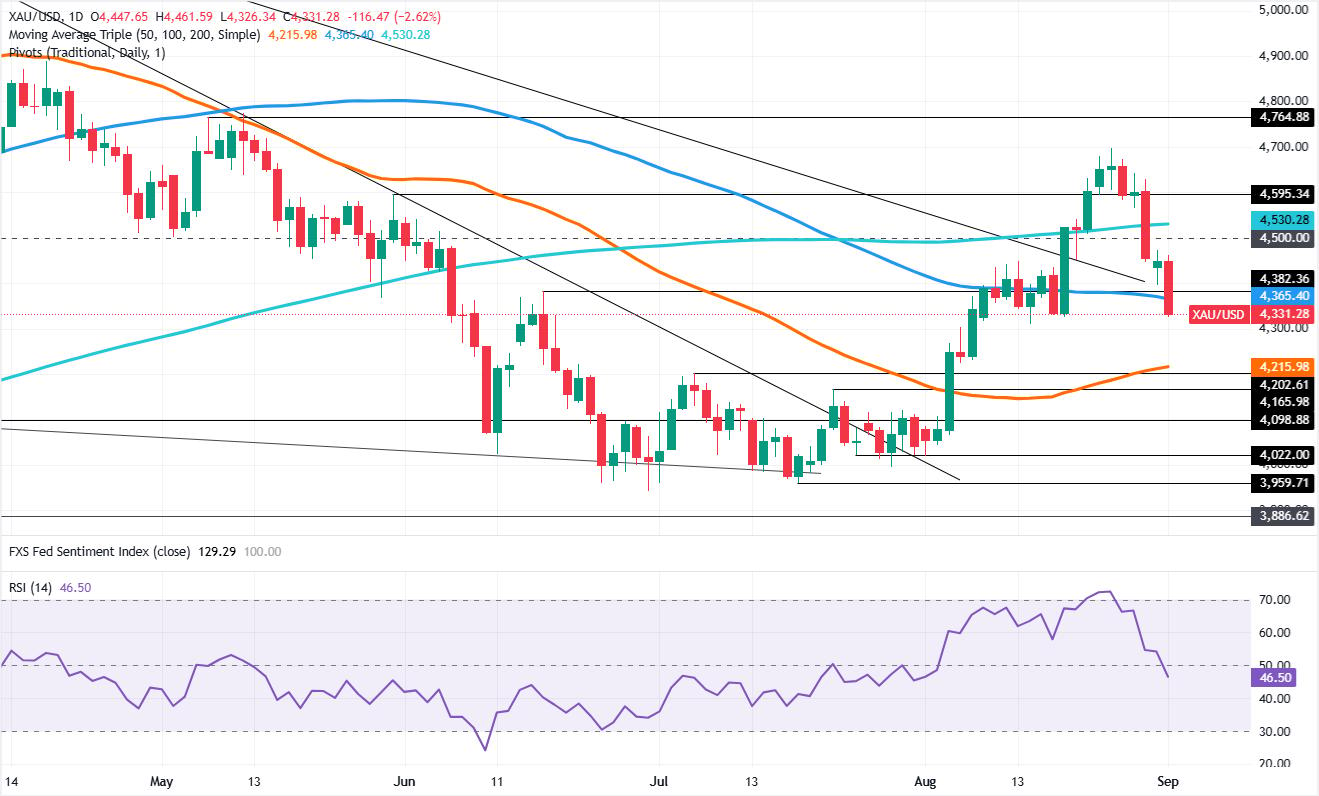
XAU/USD technical outlook: Gold sinks below 100-day SMA, eyes on $4,300
From a technical standpoint, the escalation of the US-Iran conflict accelerated Gold’s downtrend. On its way down, XAU/USD breached key support levels, including the $4,400 figure and the 100-day Simple Moving Average (SMA) at $4,365, exacerbating a breakout below $4,350.
Of note, the Relative Strength Index (RSI), which was bullish, shifted bearish amid a vertical drop, indicating that sellers are gaining momentum.
For a bearish continuation, bullion must achieve a daily close below $4,350. Below is the low of the day (LOD) at $4,326, followed by the $4,300 mark. Once hurdled, the next area of interest is the 50-day SMA at $4,215.
On the other hand, Gold could shift to neutral if the yellow metal clears the 100-day SMA at $4,365, which would open the path to reclaiming $4,400.
Gold FAQs
Gold has played a key role in human’s history as it has been widely used as a store of value and medium of exchange. Currently, apart from its shine and usage for jewelry, the precious metal is widely seen as a safe-haven asset, meaning that it is considered a good investment during turbulent times. Gold is also widely seen as a hedge against inflation and against depreciating currencies as it doesn’t rely on any specific issuer or government.
Central banks are the biggest Gold holders. In their aim to support their currencies in turbulent times, central banks tend to diversify their reserves and buy Gold to improve the perceived strength of the economy and the currency. High Gold reserves can be a source of trust for a country’s solvency. Central banks added 1,136 tonnes of Gold worth around $70 billion to their reserves in 2022, according to data from the World Gold Council. This is the highest yearly purchase since records began. Central banks from emerging economies such as China, India and Turkey are quickly increasing their Gold reserves.
Gold has an inverse correlation with the US Dollar and US Treasuries, which are both major reserve and safe-haven assets. When the Dollar depreciates, Gold tends to rise, enabling investors and central banks to diversify their assets in turbulent times. Gold is also inversely correlated with risk assets. A rally in the stock market tends to weaken Gold price, while sell-offs in riskier markets tend to favor the precious metal.
The price can move due to a wide range of factors. Geopolitical instability or fears of a deep recession can quickly make Gold price escalate due to its safe-haven status. As a yield-less asset, Gold tends to rise with lower interest rates, while higher cost of money usually weighs down on the yellow metal. Still, most moves depend on how the US Dollar (USD) behaves as the asset is priced in dollars (XAU/USD). A strong Dollar tends to keep the price of Gold controlled, whereas a weaker Dollar is likely to push Gold prices up.
Author

Christian Borjon Valencia
FXStreet
Markets analyst, news editor, and trading instructor with over 14 years of experience across FX, commodities, US equity indices, and global macro markets.

















