Gold approaches $4,100 as suspected Japanese intervention hits US Dollar
- Gold struggles below $4,100 after the Fed left interest rates unchanged at its July meeting.
- A weaker US Dollar supports Gold, though hawkish Fed expectations continue to cap gains.
- XAU/USD remains range-bound between $4,000 and $4,200, with momentum indicators indicating a neutral bias.

Gold (XAU/USD) remains trapped in its month-old $4,000-$4,200 range as the Federal Reserve’s (Fed) new era of limited forward guidance fails to shake the precious metal out of its sideways grind after policymakers left interest rates unchanged at 3.50%-3.75%.
At the time of writing, XAU/USD trades around $4,095 during American trading hours on Thursday, recovering from an intraday low of $4,028. The precious metal edges higher as the US Dollar (USD) comes under renewed selling pressure following suspected intervention by Japanese authorities to stem the Yen’s weakness.
The US Dollar Index (DXY), which tracks the currency against a basket of six major peers, trades around 99.90, its lowest level since June 17, down 0.90% on the day.
The latest US economic data add to the downside. Inflation cooled in June as the Core Personal Consumption Expenditures (PCE) Price Index rose 0.1% MoM, below the 0.2% forecast and down from 0.3% in May. Annual core inflation eased to 3.3% from 3.4%, in line with market expectations. The US economy grew at an annualized pace of 1.5% in the second quarter, missing forecasts of 2.1%.
However, Gold struggles to capitalize on the weaker US Dollar as the war in the Middle East keeps energy-driven inflation risks elevated. Fed Chair Kevin Warsh’s firm stance on inflation and three dissenting votes in favour of a 25-basis-point (bps) rate hike keep hawkish expectations alive. The CME FedWatch Tool shows a 55% probability that the central bank will raise interest rates in September.
Meanwhile, on the geopolitical front, the US military said it completed a “heavy wave of strikes” against Iran on Thursday in retaliation for Tehran’s ballistic-missile attack on US forces in Jordan, restarting the back-and-forth attacks in the region.
Technical analysis: RSI stays near neutral as XAU/USD searches for direction
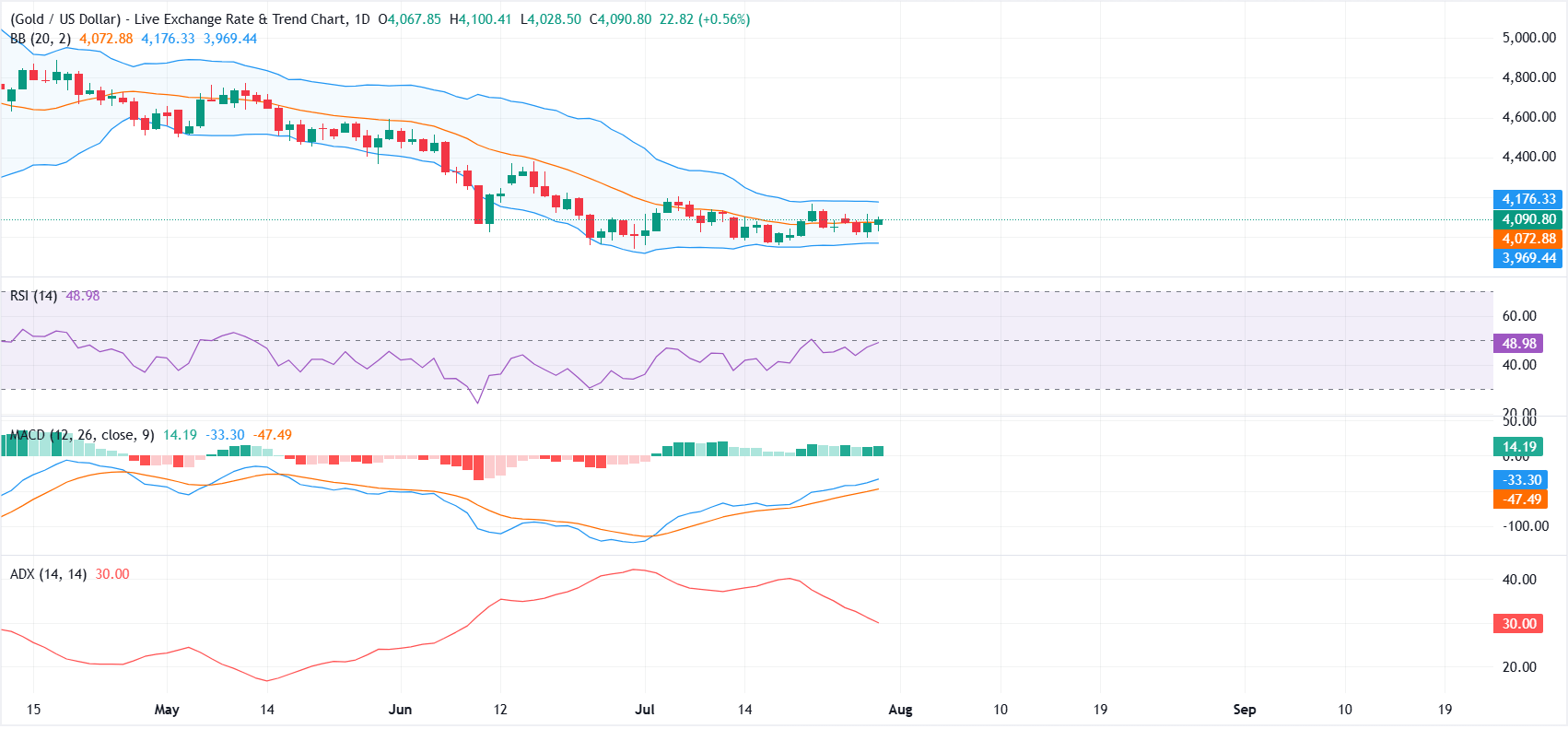
On the daily chart, XAU/USD remains confined to its $4,000-$4,200 range, trading around the 20-day SMA, which also serves as the Bollinger middle band, near $4,072. This keeps the short-term outlook neutral and points to a lack of clear directional momentum.
The Relative Strength Index (RSI) at 48 sits just below neutral, and the Moving Average Convergence Divergence (MACD) remains positive, together suggesting a constructive but not overstretched recovery within a moderately trending backdrop indicated by an Average Directional Index (ADX) reading of 30.
On the downside, the psychological $4,000 mark remains the key support holding the range together. A sustained break below this level would expose the Bollinger lower band near $3,969 and signal a possible bearish breakout.
On the upside, the Bollinger upper band near $4,176 offers initial resistance, followed by the upper boundary of the range at $4,200. A daily close above $4,200 would be needed to confirm a bullish breakout and open the door to further gains.
(The technical analysis of this story was written with the help of an AI tool. Know more.)
Inflation FAQs
Inflation measures the rise in the price of a representative basket of goods and services. Headline inflation is usually expressed as a percentage change on a month-on-month (MoM) and year-on-year (YoY) basis. Core inflation excludes more volatile elements such as food and fuel which can fluctuate because of geopolitical and seasonal factors. Core inflation is the figure economists focus on and is the level targeted by central banks, which are mandated to keep inflation at a manageable level, usually around 2%.
The Consumer Price Index (CPI) measures the change in prices of a basket of goods and services over a period of time. It is usually expressed as a percentage change on a month-on-month (MoM) and year-on-year (YoY) basis. Core CPI is the figure targeted by central banks as it excludes volatile food and fuel inputs. When Core CPI rises above 2% it usually results in higher interest rates and vice versa when it falls below 2%. Since higher interest rates are positive for a currency, higher inflation usually results in a stronger currency. The opposite is true when inflation falls.
Although it may seem counter-intuitive, high inflation in a country pushes up the value of its currency and vice versa for lower inflation. This is because the central bank will normally raise interest rates to combat the higher inflation, which attract more global capital inflows from investors looking for a lucrative place to park their money.
Formerly, Gold was the asset investors turned to in times of high inflation because it preserved its value, and whilst investors will often still buy Gold for its safe-haven properties in times of extreme market turmoil, this is not the case most of the time. This is because when inflation is high, central banks will put up interest rates to combat it. Higher interest rates are negative for Gold because they increase the opportunity-cost of holding Gold vis-a-vis an interest-bearing asset or placing the money in a cash deposit account. On the flipside, lower inflation tends to be positive for Gold as it brings interest rates down, making the bright metal a more viable investment alternative.
Author

Vishal Chaturvedi
FXStreet
I am a macro-focused research analyst with over four years of experience covering forex and commodities market. I enjoy breaking down complex economic trends and turning them into clear, actionable insights that help traders stay ahead of the curve.

















