|

GM’s $7.1 billion EV write-down meets multi-year resistance, target $66 in focus

General Motors dropped fresh news Thursday evening that should catch every trader's attention: a staggering $7.1 billion in fourth-quarter charges, with $6 billion directly tied to its struggling electric vehicle operations. The timing of this announcement couldn't be worse from a technical perspective.

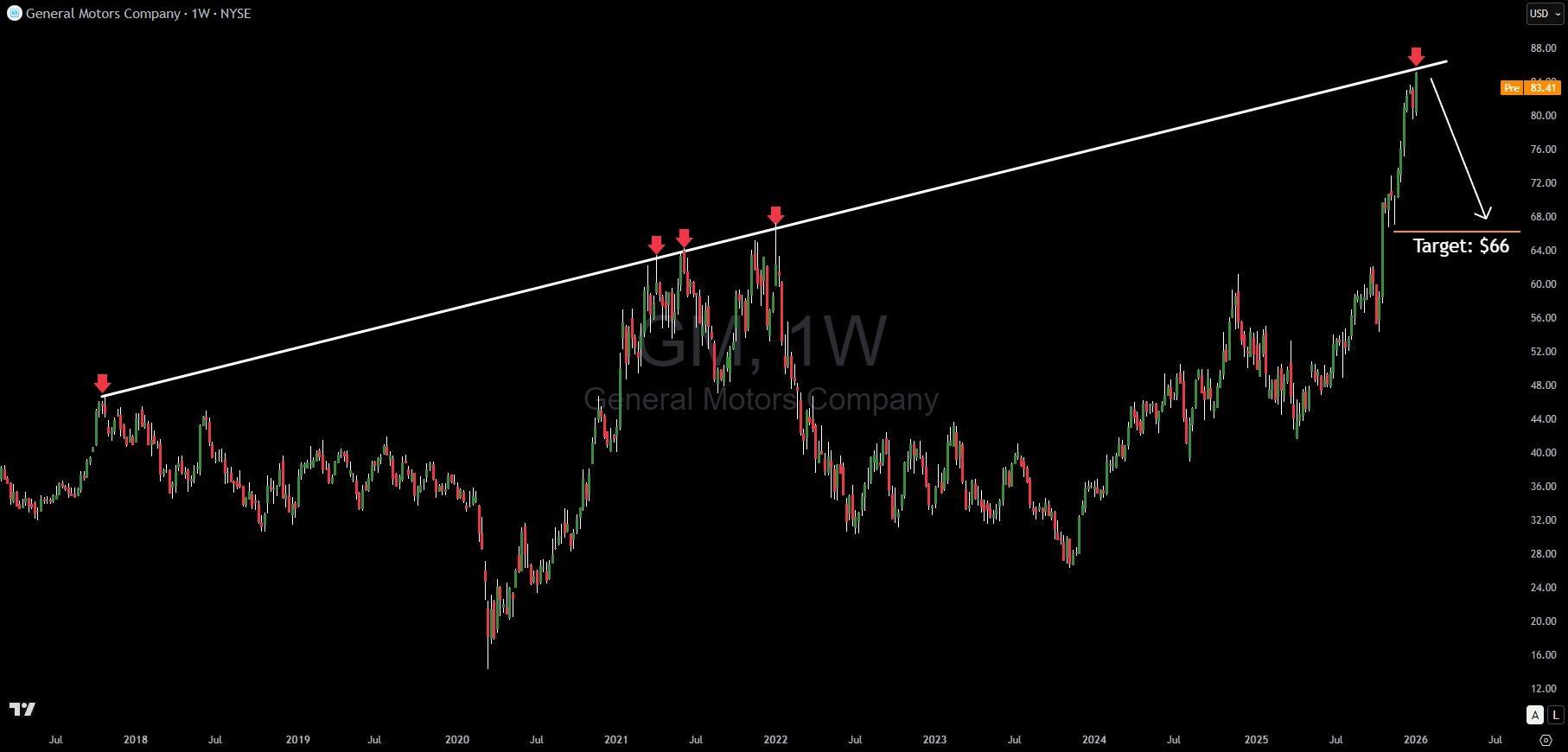
Looking at GM's weekly chart, the stock recently spiked to $85, testing a multi-year ascending resistance trendline that's rejected price advances repeatedly since 2017. This isn't the first time we've seen GM bump its head against this overhead barrier—red arrows mark multiple failed attempts in 2018 and throughout 2020-2021. Each time, sellers showed up with force.

The recent rejection at $85 looks textbook. Price currently sits at $83.36 pre-market, but the damage from this fundamental bombshell could accelerate what the technicals were already suggesting: a move back toward the $66 level.

The EV write-down stems from weakening demand after federal tax credits expired in September, forcing GM to slash production capacity and settle expensive contracts with suppliers who had prepared for much higher volumes. Most striking is the $4.2 billion cash component—real money walking out the door in supplier settlements and contract cancellations. GM warns additional charges are coming in 2026, though management expects them to be smaller.

From a technical standpoint, that ascending resistance trendline has proven reliable for years. When overhead resistance meets fundamental headwinds of this magnitude, the path of least resistance typically points lower. The $66 target represents a logical destination based on prior support levels and the chart's structure.

For traders watching GM, this setup combines technical rejection with deteriorating fundamentals—a combination that often produces sustained moves. The question isn't whether pressure exists, but how quickly it manifests in price action.
Author

Gareth Soloway

Gareth Soloway

Verified Investing

A renowned trader and financial expert specializing in chart analysis and market insights.

More from Gareth Soloway
Share:

Editor's Picks

AUD/USD consolidates above 0.7000; remains close to monthly top

AUD/USD holds steady above 0.7000 during the Asian session on Friday, trading just below the previous day's monthly low amid diverging forces. A hawkish RBA continues to support the Aussie, while the recent decline in US bond yields keeps the US Dollar depressed near a three-week low. However, oil-driven inflation fears reinforce Fed hike bets, which, along with geopolitical risks, could benefit the safe-haven buck and cap the currency pair.

USD/JPY bounces off one-month low; climbs to 157.00 amid reviving USD demand

USD/JPY rebounds from the 156.00 neighborhood, or a one-month low touched during Friday’s Asian session, with bulls looking to extend momentum beyond 157.00 amid the emergence of some US Dollar buying. Meanwhile, Japan's National CPI rose to a nine-month peak and reaffirmed BoJ rate-hike bets, which could support the Japanese Yen and cap gains for the currency pair.

Gold stalls recovery from three-month low as Fed hike bets and USD uptick cap gains

Gold struggles to capitalize on a modest intraday bounce from levels below the $4,000 psychological mark, or a three-month low set during the Asian session, and sticks to a negative tone for the second straight day. The Federal Reserve recently signaled that there is no urgency to raise interest rates. Traders, however, are still pricing in around an 80% chance that the US central bank will raise borrowing costs again at its December policy meeting.

Bitcoin, Ethereum, and Ripple rebound as major support levels cap recent sell-off

Bitcoin, Ethereum and Ripple rebound modestly on Friday after correcting and testing their key support zone the previous day. BTC holds the 50-day EMA, ETH finds support around the 100-day EMA, while XRP holds the horizontal floor near $1.300. The price action of these top three cryptocurrencies suggests a recovery if this critical support zone holds; a decisive close below these levels suggests a deeper correction.

The week ahead – UK budget, Shell, BP and HSBC and NatWest results
Financial markets have undergone another turbulent week with concerns about public sector debt levels, the impact of energy policy and higher oil and gas prices, and what events in France might mean for the UK economy going forward.
What November 3 means for the Fed's rate path and the US Dollar

The USD faces a decisive period ahead of the November 3 midterm elections. While markets anticipate another interest rate increase from the Fed in December, the battle for control of Congress could reshape fiscal policy expectations and, indirectly, the path of US monetary policy in 2027.