GE Aerospace pulls back to mid-channel — Is this a buying opportunity or a warning sign?

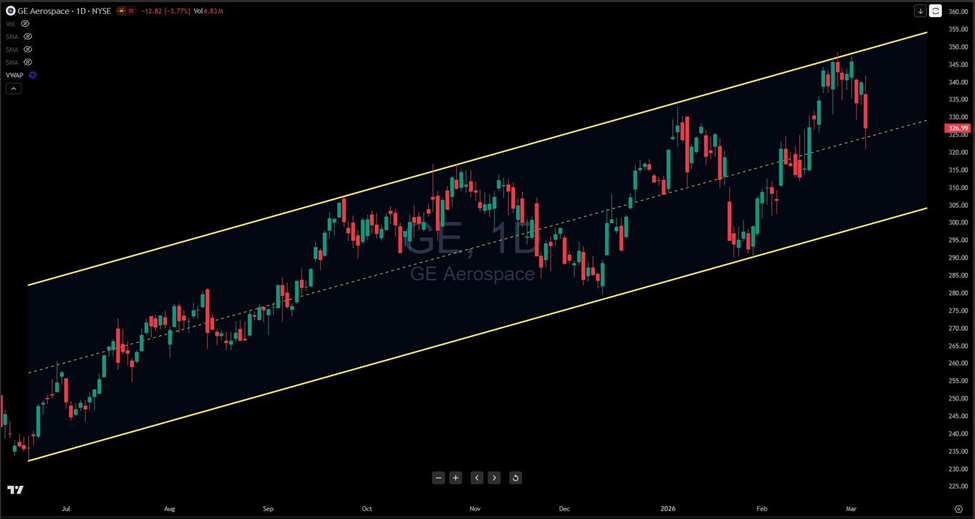
After an impressive run toward the upper boundary of its long-term ascending channel, GE Aerospace (GE) is giving back ground in a hurry — dropping nearly 4% on the session to sit right around $327. The question traders are asking right now is simple: is this a healthy pause inside a still-intact bullish structure, or the beginning of something more meaningful to the downside?
GE Aerospace designs and manufactures jet engines, propulsion systems, and aviation components for commercial and military aircraft. They are essentially the power behind some of the world's most widely flown planes. It's a business with deep ties to long-cycle defense contracts and a commercial aviation aftermarket that generates recurring revenue as airlines keep their fleets in the air.
That fundamental backdrop has helped fuel the stock's sustained climb over the past year, and the chart reflects it. Let's walk through what that chart is actually telling us.
Going back to last summer, GE has been carving out one of the cleaner ascending parallel channels you'll find on a daily chart. The lower boundary of channel support has caught price on multiple occasions, and the upper boundary has consistently capped rallies. That kind of repeated, disciplined respect for both walls tells me institutional money is very much aware of this structure. These aren't random lines on a chart.
Running right through the middle of that channel is the median line, and that's exactly where price is testing right now. What's worth noting is that this dashed midline has played both sides of the fence throughout the move — acting as resistance on the way up during the October-November consolidation, then flipping to support as buyers stepped back in. That polarity shift matters. It's now the first real line in the sand for the current pullback.
If GE can stabilize and close above the mid-channel line — somewhere in that $325–$328 zone — the bullish case remains intact. Pullbacks to the midline within a well-structured channel are textbook buy-the-dip territory, and a recovery from here would put the upper channel resistance back in play near $345–$350.
The scenario that should give bulls pause is a confirmed daily close beneath the median line. That opens the door to a full channel retest down toward lower channel support, which is currently rising through the $295–$300 area. That's a meaningful move lower, and not one to dismiss if the midline gives way.
For now, the trend structure is still bullish. GE is making higher lows inside a rising channel that's been in place for the better part of nine months. But today's sharp selling is a reminder that channels don't go straight up forever. Watch that midline close carefully.
Author

Benjamin Pool
Verified Investing
A seasoned financial expert with a passion for empowering individuals to mastering smart money management.

















