GBP/USD rises as fragile ceasefire lifts risk appetite, trims USD
- Fragile US-Iran ceasefire boosts risk appetite and pressures the US Dollar.
- Softer ISM Services data reinforced signs of slowing US activity.
- Hawkish BoE pricing and rising Gilt yields supported Sterling.

The Pound Sterling (GBP) rises by over 0.20% against the US Dollar (USD) as risk appetite improves. The ceasefire between the US and Iran, although fragile, is holding, pushing Oil prices and the USD lower and US equities higher. Hence, the risk-sensitive GBP/USD pair trades at 1.3560, with buyers eyeing 1.3600.
The Sterling gains as softer Oil and Bank of England (BoE) tightening bets keep buyers targeting 1.3600.
Washington and Tehran exchanged fire on Monday as the US Navy embarked on President Donald Trump’s 'Operation Freedom', while Iran retaliated as the US prolonged the blockade over Iranian ports.
On Monday, news reported that the US military destroyed six Iranian boats, which were intended to block the passage of commercial ships through the Strait of Hormuz. Iran resumed attacks on the UAE, damaging Oil facilities, which triggered a spike in Oil prices.
Aside from geopolitics, data from the US showed that economic activity slowed in April, with the ISM Services PMI falling to 53.6 in April from 54 in March. The sub-components of employment improved from 45.2 to 48, while prices paid remained unchanged at 70.7 from March.
Other data showed that the trade deficit in March widened due to large investments in AI, with imports rising 3.6% and exports surging 3.1%. At the same time, labor market data showed job openings fell in March, with the JOLTS report showing a dip from 6.922 million to 6.866 million, below forecasts of 6.83 million.
Markets increase bets on hawkish BoE
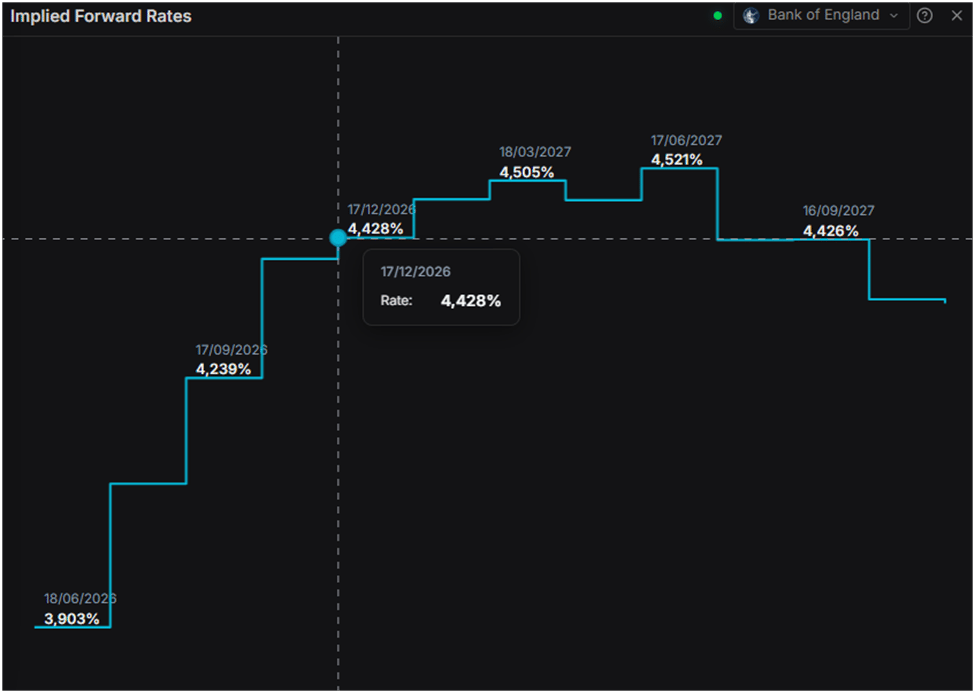
Across the pond, Sterling extended its gains, yet its fate lies in the outcome of Thursday’s local elections, which could add pressure on Prime Minister Keir Starmer. Money-market expectations pricing in a hawkish Bank of England are another reason for the Cable’s strength. Before the Iran conflict, money markets were expecting two rate cuts by the Bank of England. As of writing, they are pricing in nearly 68 basis points of tightening towards the end of 2026.
Worth noting that the UK 30-year GILT rose to its highest level since 1998 amid a broad sell-off in Gilts, before local elections this week. The 30-year Gilt yield peaked at 5.787%
On Wednesday, the UK economic docket is absent, yet in the US, speeches by Federal Reserve officials would dictate the Greenback’s direction.
GBP/USD Price Forecast: Technical outlook
In the daily chart, GBP/USD trades at 1.3566, holding a constructive bullish bias as spot extends above the clustered 50-, 100- and 200-day simple moving averages (SMAs) around 1.3415. The pair also remains supported by the previously respected descending trend line, now lying below price, and by an underlying rising trend-line structure, while the latest reading of the FXS Fed Sentiment Index near 132 hints that external policy expectations are not yet undermining the broader positive tone.
On the downside, initial support is seen near the recent trend-line zone around 1.3490, backed by the dense SMA cluster around 1.3415, which reinforces the broader bullish structure as long as it holds. With no clear overhead technical reference in the provided data, any fresh advance would likely probe uncharted resistance levels, while a daily close back below the SMA cluster would be needed to undermine the current upward bias.
(The technical analysis of this story was written with the help of an AI tool.)
Pound Sterling FAQs
The Pound Sterling (GBP) is the oldest currency in the world (886 AD) and the official currency of the United Kingdom. It is the fourth most traded unit for foreign exchange (FX) in the world, accounting for 12% of all transactions, averaging $630 billion a day, according to 2022 data. Its key trading pairs are GBP/USD, also known as ‘Cable’, which accounts for 11% of FX, GBP/JPY, or the ‘Dragon’ as it is known by traders (3%), and EUR/GBP (2%). The Pound Sterling is issued by the Bank of England (BoE).
The single most important factor influencing the value of the Pound Sterling is monetary policy decided by the Bank of England. The BoE bases its decisions on whether it has achieved its primary goal of “price stability” – a steady inflation rate of around 2%. Its primary tool for achieving this is the adjustment of interest rates. When inflation is too high, the BoE will try to rein it in by raising interest rates, making it more expensive for people and businesses to access credit. This is generally positive for GBP, as higher interest rates make the UK a more attractive place for global investors to park their money. When inflation falls too low it is a sign economic growth is slowing. In this scenario, the BoE will consider lowering interest rates to cheapen credit so businesses will borrow more to invest in growth-generating projects.
Data releases gauge the health of the economy and can impact the value of the Pound Sterling. Indicators such as GDP, Manufacturing and Services PMIs, and employment can all influence the direction of the GBP. A strong economy is good for Sterling. Not only does it attract more foreign investment but it may encourage the BoE to put up interest rates, which will directly strengthen GBP. Otherwise, if economic data is weak, the Pound Sterling is likely to fall.
Another significant data release for the Pound Sterling is the Trade Balance. This indicator measures the difference between what a country earns from its exports and what it spends on imports over a given period. If a country produces highly sought-after exports, its currency will benefit purely from the extra demand created from foreign buyers seeking to purchase these goods. Therefore, a positive net Trade Balance strengthens a currency and vice versa for a negative balance.
Author

Christian Borjon Valencia
FXStreet
Markets analyst, news editor, and trading instructor with over 14 years of experience across FX, commodities, US equity indices, and global macro markets.