GBP/USD Price Forecast: YTD low near 1.3140 to act as key support level
- GBP/USD falls sharply to near 1.3200 as the US Dollar outperforms its peers.
- The US Dollar gains even as traders have scaled back hawkish Fed bets for the October policy meeting.
- Heightened French fiscal concerns have prompted US Dollar’s safe-haven appeal.

The British pound (GBP) is down 0.26% to near 1.3200 against the US Dollar (USD) during the early European trading session on Monday. The GBP/USD pair faces selling pressure as the US Dollar (USD) outperforms due to an improvement in its safe-haven demand in the wake of heightened French fiscal concerns.
As of writing, the US Dollar Index (DXY), which gauges the Greenback’s value against six major currencies, trades 0.42% higher to near 102.53. The DXY posted a fresh yearly high at 102.53 during the day.
US Dollar Price Today
The table below shows the percentage change of US Dollar (USD) against listed major currencies today. US Dollar was the strongest against the Euro.
| USD | EUR | GBP | JPY | CAD | AUD | NZD | CHF | |
|---|---|---|---|---|---|---|---|---|
| USD | 0.61% | 0.27% | 0.09% | 0.21% | 0.12% | 0.55% | 0.17% | |
| EUR | -0.61% | -0.30% | -0.49% | -0.37% | -0.31% | -0.12% | -0.39% | |
| GBP | -0.27% | 0.30% | -0.17% | -0.07% | -0.02% | 0.17% | -0.10% | |
| JPY | -0.09% | 0.49% | 0.17% | 0.11% | 0.12% | 0.35% | 0.09% | |
| CAD | -0.21% | 0.37% | 0.07% | -0.11% | 0.02% | 0.21% | -0.05% | |
| AUD | -0.12% | 0.31% | 0.02% | -0.12% | -0.02% | 0.18% | -0.08% | |
| NZD | -0.55% | 0.12% | -0.17% | -0.35% | -0.21% | -0.18% | -0.27% | |
| CHF | -0.17% | 0.39% | 0.10% | -0.09% | 0.05% | 0.08% | 0.27% |
The heat map shows percentage changes of major currencies against each other. The base currency is picked from the left column, while the quote currency is picked from the top row. For example, if you pick the US Dollar from the left column and move along the horizontal line to the Japanese Yen, the percentage change displayed in the box will represent USD (base)/JPY (quote).
Meanwhile, traders have scaled down hawkish Federal Reserve (Fed) expectations for the October policy meeting after the release of the United States (US) Nonfarm Payrolls (NFP) data on Friday, which showed a moderate job growth.
The CME FedWatch tool shows an 82.3% that the Fed will keep interest rates steady in the policy meeting this month. This is a sharp turnaround from the probability of 35.8% seen last week.
Later in the day, investors will focus on the US ISM Services Purchasing managers Index (PMI) data for September, which will be published at 14:00 GMT. The ISM Services PMI is seen higher at 55.7 from 55.4 in August.
GBP/USD Technical Analysis
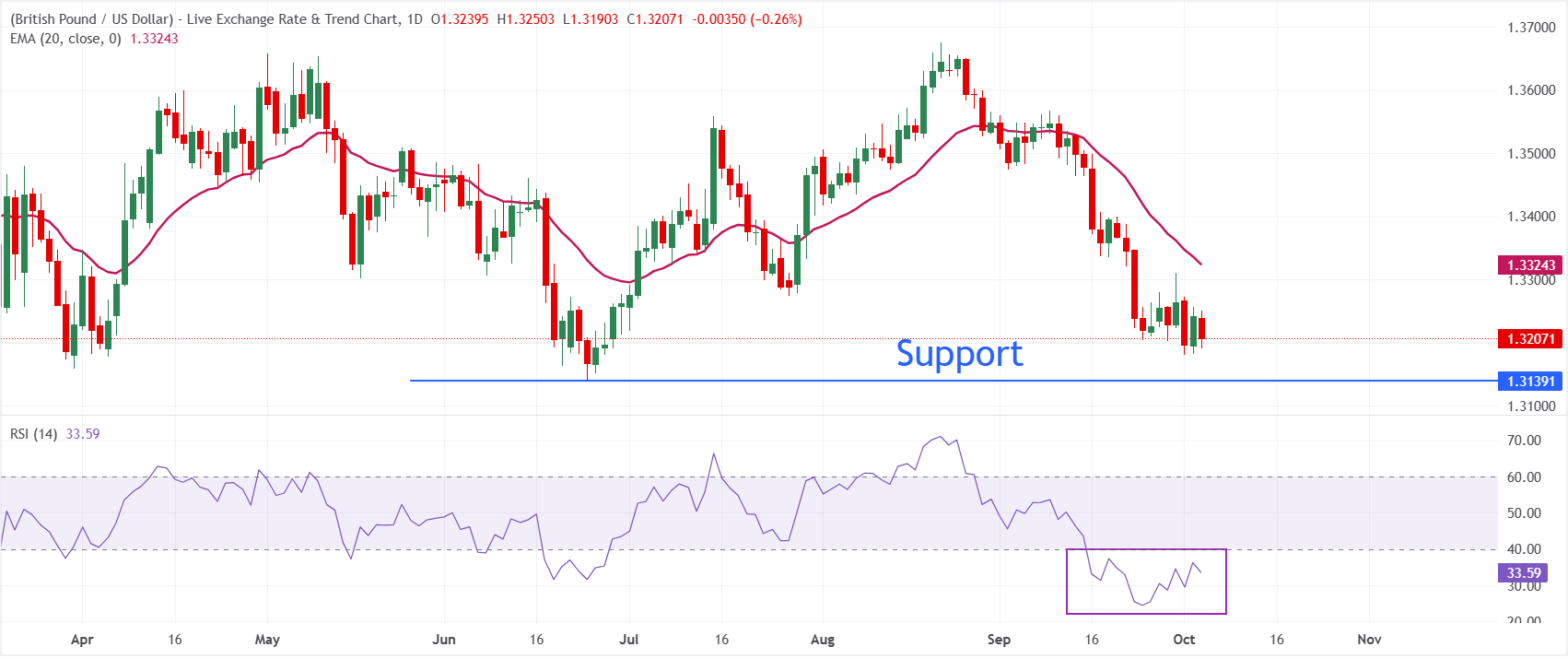
In the daily chart, GBP/USD trades at 1.3207, retaining a bearish near-term bias as spot holds beneath the 20-day exponential moving average (EMA) at 1.3324. Price action remains capped by this overhead EMA, suggesting sellers stay in control while buyers struggle to regain the broken trend reference.
The Relative Strength Index (14) at 33 is hovering just above oversold territory, hinting that while downside pressure persists, the sell-off is losing some momentum rather than accelerating.
On the topside, initial resistance is defined by the 20-day EMA at 1.3324, which acts as the first barrier that bulls would need to reclaim to ease immediate bearish pressure and open the way for a corrective bounce. Below the 20-day EMA, the 1.3300 round level would be a key hurdle.
Looking down, the Year-Till Date (YTD) low at 1.3140 is the key support zone, a decisive move below the same could expose the pair to 1.3100, followed by the psychological level of 1.3000.
(The technical analysis of this story was written with the help of an AI tool. Know more.)
Fed FAQs
Monetary policy in the US is shaped by the Federal Reserve (Fed). The Fed has two mandates: to achieve price stability and foster full employment. Its primary tool to achieve these goals is by adjusting interest rates. When prices are rising too quickly and inflation is above the Fed’s 2% target, it raises interest rates, increasing borrowing costs throughout the economy. This results in a stronger US Dollar (USD) as it makes the US a more attractive place for international investors to park their money. When inflation falls below 2% or the Unemployment Rate is too high, the Fed may lower interest rates to encourage borrowing, which weighs on the Greenback.
The Federal Reserve (Fed) holds eight policy meetings a year, where the Federal Open Market Committee (FOMC) assesses economic conditions and makes monetary policy decisions. The FOMC is attended by twelve Fed officials – the seven members of the Board of Governors, the president of the Federal Reserve Bank of New York, and four of the remaining eleven regional Reserve Bank presidents, who serve one-year terms on a rotating basis.
In extreme situations, the Federal Reserve may resort to a policy named Quantitative Easing (QE). QE is the process by which the Fed substantially increases the flow of credit in a stuck financial system. It is a non-standard policy measure used during crises or when inflation is extremely low. It was the Fed’s weapon of choice during the Great Financial Crisis in 2008. It involves the Fed printing more Dollars and using them to buy high grade bonds from financial institutions. QE usually weakens the US Dollar.
Quantitative tightening (QT) is the reverse process of QE, whereby the Federal Reserve stops buying bonds from financial institutions and does not reinvest the principal from the bonds it holds maturing, to purchase new bonds. It is usually positive for the value of the US Dollar.
Author

Sagar Dua
FXStreet
Sagar Dua is associated with the financial markets from his college days. Along with pursuing post-graduation in Commerce in 2014, he started his markets training with chart analysis.