GBP/USD Price Forecast: Risk-on sentiment lends support
- GBP/USD rises to near 1.3250 as the market sentiment turns favorable for riskier assets.
- A pause in rally in US bond yields lend support to the British Pound.
- The US Dollar retreats amid correction in US Treasury Yields.


The British Pound (GBP) is up 0.17% at around 1.3250 against the US Dollar (USD) during the European trading session on Friday. The GBP/USD pair gains as a pullback in United States (US) Treasury Yields after a juggernaut rally has lifted market sentiment.
At press time, S&P 500 futures are up 0.34% to near 7,8000, reflecting a risk-on market mood. 10-year US Treasury Yields are down 0.23% to near 5.22%. Yields on US-backed securities are down over 2.5% from its fresh-two-decade high of 5.36% posted this week.
Lower US bond yields have also weighed on the US Dollar. In the early European trade, the US Dollar Index (DXY), which gauges the Greenback’s value against six major currencies, trades 0.16% lower marginally below 102.00.
US Dollar Price Today
The table below shows the percentage change of US Dollar (USD) against listed major currencies today. US Dollar was the weakest against the Australian Dollar.
| USD | EUR | GBP | JPY | CAD | AUD | NZD | CHF | |
|---|---|---|---|---|---|---|---|---|
| USD | -0.18% | -0.10% | 0.16% | -0.09% | -0.38% | -0.36% | -0.18% | |
| EUR | 0.18% | 0.09% | 0.36% | 0.09% | -0.19% | -0.11% | -0.01% | |
| GBP | 0.10% | -0.09% | 0.29% | 0.04% | -0.27% | -0.18% | -0.03% | |
| JPY | -0.16% | -0.36% | -0.29% | -0.25% | -0.55% | -0.48% | -0.32% | |
| CAD | 0.09% | -0.09% | -0.04% | 0.25% | -0.32% | -0.24% | -0.07% | |
| AUD | 0.38% | 0.19% | 0.27% | 0.55% | 0.32% | 0.07% | 0.26% | |
| NZD | 0.36% | 0.11% | 0.18% | 0.48% | 0.24% | -0.07% | 0.17% | |
| CHF | 0.18% | 0.01% | 0.03% | 0.32% | 0.07% | -0.26% | -0.17% |
The heat map shows percentage changes of major currencies against each other. The base currency is picked from the left column, while the quote currency is picked from the top row. For example, if you pick the US Dollar from the left column and move along the horizontal line to the Japanese Yen, the percentage change displayed in the box will represent USD (base)/JPY (quote).
Meanwhile, investors shift their focus to the US Consumer Price Index (CPI) data for September, which will be released on Wednesday. The inflation data is expected to have a significant impact on Federal Reserve’s (Fed) interest rate expectations as several officials have signaled that high price pressures due to energy shocks and Artificial Intelligence (AI) build up is a key concern for them.
“Several officials warned that the AI buildout could eventually push aggregate demand ahead of supply, creating additional upward pressure on prices,” Federal Open Market Committee (FOMC) minutes of the September meeting showed on Wednesday.
GBP/USD Technical Analysis
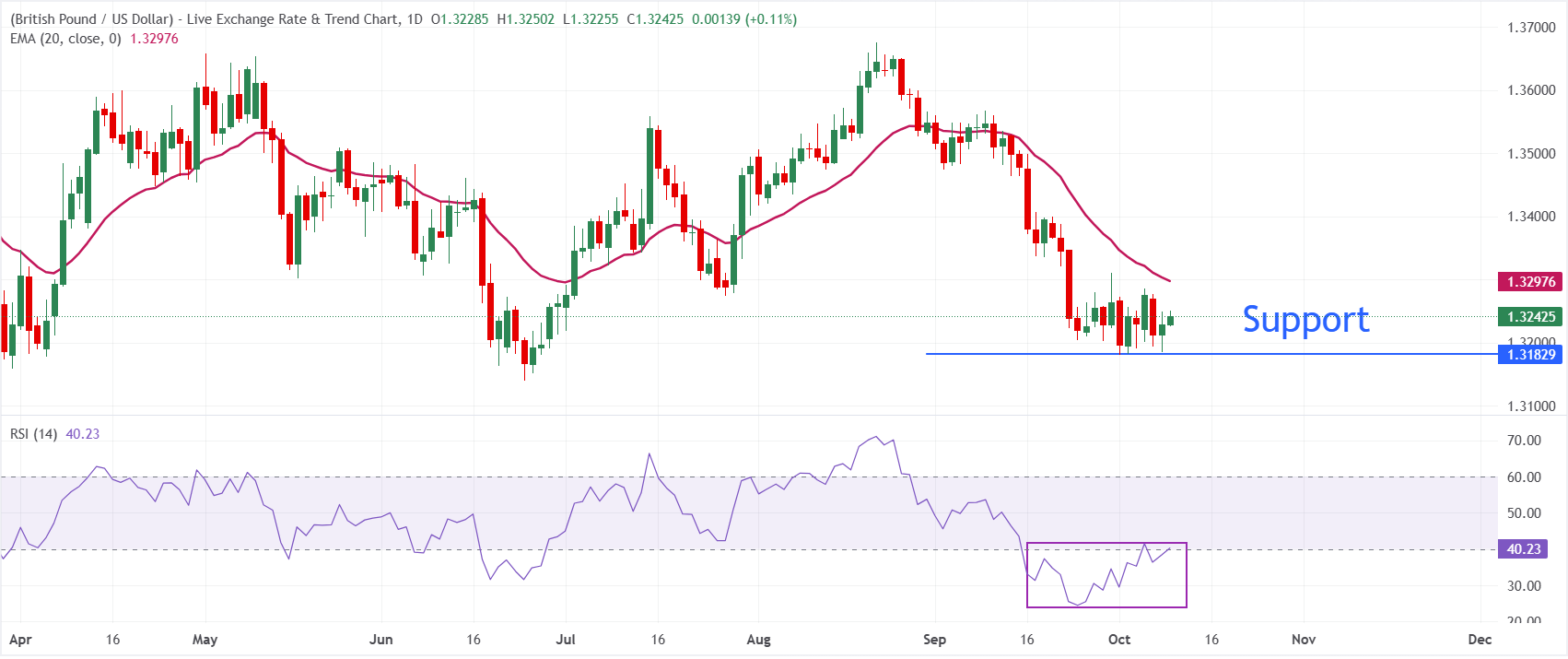
In the daily chart, GBP/USD trades at 1.3243, maintaining a bearish near-term bias as spot holds under the 20-day exponential moving average (EMA) at 1.3298. The positioning below this short-term EMA hints at a market still prone to selling into upticks, while the Relative Strength Index (RSI) around 40 suggests weak but not extreme downside momentum, consistent with a pressured, rather than oversold, tone.
On the topside, immediate resistance is defined by the 20-day EMA at 1.3298, which needs to be reclaimed to ease the current bearish pressure and open the way for a more sustained recovery. Looking down, the October low at 1.3181 is the key support zone.
(The technical analysis of this story was written with the help of an AI tool. Know more.)
Pound Sterling FAQs
The Pound Sterling (GBP) is the oldest currency in the world (886 AD) and the official currency of the United Kingdom. It is the fourth most traded unit for foreign exchange (FX) in the world, accounting for 12% of all transactions, averaging $630 billion a day, according to 2022 data. Its key trading pairs are GBP/USD, also known as ‘Cable’, which accounts for 11% of FX, GBP/JPY, or the ‘Dragon’ as it is known by traders (3%), and EUR/GBP (2%). The Pound Sterling is issued by the Bank of England (BoE).
The single most important factor influencing the value of the Pound Sterling is monetary policy decided by the Bank of England. The BoE bases its decisions on whether it has achieved its primary goal of “price stability” – a steady inflation rate of around 2%. Its primary tool for achieving this is the adjustment of interest rates. When inflation is too high, the BoE will try to rein it in by raising interest rates, making it more expensive for people and businesses to access credit. This is generally positive for GBP, as higher interest rates make the UK a more attractive place for global investors to park their money. When inflation falls too low it is a sign economic growth is slowing. In this scenario, the BoE will consider lowering interest rates to cheapen credit so businesses will borrow more to invest in growth-generating projects.
Data releases gauge the health of the economy and can impact the value of the Pound Sterling. Indicators such as GDP, Manufacturing and Services PMIs, and employment can all influence the direction of the GBP. A strong economy is good for Sterling. Not only does it attract more foreign investment but it may encourage the BoE to put up interest rates, which will directly strengthen GBP. Otherwise, if economic data is weak, the Pound Sterling is likely to fall.
Another significant data release for the Pound Sterling is the Trade Balance. This indicator measures the difference between what a country earns from its exports and what it spends on imports over a given period. If a country produces highly sought-after exports, its currency will benefit purely from the extra demand created from foreign buyers seeking to purchase these goods. Therefore, a positive net Trade Balance strengthens a currency and vice versa for a negative balance.
Author
Sagar Dua
FXStreet
Sagar Dua is associated with the financial markets from his college days. Along with pursuing post-graduation in Commerce in 2014, he started his markets training with chart analysis.

















