GBP/USD Price Forecast: Attracts slight bids below trendline near 1.3360
- GBP/USD rises to near 1.3372 as the British Pound gains after upbeat UK Retail Sales data.
- UK Retail Sales rose by 0.5% MoM in August.
- The BoE leaves interest rates unchanged at 3.75% with 6-3 vote split, as expected.

The British Pound (GBP) is up 0.1% at around 1.3372 against the US Dollar (USD) during the European trading session on Friday. The GBP/USD pair gains as the British currency rises, following the release of the surprisingly upbeat United Kingdom (UK) Retail Sales data for August.
The Office for National Statistics (ONS) has reported that Retail Sales grew by 0.5% Month-on-Month (MoM) after declining at a same pace. The data was expected to contract by 0.2%.
While the British currency has reacted positively to the Retail Sales data, it underperformed the entire data-packed and Bank of England (BoE) policy week.
What happened at the BoE policy meeting
The BoE opted to keep Bank Rate unchanged at 3.75% in a 6–3 vote, as expected, while acknowledging a more challenging inflation backdrop. The UK central bank said that it expects Consumer Price Index (CPI) to rise to around 3.75% in the last quarter this year and slightly above 4% in early 2027 in the wake of higher energy prices. The BoE sees little evidence of material second-round effects of inflation in wages and prices.
Meanwhile, the US Dollar trades firmly on hawkish repricing of Federal Reserve’s (Fed) interest rate expectations. In the European trade, the US Dollar Index (DXY), which gauges the Greenback’s value against six major currencies, posts a fresh six-week high at 100.38.
GBP/USD Technical Analysis
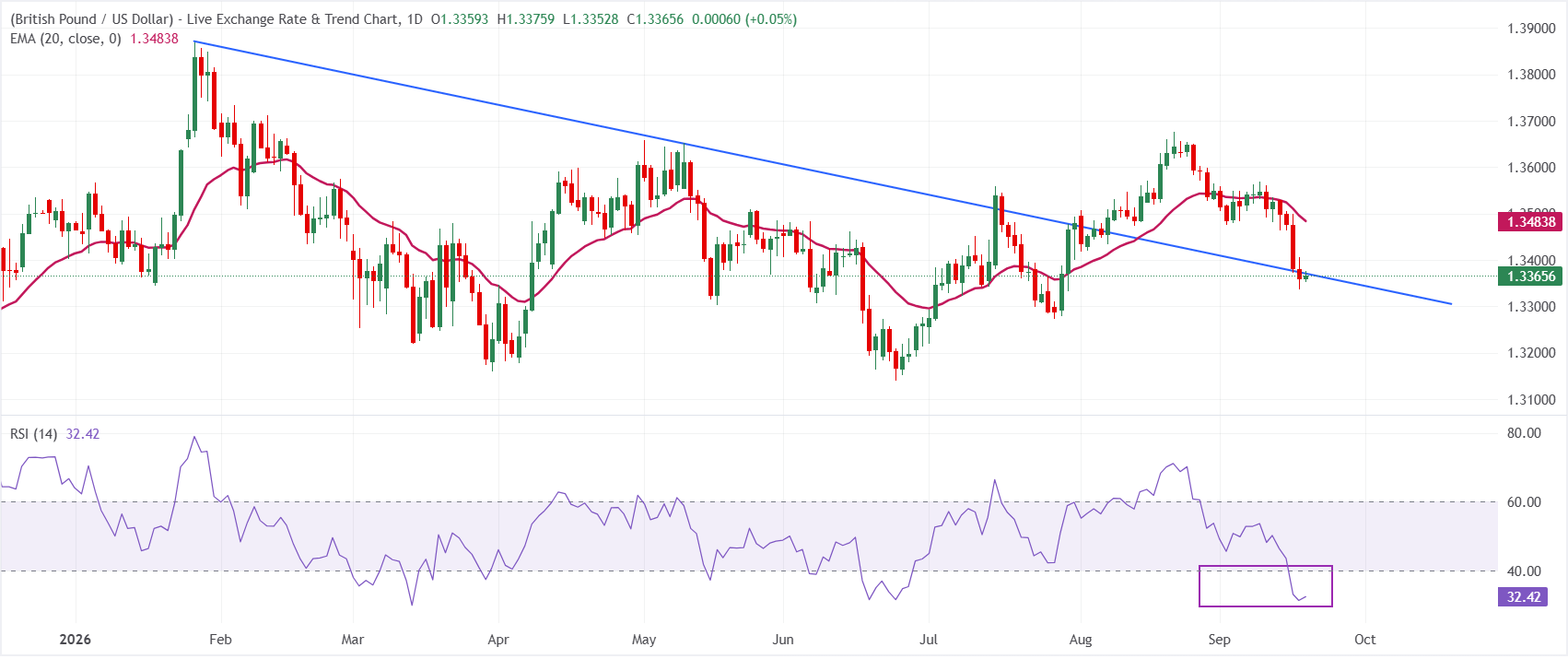
GBP/USD trades at 1.3366, keeping a bearish near-term tone as spot is well below the 20-period Exponential Moving Average (EMA) at 1.3484 and close to the downtrend resistance line coming in around 1.3372.
The location of price beneath these key overhead levels suggests rallies remain vulnerable, while the Relative Strength Index (14) at 32.4 hovers just above oversold territory, hinting that selling pressure is still dominant but nearing exhaustion rather than outright collapse.
On the topside, initial resistance is defined by the broken downtrend line at 1.3372, with a more significant cap at the 20-period EMA clustered near 1.3484, where fresh supply could emerge if the pair attempts a corrective bounce. Looking down, the pair could decline to near 1.3300 if it fails to hold the September 17 low at 1.3336.
(The technical analysis of this story was written with the help of an AI tool. Know more.)
Economic Indicator
Retail Sales (MoM)
The Retail Sales data, released by the Office for National Statistics on a monthly basis, measures the volume of sales of goods by retailers in Great Britain directly to end customers. Changes in Retail Sales are widely followed as an indicator of consumer spending. Percent changes reflect the rate of changes in such sales, with the MoM reading comparing sales volumes in the reference month with the previous month. Generally, a high reading is seen as bullish for the Pound Sterling (GBP), while a low reading is seen as bearish.
Read more.Last release: Fri Sep 18, 2026 06:00
Frequency: Monthly
Actual: 0.5%
Consensus: -0.2%
Previous: -0.5%
Source: Office for National Statistics
Author

Sagar Dua
FXStreet
Sagar Dua is associated with the financial markets from his college days. Along with pursuing post-graduation in Commerce in 2014, he started his markets training with chart analysis.

















