GBP/USD gathers momentum on mixed US labor market data, BoE last week hike
- The US economy added just 187K jobs, below estimates, but an increase in wages could reignite inflation fears.
- US Fed policymakers began to turn cautious as most officials eye the end of the tightening cycle.
- Upcoming US CPI is expected to edge to 3%, while Core CPI is estimated to decelerate to 4.7% YoY.
- BoE’s Pill: Inflation could fall below 5% by the end of 2023.

The Pound Sterling (GBP) registered modest gains on Monday, following a mixed US jobs report, while the Bank of England (BoE) decided to hike rates to a 15-year high. The GBP/USD is trading at 1.2769 after hitting a daily low of 1.2712.
Pound Sterling benefits from BoE's aggressive stance while the US Fed remains data-dependent after a mixed jobs report
Last week, the US Bureau of Labor Statistics (BLS) revealed the US economy added just 187K jobs to the economy missing estimates of 200K, portraying slight softness in the labor market, a sign sought by the US Federal Reserve (Fed) as it scrambles to get inflation towards its 2% target. Although the headline report was positive, salaries remain high, as Average Hourly Earnings (AHE) remained unchanged at 4.4% YoY, above estimates of 4.2%.
That could keep the Federal Reserve (Fed) eyeing additional rate hikes, but the release of inflation figures on August 10 could shed some light regarding the US prices’ status. The Consumer Price Index (CPI) is expected to slow to 3% YoY, while core CPI, which excludes food and energy, is estimated to slow down from 4.8% to 4.7% YoY.
In the meantime, Fed officials’ posture began to diverge. On the hawkish front, Fed Governor Michelle Bowman says the US central bank needs to lift rates to curb high inflation. Contrarily, New York Fed President John Williams stated that rate cuts could begin early in 2024, though he stated that monetary policy would be data-dependent.
Even though the US Dollar Index (DXY) is registering gains of 0.05% 102.063, the GBP/USD remains bolstered by the last week’s rate hike by the BoE to 5.25%.
Alight economic docket on the UK front left traders adrift to BoE’s Chief Economist Huw Pill’s words, saying that food price inflation must fall to around 10% to drive inflation towards the BoE’s 2% inflation target. He expects inflation to fall below 5% by the year’s end.
In remarks on Friday, Huw Pill said that successive interest-rate hikes are cooling the labor market and easing inflationary pressures. He further added that higher unemployment and lower vacancies would eventually lead to lower wage growth.
GBP/USD Price Analysis: Technical outlook
The GBP/USD daily chart remains neutral to upward biased, though Monday’s price action was capped by the last Friday’s high of 1.2792, slightly below the 20-day Exponential Moving Average (EMA) at 1.2814. Another key resistance area for the GBP/USD is a downslope resistance trendline at around 1.2870/80. Conversely, support is expected at the 50-day EMA at 1.2743 before falling to 1.2700.
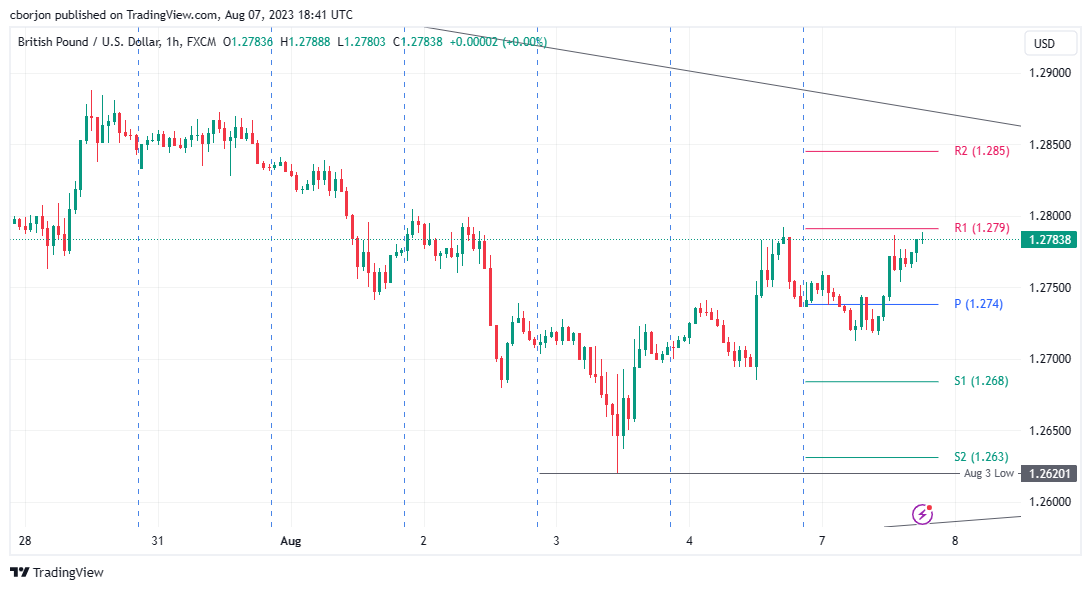
From an intraday perspective, the GBP/USD remains neutral biased, capped by the 1.2800 figure. A decisive break could open the door for further upside, with the R2 daily pivot emerging at 1.2845, followed by a resistance trendline around 1.2870/80. Conversely, the GBP/USD first support emerged at the daily pivot at 1.2738, followed by the day’s lows at 1.2712. Next, support is found at 1.2700.
Author

Christian Borjon Valencia
FXStreet
Markets analyst, news editor, and trading instructor with over 14 years of experience across FX, commodities, US equity indices, and global macro markets.

















