GBP/JPY slips as UK political risk pressures Pound, Yen weakness limits losses
- GBP/JPY trims intraday gains as the British Pound softens on UK political uncertainty.
- Markets await the BoE and BoJ monetary policy decisions due this week.
- Technicals remain bullish above key SMAs, though momentum shows signs of cooling.

GBP/JPY gives back part of its earlier gains on Monday as the British Pound (GBP) comes under pressure following reports that UK Prime Minister Keir Starmer will face a parliamentary vote on a possible probe into whether he misled lawmakers over the appointment of Peter Mandelson as ambassador to the United States.
However, the downside remains limited as the Japanese Yen (JPY) continues to underperform most of its major peers, with elevated Oil prices weighing on the currency given Japan’s heavy reliance on imported energy.
At the time of writing, GBP/JPY is trading around 215.67, easing slightly after hitting 216.06, its highest level since January 2008, while the wide interest rate differential between the Bank of England (BoE) and the Bank of Japan (BoJ) keeps the broader bias tilted to the upside.
Attention now turns to upcoming monetary policy meetings due this week, with both the BoE and the BoJ widely expected to hold rates steady as policymakers assess the impact of rising Oil prices on inflation and economic growth.
The BoJ’s slow pace of policy normalization is likely to keep the Yen on the defensive, although lingering intervention risks could limit further weakness amid repeated warnings from Japanese officials, with USD/JPY hovering close to the 160 mark.
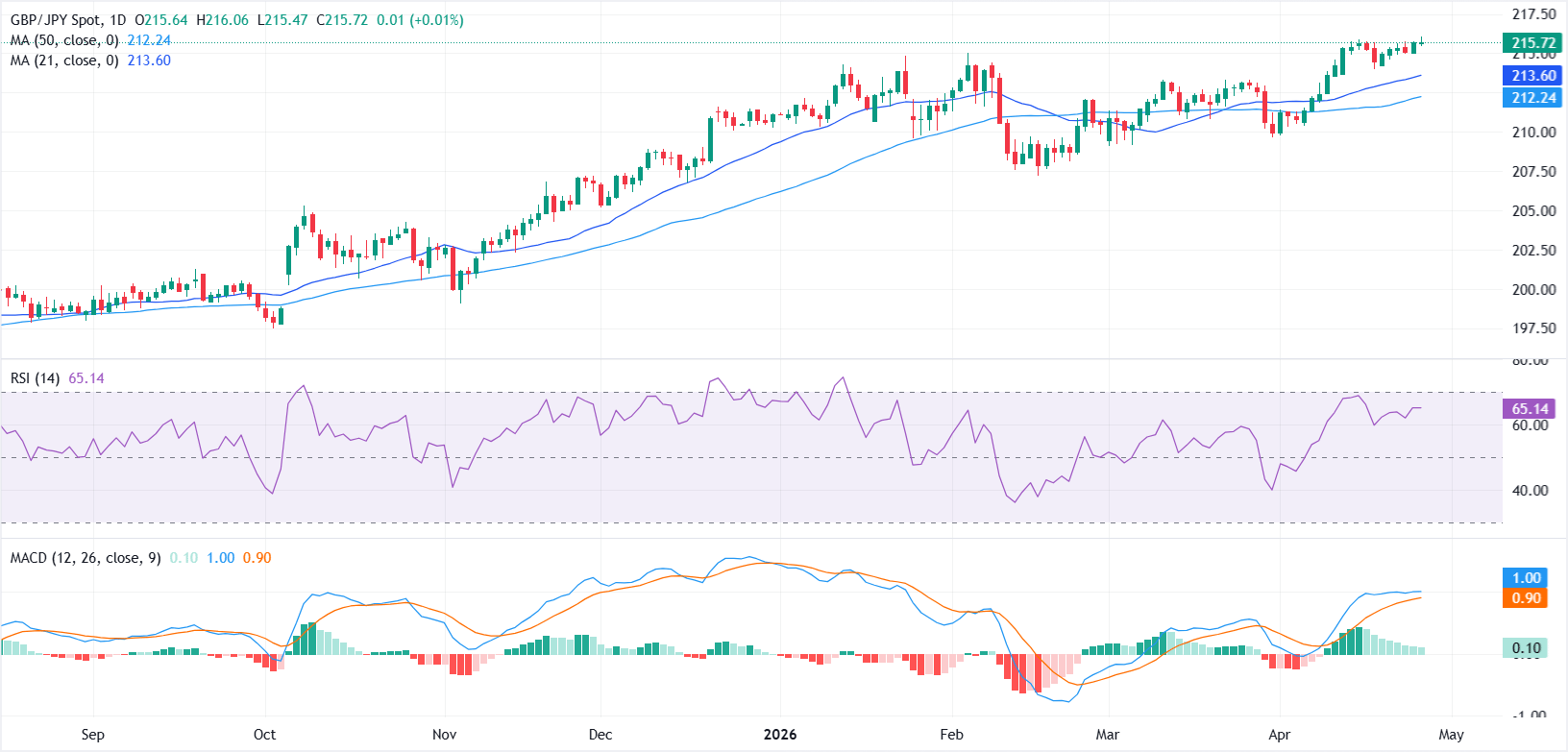
In the daily chart, GBP/JPY keeps a bullish near-term bias as it holds well above both the 21-day simple moving average (SMA) at 213.60 and the 50-day SMA at 212.24. The positive but moderating Relative Strength Index (RSI) around 65 and a still-positive Moving Average Convergence Divergence (MACD) histogram hint that upside momentum persists, though the pace of the advance is losing some steam as the cross consolidates near recent highs.
On the downside, initial support is seen at the 21-day SMA at 213.60, with a deeper pullback likely finding additional demand near the 50-day SMA at 212.24. As long as GBP/JPY holds above these moving averages, the broader bullish structure remains intact, and any dips toward this support band may be treated as corrective rather than signaling a sustained reversal.
(The technical analysis of this story was written with the help of an AI tool.)
Japanese Yen Price Today
The table below shows the percentage change of Japanese Yen (JPY) against listed major currencies today. Japanese Yen was the strongest against the Swiss Franc.
| USD | EUR | GBP | JPY | CAD | AUD | NZD | CHF | |
|---|---|---|---|---|---|---|---|---|
| USD | -0.14% | -0.08% | -0.06% | -0.43% | -0.49% | -0.51% | -0.03% | |
| EUR | 0.14% | 0.08% | 0.09% | -0.28% | -0.32% | -0.35% | 0.13% | |
| GBP | 0.08% | -0.08% | 0.00% | -0.38% | -0.43% | -0.45% | 0.05% | |
| JPY | 0.06% | -0.09% | 0.00% | -0.35% | -0.42% | -0.46% | 0.09% | |
| CAD | 0.43% | 0.28% | 0.38% | 0.35% | -0.06% | -0.10% | 0.41% | |
| AUD | 0.49% | 0.32% | 0.43% | 0.42% | 0.06% | -0.01% | 0.47% | |
| NZD | 0.51% | 0.35% | 0.45% | 0.46% | 0.10% | 0.01% | 0.49% | |
| CHF | 0.03% | -0.13% | -0.05% | -0.09% | -0.41% | -0.47% | -0.49% |
The heat map shows percentage changes of major currencies against each other. The base currency is picked from the left column, while the quote currency is picked from the top row. For example, if you pick the Japanese Yen from the left column and move along the horizontal line to the US Dollar, the percentage change displayed in the box will represent JPY (base)/USD (quote).
Author

Vishal Chaturvedi
FXStreet
I am a macro-focused research analyst with over four years of experience covering forex and commodities market. I enjoy breaking down complex economic trends and turning them into clear, actionable insights that help traders stay ahead of the curve.