Eurozone flash HICP cools faster-than-expected to 2.8% in June: What it means for EUR/USD?

Eurozone’s preliminary Harmonized Index of Consumer Prices (HICP) data for June arrives at 2.8% Year-on-Year (YoY), lower than estimates of 3% and the previous reading of 3.2%. On a monthly basis, the inflation data declined by 0.1% after rising at a similar pace in May.
The core HICP – which excludes volatile components like food, energy, alcohol, and tobacco – arrives at 2.4% YoY, lower than estimates and the prior release of 2.6%. Month-on-month core HICP rises at a moderate pace of 0.2% against 0.3% in May.
Slower-than-projected Eurozone HICP growth has put marginal pressure on the Euro (EUR). As of writing, EUR/USD trades 0.22% lower to near 1.1395.
Euro Price Today
The table below shows the percentage change of Euro (EUR) against listed major currencies today. Euro was the weakest against the US Dollar.
| USD | EUR | GBP | JPY | CAD | AUD | NZD | CHF | |
|---|---|---|---|---|---|---|---|---|
| USD | 0.24% | 0.12% | 0.08% | 0.18% | 0.39% | 0.04% | 0.17% | |
| EUR | -0.24% | -0.13% | -0.17% | -0.05% | 0.16% | -0.22% | -0.07% | |
| GBP | -0.12% | 0.13% | -0.04% | 0.07% | 0.26% | -0.10% | 0.07% | |
| JPY | -0.08% | 0.17% | 0.04% | 0.09% | 0.31% | -0.07% | 0.09% | |
| CAD | -0.18% | 0.05% | -0.07% | -0.09% | 0.21% | -0.18% | -0.01% | |
| AUD | -0.39% | -0.16% | -0.26% | -0.31% | -0.21% | -0.38% | -0.21% | |
| NZD | -0.04% | 0.22% | 0.10% | 0.07% | 0.18% | 0.38% | 0.17% | |
| CHF | -0.17% | 0.07% | -0.07% | -0.09% | 0.00% | 0.21% | -0.17% |
The heat map shows percentage changes of major currencies against each other. The base currency is picked from the left column, while the quote currency is picked from the top row. For example, if you pick the Euro from the left column and move along the horizontal line to the US Dollar, the percentage change displayed in the box will represent EUR (base)/USD (quote).
What do softer-than-expected Eurozone HICP data for June mean for EUR/USD?
Lower-than-projected growth in the Eurozone inflation data for June will likely discourage European Central Bank (ECB) policymakers from supporting more interest rate hikes in the near term, a scenario that could diminish the appeal of the Euro. In the June policy meeting, the ECB hiked its key policy rates by 25 basis points (bps), and various officials after the meeting have stated that price pressures could remain above the central bank’s 2% target in some quarters.
Earlier in the day, ECB Governing Council Member and President of the Deutsche Bundesbank, Joachim Nagel, said, “Inflation will stay above target in 2027.” Nagel added, “I will keep options open for July and September decisions.”
Technical Analysis: EUR/USD sees more downside below 1.1325
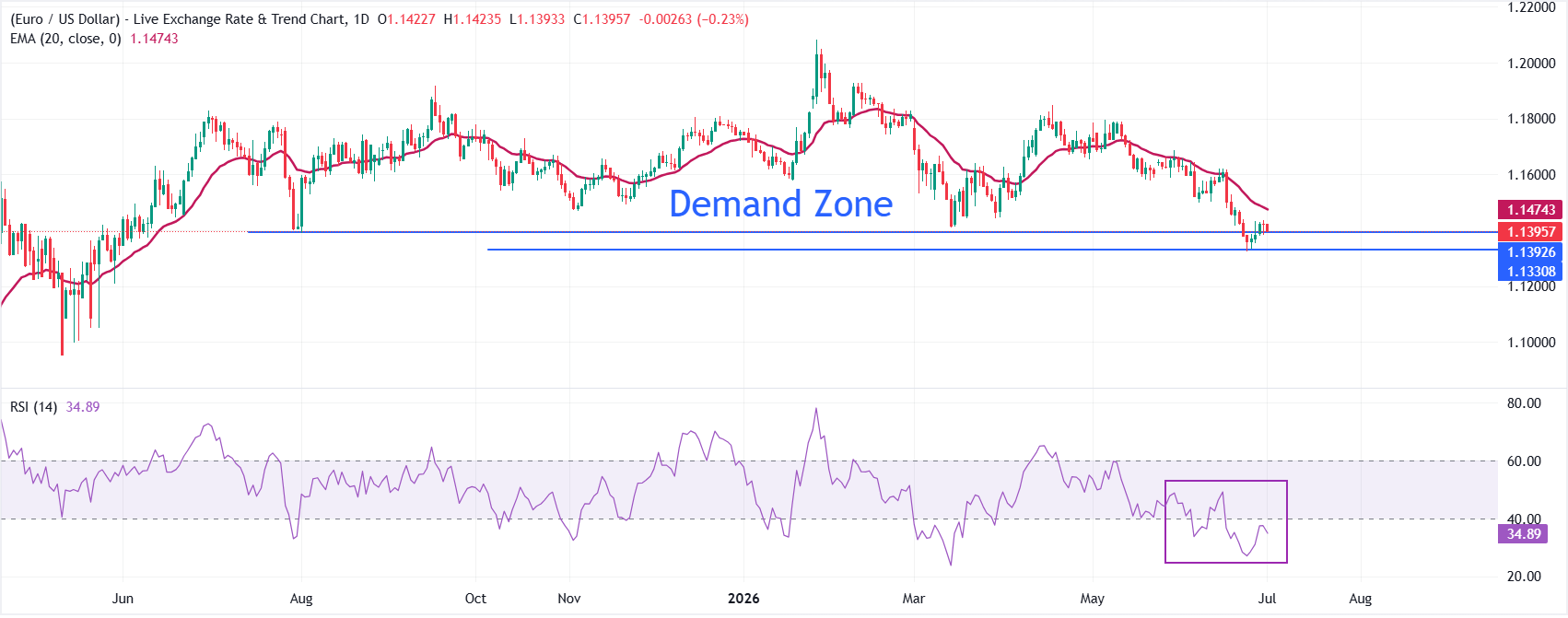
EUR/USD trades 0.23% lower at around 1.1395, keeping a bearish near-term bias as spot holds below the 20-period Exponential Moving Average (EMA) at 1.1474. The pair’s inability to reclaim this short-term EMA suggests rallies remain capped for now, while the Relative Strength Index (RSI) near 35 points to weak but not yet oversold downside momentum, hinting that sellers retain control despite a risk of intermittent corrective bounces.
On the topside, immediate resistance is located at the 20-period EMA around 1.1474, and a daily close above this barrier would be needed to ease the current bearish pressure and open the way for a more sustained recovery. Looking down, the pair could slide towards the May 29 low at 1.1210 if the pair resumes its decline and slips below the June 24 low at 1.1325.
(The technical analysis of this story was written with the help of an AI tool.)
Economic Indicator
Harmonized Index of Consumer Prices (YoY)
The Harmonized Index of Consumer Prices (HICP) measures changes in the prices of a representative basket of goods and services in the European Monetary Union. The HICP, released by Eurostat on a monthly basis, is harmonized because the same methodology is used across all member states and their contribution is weighted. The YoY reading compares prices in the reference month to a year earlier. Generally, a high reading is seen as bullish for the Euro (EUR), while a low reading is seen as bearish.
Read more.Last release: Wed Jul 01, 2026 09:00 (Prel)
Frequency: Monthly
Actual: 2.8%
Consensus: 3%
Previous: 3.2%
Source: Eurostat
Author

Sagar Dua
FXStreet
Sagar Dua is associated with the financial markets from his college days. Along with pursuing post-graduation in Commerce in 2014, he started his markets training with chart analysis.