European equities climb on Wednesday on EU PMI manufacturing beat, tech stock rally
- Euro area indexes broadly higher in the mid-week.
- German DAX pings €16,900 level in tech rally.
- European manufacturing sees signs of life, but still in contraction territory.

European equity indexes broadly climbed on Wednesday after a surprise upside in the Manufacturing component of the pan-European and German Purchasing Managers’ Indexes (PMI), with stocks getting a further boost from a global rally in tech-based stocks.
A slate of better-than-expected earnings concentrated in the tech sector helped to lift European equities on Wednesday, with markets rallying across the board after Manufacturing PMIs for both the euro area and Germany beat expectations, with investors shrugging off a broad-base miss in the Services PMI component.
Eurozone HCOB Composite PMI improves to 47.9 in January vs. 48 expected
The pan-European HCOB Manufacturing PMI for January came in at 46.6, still in contraction territory but above the forecast increase from 44.4 to 44.8, and Germany’s Manufacturing PMI fared equally well, driving to an eleven-month high of 45.4 versus the forecast uptick from 43.3 to 43.7.
The European Services PMI backslid to 48.4 from 48.8, missing the forecast increase to 49.0, but the slight shift in the services sector was brushed off by EU investors piling back into stock bids after weeks of waffling index prices.
Thursday brings another rate call and monetary policy statement from the European Central Bank (ECB), and European markets will have to grapple with how dovish or hawkish ECB President Christine Lagarde strikes at the ECB’s first scheduled meeting after ECB policymakers hammered down on market rate cut hopes last week. ECB President Lagarde and several central policy planners have made several speaking appearances in recent weeks to try to quell market hopes of fast and furious rate cuts, and the ECB has loudly telegraphed their current stance that there will be no moves on rates until the summer months at the earliest.
ECB Preview: Forecasts from 12 major banks
Germany’s DAX equity index climbed 1.58% on Wednesday to close 262.83 points higher at €16,889.92, hitting an intraday peak above the €16,900.00 handle, the index’s highest prices since a sharp rally at the start of 2024.
The pan-European STOXX600 major index climbed 1.18%, gaining 5.56 points and ending the day at €477.09, and the French CAC40 rose 0.91% to end Wednesday trading at €7,455.64, a 67.6 point gain.
London’s FTSE 100 also gains over half a percent on Wednesday, adding a modest 41.94 points to close at £7,527.67.
DAX Technical Outlook
The DAX index’s rise on Wednesday dragged the major equity board into the €16,900 handle for the first time since the DAX’s early 2024 spike. A near-term pullback will see the index support from a bullish crossover of the 50-hour and 200-hour Simple Moving Averages (SMA).
The DAX has risen 3.3% from 2024’s low bids of €16,322.87 set last week, and is riding technical support from the 50-day SMA near €16,400.00.
DAX Hourly Chart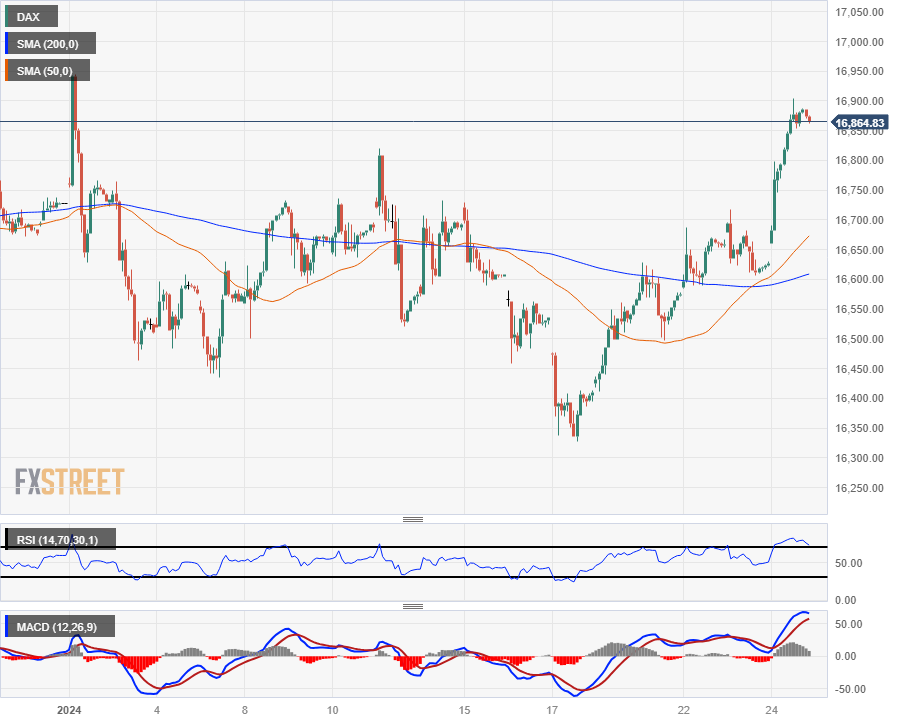
DAX Daily Chart
Author

Joshua Gibson
FXStreet
Joshua joins the FXStreet team as an Economics and Finance double major from Vancouver Island University with twelve years' experience as an independent trader focusing on technical analysis.

















