Euro trades close to 19-month low below 1.1000 against US Dollar, US data in focus
- Euro slumps to a fresh 19-month low at around 1.0985 against the US Dollar as the latter trades broadly firm.
- The AI unwinding trade has improved the US Dollar’s safe-haven demand.
- Investors await German ZEW Survey – Economic Sentiment data, and the US Retail Sales and FOMC Minutes data.


The Euro (EUR) hits a fresh 19-month low at around 1.0985 against the US Dollar (USD) during the European trading session on Tuesday. The major currency pair has been consistently under pressure as the US Dollar outperforms amid a significant improvement in its safe-haven demand.
As of writing, the US Dollar Index (DXY), which gauges the Greenback’s value against six major currencies, trades close to its fresh 19-month high of 103.70 posted during the day.
What has strengthened US Dollar?
Analysts at ING highlight that the recent “drop in US tech stocks has done little to dent the Dollar’s strong momentum.” They argue this is largely because “the sell-off has spilled over sufficiently into broader US and global equities for the Dollar to benefit from its safe-haven role.
Looking ahead, ING cautions that “we still think further weakness in tech/AI stocks should make additional greenback appreciation less sustainable as it drives more dovish Fed repricing,” suggesting the Dollar’s current strength may be harder to extend if the AI complex comes under renewed pressure.
Going forward, investors will pay attention to the United States (US) Retail Sales data for October at 13:30 GMT and Federal Open Market Committee (FOMC) minutes of the October policy meeting, which will be released on Friday.
ING points out that “October US retail sales are due today. Expectations are for a slowdown from September, but still slightly positive MoM growth: 0.1% in the headline and 0.3% ex auto and gas. October industrial production is also expected at 0.1% MoM.” However, the bank downplays their market impact, noting that “these aren't tier-one releases, and equity market dynamics still have a greater chance of driving FX moves today.”
On the Euro front, investors await key German ZEW Survey – Economic Sentiment data for November, which will be published at 10:00 GMT. German ZEW Survey – Economic Sentiment is expected to have improved to 29.0 from 28.1 in October.
EUR/USD Technical Analysis
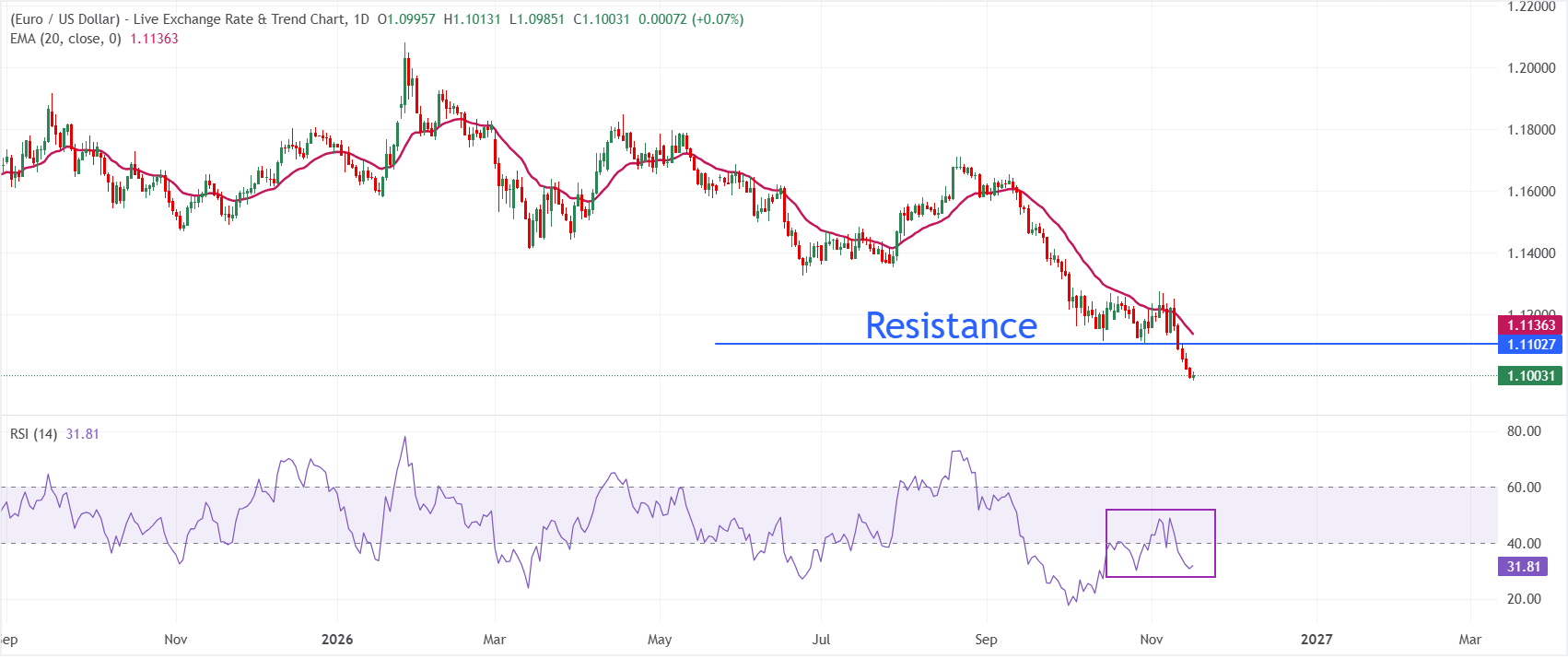
In the daily chart, EUR/USD trades at 1.1003, keeping a bearish near-term tone as spot remains below the 20-day exponential moving average (EMA) at 1.1136. The pair is entrenched under this dynamic barrier, suggesting rallies are likely to be capped while downside pressure persists. The Relative Strength Index (RSI) at 31.8 hovers just above oversold territory, hinting at stretched conditions but not yet signaling a robust recovery.
On the topside, immediate resistance is located at the 20-day EMA at 1.1136, which acts as the first hurdle for any corrective bounce. A daily close above this level would ease the current bearish bias and open the door for a broader recovery phase, while failure to reclaim it keeps risks skewed toward further losses, even in the absence of clearly defined nearby support levels.
(The technical analysis of this story was written with the help of an AI tool. Know more.)
Economic Indicator
ZEW Survey – Economic Sentiment
The Economic Sentiment published by the Zentrum für Europäische Wirtschaftsforschung measures the institutional investor sentiment, reflecting the difference between the share of investors that are optimistic and the share of analysts that are pessimistic. Generally speaking, an optimistic view is considered as positive (or bullish) for the EUR, whereas a pessimistic view is considered as negative (or bearish).
Read more.Next release: Tue Nov 17, 2026 10:00
Frequency: Monthly
Consensus: 29
Previous: 28.1
Author
Sagar Dua
FXStreet
Sagar Dua is associated with the financial markets from his college days. Along with pursuing post-graduation in Commerce in 2014, he started his markets training with chart analysis.

















