Euro hovers within previous ranges, amid higher Oil prices, fading Fed easing hopes
- EUR/USD picks up to the 1.1775 area but remains within previous ranges below 1.1800.
- The Euro faltered at Monday's opening after Trump dismissed Iran's peace plan.
- The recent jump in Oil prices is likely to keep Euro bulls in check.

The Euro (EUR) is trading moderately higher against the Dollar (USD), yet moving within previous ranges on Monday. The pair has returned to the upper side of the 1.1700s range, and is trading at 1.1775 at the time of writing after a negative opening, following US President Donald Trump’s rejection of Iran’s peace plan.
Trump posted on social media that Tehran’s latest peace proposal was “totally unacceptable”, crushing market hopes of a swift end to the war in the Middle East and the reopening of the Strait of Hormuz. Oil prices jumped after the news, with the barrel of Brent returning above $100, which puts the Eurozone’s Crude-importing economies under pressure and undermines the Euro’s upside attempts.
On the macroeconomic front, US Nonfarm Payrolls beat expectations on Friday, showing a 115K increase, almost twice the 62K expected. These figures strengthen the case for Federal Reserve (Fed) hawks and ease pressure on the bank to cut interest rates, which provides support to the Greenback.
The economic calendar is thin in the US and Europe on Monday. Later this week, US Consumer Prices Index (CPI) data, due on Tuesday, and US Retail Sales on Thursday, together with Fed speakers throughout the week, will provide the fundamental guidance for the USD. In Europe, Germany’s final consumer inflation data on Tuesday, but above all, Wednesday’s Eurozone Gross Domestic Product (GDP) and European Central Bank (ECB) President Lagarde’s speech, will be the highlights of the week.
Technical Analysis: Bulls to be tested at 1.1800
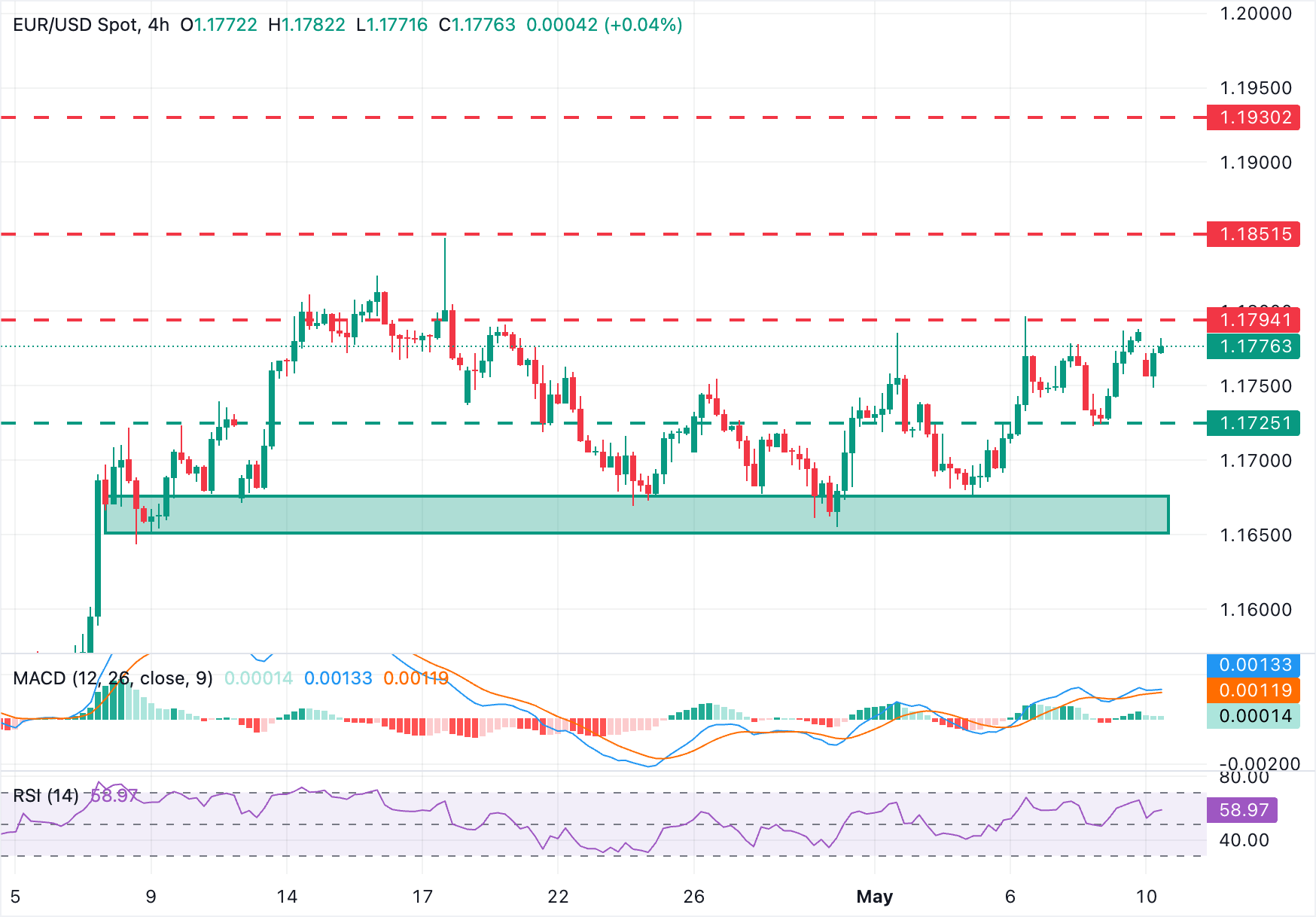
EUR/USD shows a modest bullish bias with momentum readings backing this constructive tone. The 4-hour Relative Strength Index is near 60, and the Moving Average Convergence Divergence (MACD) remains in positive territory, hinting that buyers retain control.
Bulls, however, are likely to meet significant resistance in the area between 1.1790 and 1.1800 (around April 20, May 6, 8 highs), which, so far, is closing the path to April's high, in the 1.1850 area. Further up, February's top, at the 1.1930 area, would come into focus.
On the downside, session lows at the 1.1750 area and Friday's lows, near 1.1725, are likely to provide some support to a potential bearish reversal, although the key support is at the area between 1.1645 and 1.1675, which contained downside attempts in April.
(The technical analysis of this story was written with the help of an AI tool.)
US Dollar FAQs
The US Dollar (USD) is the official currency of the United States of America, and the ‘de facto’ currency of a significant number of other countries where it is found in circulation alongside local notes. It is the most heavily traded currency in the world, accounting for over 88% of all global foreign exchange turnover, or an average of $6.6 trillion in transactions per day, according to data from 2022. Following the second world war, the USD took over from the British Pound as the world’s reserve currency. For most of its history, the US Dollar was backed by Gold, until the Bretton Woods Agreement in 1971 when the Gold Standard went away.
The most important single factor impacting on the value of the US Dollar is monetary policy, which is shaped by the Federal Reserve (Fed). The Fed has two mandates: to achieve price stability (control inflation) and foster full employment. Its primary tool to achieve these two goals is by adjusting interest rates. When prices are rising too quickly and inflation is above the Fed’s 2% target, the Fed will raise rates, which helps the USD value. When inflation falls below 2% or the Unemployment Rate is too high, the Fed may lower interest rates, which weighs on the Greenback.
In extreme situations, the Federal Reserve can also print more Dollars and enact quantitative easing (QE). QE is the process by which the Fed substantially increases the flow of credit in a stuck financial system. It is a non-standard policy measure used when credit has dried up because banks will not lend to each other (out of the fear of counterparty default). It is a last resort when simply lowering interest rates is unlikely to achieve the necessary result. It was the Fed’s weapon of choice to combat the credit crunch that occurred during the Great Financial Crisis in 2008. It involves the Fed printing more Dollars and using them to buy US government bonds predominantly from financial institutions. QE usually leads to a weaker US Dollar.
Quantitative tightening (QT) is the reverse process whereby the Federal Reserve stops buying bonds from financial institutions and does not reinvest the principal from the bonds it holds maturing in new purchases. It is usually positive for the US Dollar.
Author

Guillermo Alcala
FXStreet
Graduated in Communication Sciences at the Universidad del Pais Vasco and Universiteit van Amsterdam, Guillermo has been working as financial news editor and copywriter in diverse Forex-related firms, like FXStreet and Kantox.
















