Euro treads water near two-month lows ahead of the ECB decision
- EUR/USD holds losses below 1.1550, just above two-month lows in the 1.1500 area.
- The ECB is widely expected to hike interest rates, but a dovish statement might hurt the Euro
- Growing tensions in the Middle East and hot US inflation data are supporting the US Dollar.

The Euro (EUR) has given away previous gains against the US Dollar (USD) on Thursday and is trading at 1.1535 at the time of writing, practically unchanged in daily charts with the two-month lows, near 1.1500, at hand. Fresh US strikes on Iran have crushed risk appetite, while market expectations that the European Central Bank (ECB) will hike rates later on the day keep the Euro afloat.
The ECB concludes its two-day monetary policy meeting later in the day, and a 25-basis-point rate hike is practically written in stone. Investors, thus, will be more attentive to President Christine Lagarde's press release, looking for hints about the bank's forward guidance. In that sense, a lack of commitment to further monetary tightening might be seen as a dovish message and trigger further Euro weakness.
Market sentiment, meanwhile, remains somber, following a new exchange of attacks between the US and Iran, and US President Donald Trump's threat of further strikes if Tehran fails to sign a deal. CNN News, citing diplomatic sources, reported that peace negotiations remain on track, although the traders need more certainty to shrug off the risk-off mood.
In the US, on Wednesday, Consumer Price Index (CPI) figures confirmed that inflation accelerated to a 4.2% year-over-year pace in May. This is the highest level in more than three years and more than twice the Federal Reserve’s (Fed) 2% target, which boosts expectations of Fed rate hikes later this year and provides additional support to the USD.
Technical Analysis: Euro remains vulnerable near 1.1500
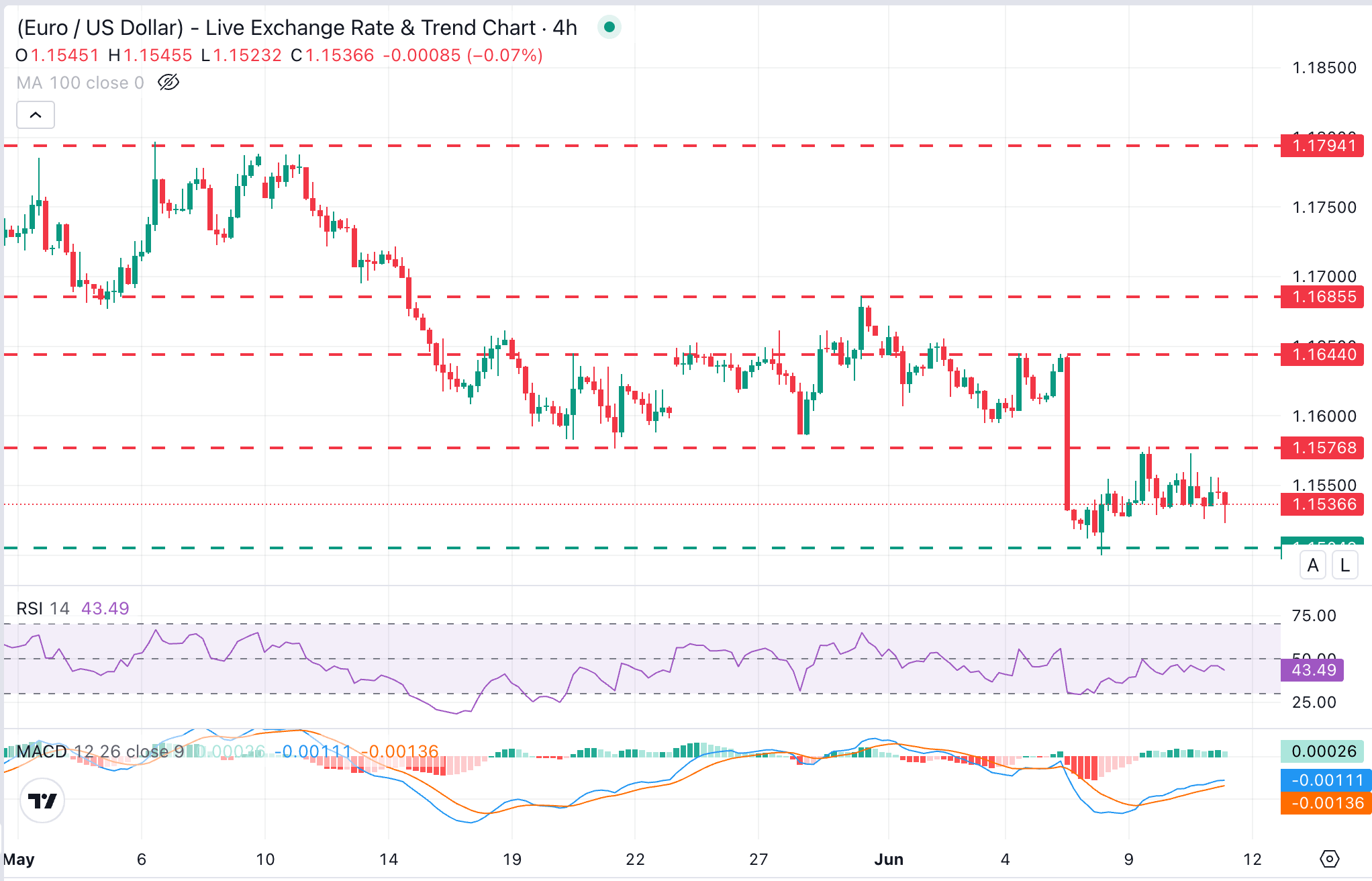
EUR/USD is wavering without a clear bias within a broader bearish trend and following a modest recovery from recent lows. Indicators on intraday charts are mixed. The 4-hour Relative Strength Index (RSI) shows subdued bullish pressure at levels below 50, while the slightly positive Moving Average Convergence Divergence (MACD) hints at a tentative attempt to stabilize rather than a decisive bullish reversal.
Resistance at the 1.1580 previous support area (May 21 low) is capping upside attempts and closing the path towards the June 4 and 5 highs, around 1.1645, and the late-May highs, at 1.1685.
On the downside, a confirmation below Monday's low, at the 1.1500 area, would give fresh hope for bears and expose the March 30 low, at 1.1443. Further down, the year-to-date low, at 1.1411 (March 13 low), will come into focus.
(The technical analysis of this story was written with the help of an AI tool.)
Economic Indicator
ECB Rate On Deposit Facility
One of the European Central Bank's three key interest rates, the rate on the deposit facility, is the rate at which banks earn interest when they deposit funds with the ECB. It is announced by the European Central Bank at each of its eight scheduled annual meetings.
Read more.Next release: Thu Jun 11, 2026 12:15
Frequency: Irregular
Consensus: 2.25%
Previous: 2%
Source: European Central Bank
Economic Indicator
ECB Press Conference
Following the European Central Bank’s (ECB) economic policy decision, the ECB President gives a press conference regarding monetary policy. The president’s comments may influence the volatility of the Euro (EUR) and determine a short-term positive or negative trend. If the president adopts a hawkish tone it is considered bullish for the EUR, whereas if the tone is dovish the result is usually bearish for the Euro.
Read more.Next release: Thu Jun 11, 2026 12:45
Frequency: Irregular
Consensus: -
Previous: -
Source: European Central Bank
Author

Guillermo Alcala
FXStreet
Graduated in Communication Sciences at the Universidad del Pais Vasco and Universiteit van Amsterdam, Guillermo has been working as financial news editor and copywriter in diverse Forex-related firms, like FXStreet and Kantox.

















