Euro comes under pressure and challenges 1.0800 on data, USD buying
- Euro trades well on the back foot against the US Dollar.
- European stocks now trade in a mixed fashion.
- EUR/USD trades at shouting distance from the 1.0800 zone.
- The USD Index (DXY) advances to new two-month highs near 104.00.
- Flash PMIs in the euro area came in mixed for August.
- Housing data, advanced PMIs are due next across the pond.

There is no respite for the selling pressure around the Euro (EUR) against the US Dollar (USD) on Wednesday, forcing EUR/USD to trade in new multi-week lows and confront the key support at 1.0800.
Further gains in the Greenback encourage the USD Index (DXY) to flirt with the important barrier at 104.00 in a context of further correction in US yields across different maturities following recent peaks.
In terms of monetary policy, there has been renewed discussion regarding the Federal Reserve's commitment to maintaining a more restrictive stance for an extended period of time. This renewed focus is a result of the US economy's resilience, even amidst a slight easing in the labour market and lower inflation readings in recent months.
At the European Central Bank (ECB), internal disagreements among its Council members have surfaced regarding the continuation of tightening measures beyond the summer period. These disagreements are contributing to a renewed sense of weakness that is having a negative impact on the Euro.
Looking ahead, market participants are expected tobe cautious ahead of the upcoming Jackson Hole Symposium and Chairman Jerome Powell's speech in the latter part of the week.
In the European docket, August flash PMIs in Germany and the broader eurozone showed a small improvement in the manufacturing sector but renewed weakness among services providers.
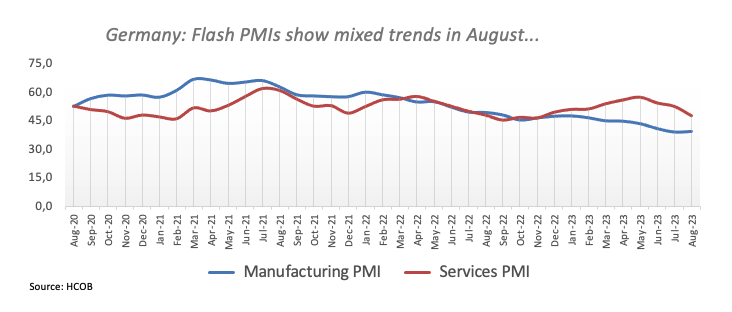
On this, money market futures indicate a probability of only 40% for a 25 bps increase in interest rates by the ECB in the upcoming month. This is in contrast to the situation before the data release, when the probability was approximately 60%.
In the US, advanced PMIs are also due, along with the usual weekly Mortgage Applications data tracked by MBA and New Home Sales.
Daily digest market movers: Euro seems poised to extend the pullback
- The EUR weakens further against USD and trades closer to 1.0800.
- The risk-off trade and poor euro data, prop up the upside bias in the US Dollar.
- US yields seem to have entered an impasse following recent peaks.
- Investors’ focus remains on the Jackson Hole event due later in the week.
- Fed’s tighter-for-longer narrative dominates the mood among traders.
- The Fed is likely to maintain rates unchanged until Q1 2024.
Technical Analysis: Euro risks a breakdown of 1.0800
EUR/USD’s decline gathers extra impulse and gradually approaches the key support at 1.0800, which appears also underpinned by the proximity of the crucial 200-day SMA at 1.0797.
Further retracements could force EUR/USD to revisit the significant 200-day SMA at 1.0797 ahead of the May 31 low of 1.0635. Deeper down, there are additional support levels at the March 15 low of 1.0516 and the 2023 low at 1.0481 seen on January 6.
In case bulls regain the initiative, the pair is expected to meet an interim barrier at the 55-day SMA at 1.0961 prior to the psychological 1.1000 the figure and the August 10 high at 1.1064. Once the latter is cleared, spot could challenge the weekly top at 1.1149. If the pair surpasses this region, it could alleviate some of the downward pressure and potentially visit the 2023 peak of 1.1275 recorded on July 18. Further up comes the 2022 high at 1.1495 from February 10, which is closely followed by the round level of 1.1500.
Furthermore, the positive outlook for EUR/USD could be threatened is spot breaks below the important 200-day SMA.
ECB FAQs
What is the ECB and how does it influence the Euro?
The European Central Bank (ECB) in Frankfurt, Germany, is the reserve bank for the Eurozone. The ECB sets interest rates and manages monetary policy for the region.
The ECB primary mandate is to maintain price stability, which means keeping inflation at around 2%. Its primary tool for achieving this is by raising or lowering interest rates. Relatively high interest rates will usually result in a stronger Euro and vice versa.
The ECB Governing Council makes monetary policy decisions at meetings held eight times a year. Decisions are made by heads of the Eurozone national banks and six permanent members, including the President of the ECB, Christine Lagarde.
What is Quantitative Easing (QE) and how does it affect the Euro?
In extreme situations, the European Central Bank can enact a policy tool called Quantitative Easing. QE is the process by which the ECB prints Euros and uses them to buy assets – usually government or corporate bonds – from banks and other financial institutions. QE usually results in a weaker Euro.
QE is a last resort when simply lowering interest rates is unlikely to achieve the objective of price stability. The ECB used it during the Great Financial Crisis in 2009-11, in 2015 when inflation remained stubbornly low, as well as during the covid pandemic.
What is Quantitative tightening (QT) and how does it affect the Euro?
Quantitative tightening (QT) is the reverse of QE. It is undertaken after QE when an economic recovery is underway and inflation starts rising. Whilst in QE the European Central Bank (ECB) purchases government and corporate bonds from financial institutions to provide them with liquidity, in QT the ECB stops buying more bonds, and stops reinvesting the principal maturing on the bonds it already holds. It is usually positive (or bullish) for the Euro.
Author

Pablo Piovano
FXStreet
Born and bred in Argentina, Pablo has been carrying on with his passion for FX markets and trading since his first college years.

















