Euro remains flat near 1.1700 with Beijing summit, US Retail Sales on tap
- EUR/USD consolidates losses above 1.1700, about 0.65% lower on the week.
- Safe-haven flows and growing expectations of Fed rate hikes are supporting the US Dollar.
- Investors are in a "wait-and-see" mode, with the Trump-Xi meeting and US Retail Sales data on focus.

The Euro (EUR) is trading flat right above 1.1700 against the Dollar (USD) on Thursday, about 0.65% lower so far this week. Investors are bidding their time, awaiting the outcome of a two-day summit between US President Donald Trump and Chinese President Xi Jinping, while in the US, April's Retail Sales data might draw some attention.
Trump said that it was a fantastic day, with positive and productive meetings, and that the topics discussed in a two-hour talk with Xi Jinping were good for China and the US. The Chinese President, with a more moderate tone, affirmed that ties between the two countries are stable and that he had an in-depth exchange of views with Trump today.
The Greenback is holding the upper hand this week, supported by safe-haven flows amid the deadlock in Iran’s war and raising bets that the US Federal Reserve will be forced to hike rates at the end of 2026 or the beginning of 2027, as energy prices are boosting inflationary pressures.
US Producer Prices Index (PPI) figures endorsed these views on Wednesday, showing a 1.4% rise in April, twice the 0.7% advance seen in March, with the year-on-year rate accelerating to 6%, its highest reading since December 2023. These figures follow the strong Consumer Price Index (CPI) data released and add pressure on the US Federal Reserve (Fed) to bring rate hikes back to the table.
Later in the day, the US Census Bureau will release April's Retail Sales data, which are expected to show that consumption slowed down to a 0.5% month-on-month growth from 1.7% in March. Excluding automobiles, sales of all other products are also seen lower, to a 0.6% MoM growth from March's 1.9% increase. Later on, some Fed speakers might provide further insight about the bank's monetary policy plans.
Technical Analysis: Euro keeps looking for direction around 1.1700
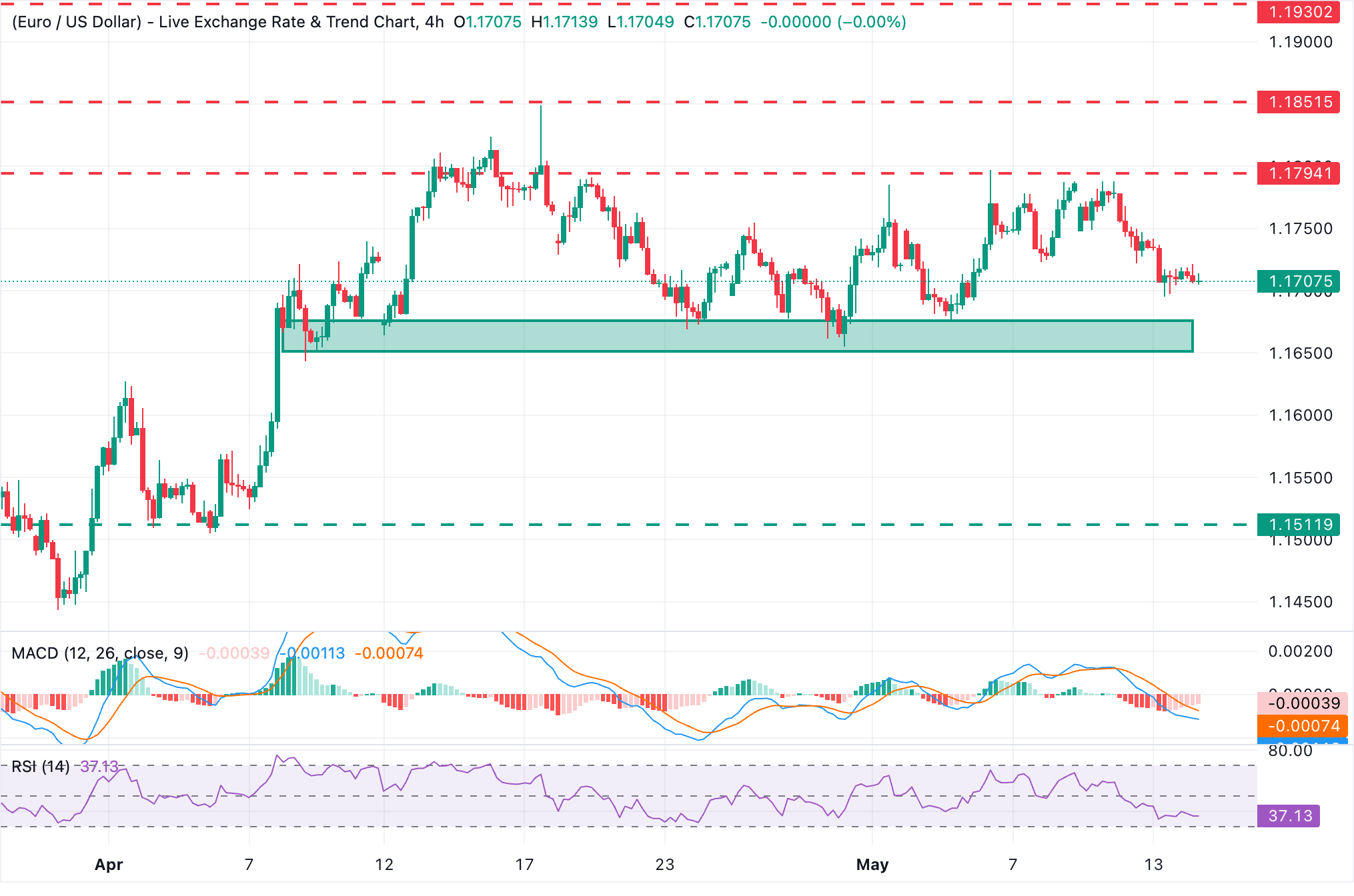
The technical picture in the 4-hour chart shows the EUR/USD keeping a bearish near-term tone, with the Moving Average Convergence Divergence (MACD) indicator in negative territory, yet with recent readings turning slightly less negative, and the Relative Strength Index (RSI) remains well below the midline, together suggesting downside pressure persists.
On the topside, the pair might find resistance at Wednesday's high in the area of 1.1740, ahead of the top of the last three weeks' trading range, around 1.1795, and April's peak, at 1.1851.
On the downside, the 1.1700 level is providing support on Thursday and keeping bears away from the key support area between 1.1645 and 1.1675, which contained downside attempts several times in April. A confirmation below those levels would bring April's bottom, near 1.1510, into focus.
(The technical analysis of this story was written with the help of an AI tool.)
Economic Indicator
Retail Sales (MoM)
The Retail Sales data, released by the US Census Bureau on a monthly basis, measures the value in total receipts of retail and food stores in the United States. Monthly percent changes reflect the rate of changes in such sales. A stratified random sampling method is used to select approximately 4,800 retail and food services firms whose sales are then weighted and benchmarked to represent the complete universe of over three million retail and food services firms across the country. The data is adjusted for seasonal variations as well as holiday and trading-day differences, but not for price changes. Retail Sales data is widely followed as an indicator of consumer spending, which is a major driver of the US economy. Generally, a high reading is seen as bullish for the US Dollar (USD), while a low reading is seen as bearish.
Read more.Next release: Thu May 14, 2026 12:30
Frequency: Monthly
Consensus: 0.5%
Previous: 1.7%
Source: US Census Bureau
Retail Sales data published by the US Census Bureau is a leading indicator that gives important information about consumer spending, which has a significant impact on the GDP. Although strong sales figures are likely to boost the USD, external factors, such as weather conditions, could distort the data and paint a misleading picture. In addition to the headline data, changes in the Retail Sales Control Group could trigger a market reaction as it is used to prepare the estimates of Personal Consumption Expenditures for most goods.
Economic Indicator
Retail Sales ex Autos (MoM)
The Retail Sales ex Autos data, released by the US Census Bureau on a monthly basis, measures the value in total receipts of retail and food stores in the United States excluding the key sector of motor vehicles and parts. A stratified random sampling method is used to select approximately 4,800 retail and food services firms whose sales are then weighted and benchmarked to represent the complete universe of over three million retail and food services firms across the country. The data is adjusted for seasonal variations as well as holiday and trading-day differences, but not for price changes. Retail sales data is widely followed as an indicator of consumer spending, which is a major driver of the US economy. Generally, a high reading is seen as bullish for the US Dollar (USD), while a low reading is seen as bearish.
Read more.Next release: Thu May 14, 2026 12:30
Frequency: Monthly
Consensus: 0.6%
Previous: 1.9%
Source: US Census Bureau
Author

Guillermo Alcala
FXStreet
Graduated in Communication Sciences at the Universidad del Pais Vasco and Universiteit van Amsterdam, Guillermo has been working as financial news editor and copywriter in diverse Forex-related firms, like FXStreet and Kantox.