EUR/USD slumps on surprisingly robust US NFP data
- EUR/USD dives to near 1.0200 on surprisingly robust US NFP data.
- US President-elect Donald Trump is expected to declare a national economic emergency.
- The Euro gains despite traders price in four interest rate cuts by the ECB this year.

EUR/USD posts a fresh more-than-two-year-low near 1.0200 in Friday’s North American session. The major currency pair slides vertically as the United States (US) Nonfarm Payrolls NFP) data for December unexpectedly came in higher. The US official employment report showed that 256K fresh workers were added against 212K, downwardly revised from 227K. Economists anticipated slower job growth at 160K. The Unemployment Rate decelerated to 4.1% from the consensus and the former release of 4.2%.
The US Dollar (USD) rallies on upbeat US employment data as it would compel Federal Reserve (Fed) policymakers to delay plans for the first interest rate cut of this year. The US Dollar Index (DXY), which tracks the Greenback's value against six major currencies, tests 110.00, the highest level seen in over two years.
According to the CME FedWatch tool, trades are confident that the Fed will keep interest rates unchanged in the January and March meeting at their current range of 4.25%-4.50%.
Meanwhile, Average Hourly Earnings rose by 3.9%, slower than expectations and the former reading of 4% on a year-on-year basis. Month-on-month Average Hourly Earnings grew by 0.3%, as expected. slower than 0.4% in November.
The performance of the US Dollar (USD) has remained firm against its major peers as President-elect Donald Trump is expected to declare a national economic emergency to provide legal justification for preparing an import tariff plan for the nation’s allies and adversaries, CNN reported.
Daily digest market movers: EUR/USD weakens sharply after US NFP data
- EUR/USD weakens after the US job market data. However, the Euro (EUR) exhibits a mixed performance against other peers even though traders have priced in four interest rate cuts by the European Central Bank (ECB), which will come in every meeting by summer.
- ECB policymakers are comfortable with firm dovish bets as inflationary pressures in the Eurozone are broadly under control. However, price pressures rose expectedly in December. On Wednesday, ECB policymaker and Governor of the Bank of France François Villeroy said that price pressures were expected to tick higher in December, however, interest rates will continue heading towards the neutral rate “without a slowdown in the pace by summer” if the upcoming data confirm that the “pullback in price pressures won’t continue”.
- Meanwhile, a weak Eurozone economic outlook has also boosted bets supporting more interest rate cuts. Investors expect the old continent to face a trade war with the US as incoming policies from President-elect Donald Trump will be highly protectionist and weigh on the Eurozone’s export sector.
Euro PRICE Today
The table below shows the percentage change of Euro (EUR) against listed major currencies today. Euro was the strongest against the New Zealand Dollar.
| USD | EUR | GBP | JPY | CAD | AUD | NZD | CHF | |
|---|---|---|---|---|---|---|---|---|
| USD | 0.46% | 0.65% | 0.29% | 0.11% | 0.70% | 0.79% | 0.50% | |
| EUR | -0.46% | 0.19% | -0.21% | -0.35% | 0.24% | 0.32% | 0.04% | |
| GBP | -0.65% | -0.19% | -0.35% | -0.50% | 0.05% | 0.14% | -0.15% | |
| JPY | -0.29% | 0.21% | 0.35% | -0.17% | 0.41% | 0.49% | 0.22% | |
| CAD | -0.11% | 0.35% | 0.50% | 0.17% | 0.58% | 0.68% | 0.37% | |
| AUD | -0.70% | -0.24% | -0.05% | -0.41% | -0.58% | 0.09% | -0.19% | |
| NZD | -0.79% | -0.32% | -0.14% | -0.49% | -0.68% | -0.09% | -0.28% | |
| CHF | -0.50% | -0.04% | 0.15% | -0.22% | -0.37% | 0.19% | 0.28% |
The heat map shows percentage changes of major currencies against each other. The base currency is picked from the left column, while the quote currency is picked from the top row. For example, if you pick the Euro from the left column and move along the horizontal line to the US Dollar, the percentage change displayed in the box will represent EUR (base)/USD (quote).
Technical Analysis: EUR/USD is broadly weak as 20-week EMA slops downwards
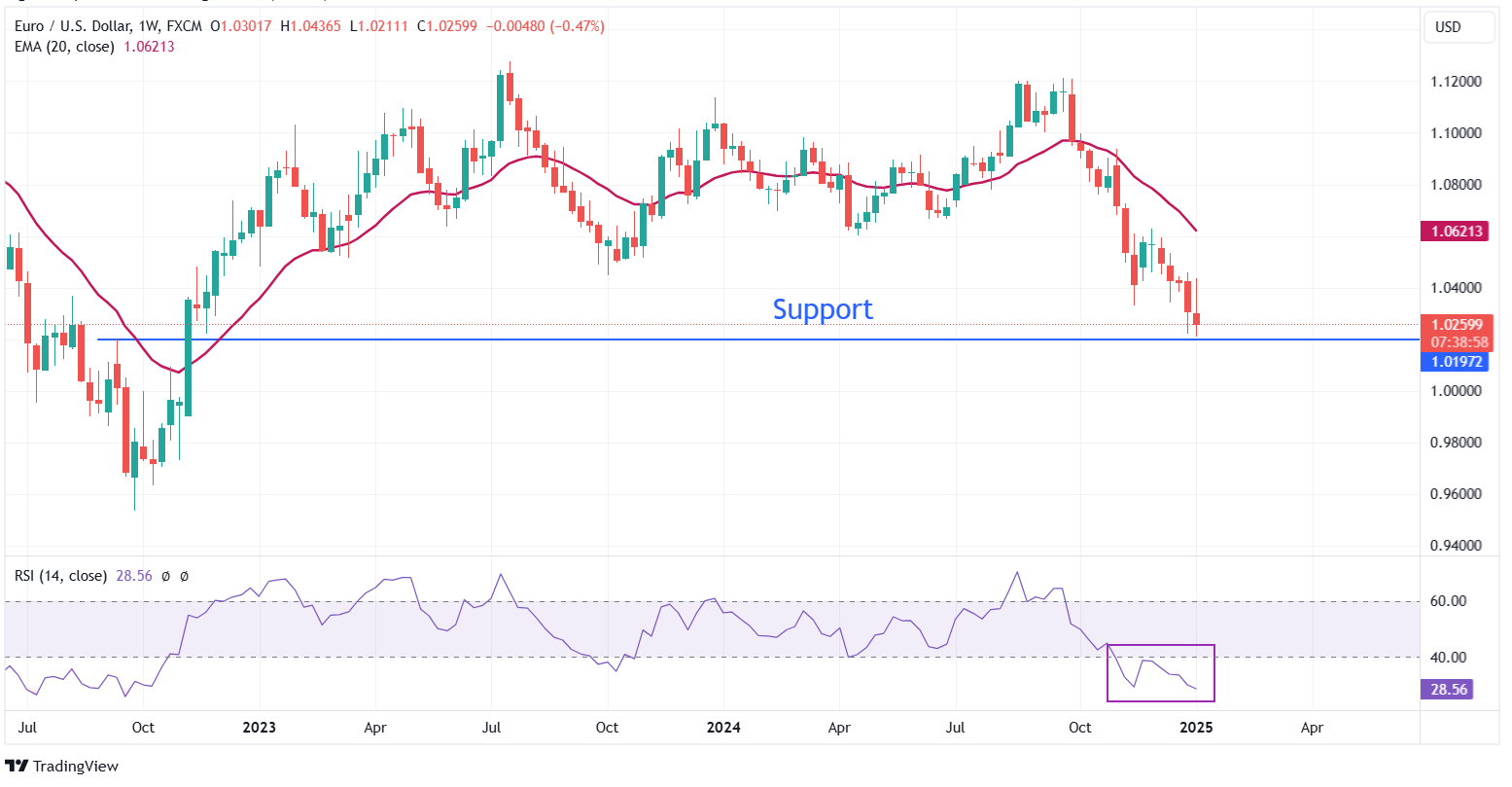
EUR/USD trades near the key support plotted from the September 2022 high of 1.0200 on the weekly chart. The outlook of the major currency pair is broadly bearish as the 20-week Exponential Moving Average (EMA) at 1.0595 is declining.
The 14-week Relative Strength Index (RSI) slides to near 30.00, indicating a strong downside momentum. However, a slight recovery cannot be ruled out as the momentum oscillator has turned oversold.
Looking down, the pair could find support near the round level of 1.0100. Conversely, the January 6 high of 1.0437 will be the key barrier for the Euro bulls.
Nonfarm Payrolls FAQs
Nonfarm Payrolls (NFP) are part of the US Bureau of Labor Statistics monthly jobs report. The Nonfarm Payrolls component specifically measures the change in the number of people employed in the US during the previous month, excluding the farming industry.
The Nonfarm Payrolls figure can influence the decisions of the Federal Reserve by providing a measure of how successfully the Fed is meeting its mandate of fostering full employment and 2% inflation. A relatively high NFP figure means more people are in employment, earning more money and therefore probably spending more. A relatively low Nonfarm Payrolls’ result, on the either hand, could mean people are struggling to find work. The Fed will typically raise interest rates to combat high inflation triggered by low unemployment, and lower them to stimulate a stagnant labor market.
Nonfarm Payrolls generally have a positive correlation with the US Dollar. This means when payrolls’ figures come out higher-than-expected the USD tends to rally and vice versa when they are lower. NFPs influence the US Dollar by virtue of their impact on inflation, monetary policy expectations and interest rates. A higher NFP usually means the Federal Reserve will be more tight in its monetary policy, supporting the USD.
Nonfarm Payrolls are generally negatively-correlated with the price of Gold. This means a higher-than-expected payrolls’ figure will have a depressing effect on the Gold price and vice versa. Higher NFP generally has a positive effect on the value of the USD, and like most major commodities Gold is priced in US Dollars. If the USD gains in value, therefore, it requires less Dollars to buy an ounce of Gold. Also, higher interest rates (typically helped higher NFPs) also lessen the attractiveness of Gold as an investment compared to staying in cash, where the money will at least earn interest.
Nonfarm Payrolls is only one component within a bigger jobs report and it can be overshadowed by the other components. At times, when NFP come out higher-than-forecast, but the Average Weekly Earnings is lower than expected, the market has ignored the potentially inflationary effect of the headline result and interpreted the fall in earnings as deflationary. The Participation Rate and the Average Weekly Hours components can also influence the market reaction, but only in seldom events like the “Great Resignation” or the Global Financial Crisis.
Author

Sagar Dua
FXStreet
Sagar Dua is associated with the financial markets from his college days. Along with pursuing post-graduation in Commerce in 2014, he started his markets training with chart analysis.

















