EUR/USD slips under 1.1800 on strong PMI data, Fed bets boost Dollar
- EUR/USD extends losses as last week’s metals sell-off fuels safe-haven flows into the US Dollar.
- Strong ISM Manufacturing data reinforces expectations the Federal Reserve will delay further rate cuts.
- Euro gains capped despite improved German Retail Sales and higher PMI remaining in contraction territory.

EUR/USD drops for the second straight day down 0.49%, following last Friday’s metals rout which underpinned the Greenback to the detriment of the shared currency. Also the nomination of Kevin Warsh to lead the Federal Reserve and upbeat US economic data drove the pair lower. At the time of writing, the pair trades below the 1.1800 figure, poised for a daily close below the latter.
Euro weakens for a second session as upbeat US data, Fed leadership expectations, and firm Dollar demand pressure the pair
Market mood improved on Monday, yet in the FX markets traders keep the US Dollar bid, who is posting a two-day gain of over 1.40%, according to the US Dollar Index (DXY). The DXY, which measures the buck’s performance against a basket of other currencies, is up 0.46% at 97.60.
Expectations that the Federal Reserve will cut rates continue to diminish following the release of solid US economic data. The Institute for Supply Management (ISM) revealed that manufacturing activity improved in January.
Meanwhile, the partial government shutdown in the US will impede the release of jobs data, regarding the Job Openings and Labor Turnover Survey, Initial Jobless Claims and the Nonfarm Payrolls report for January. The releases will be delayed even though the US Congress approves the government’s funding package.
Aside from this, data in Europe witnessed an improvement on German Retail Sales, wbile the HCOB Manufacturing PMI for January increased but remained at contractionary territory.
Daily market movers: The Dollar stages a comeback on strong data
- The Institute for Supply Management (ISM) Manufacturing PMI jumped into expansion at 52.6 in January, crushing expectations of 48.5 and reversing December’s 47.9 contraction. Prices Paid rose for a 16th consecutive month, underscoring persistent cost pressures. Employment, however, remained in contraction, staying below the 50 threshold—signaling firms are still cautious on hiring.
- The S&P Global Manufacturing PMI also confirmed strength, rising to 52.4 in January, up from a preliminary 51.9 and marking the best reading since May 2022, pointing to broad-based improvement in factory activity.
- Last week’s red hot inflation report on the producer side kept factory prices near at around the 3% threshold, an indication that further rate cuts could spur a jump on prices. Hence, the latest Producer Price Index (PPI) report justified the Fed’s decision.
- German Retail Sales increased less than expected in December, rose by 0.1% compared with the previous month, data showed on Monday.
- Ahead of this week, the docket in Europe will feature the European Central Bank (ECB) Lending Survey, inflation for the bloc, Retail Sales and the monetary policy meeting of the ECB.
- In the US, the schedule will feature the ADP Employment Change for January, S&P and ISM Services PMIs and speeches by Federal Reserve officials.
Technical outlook: Euro poised to challenge 1.1700
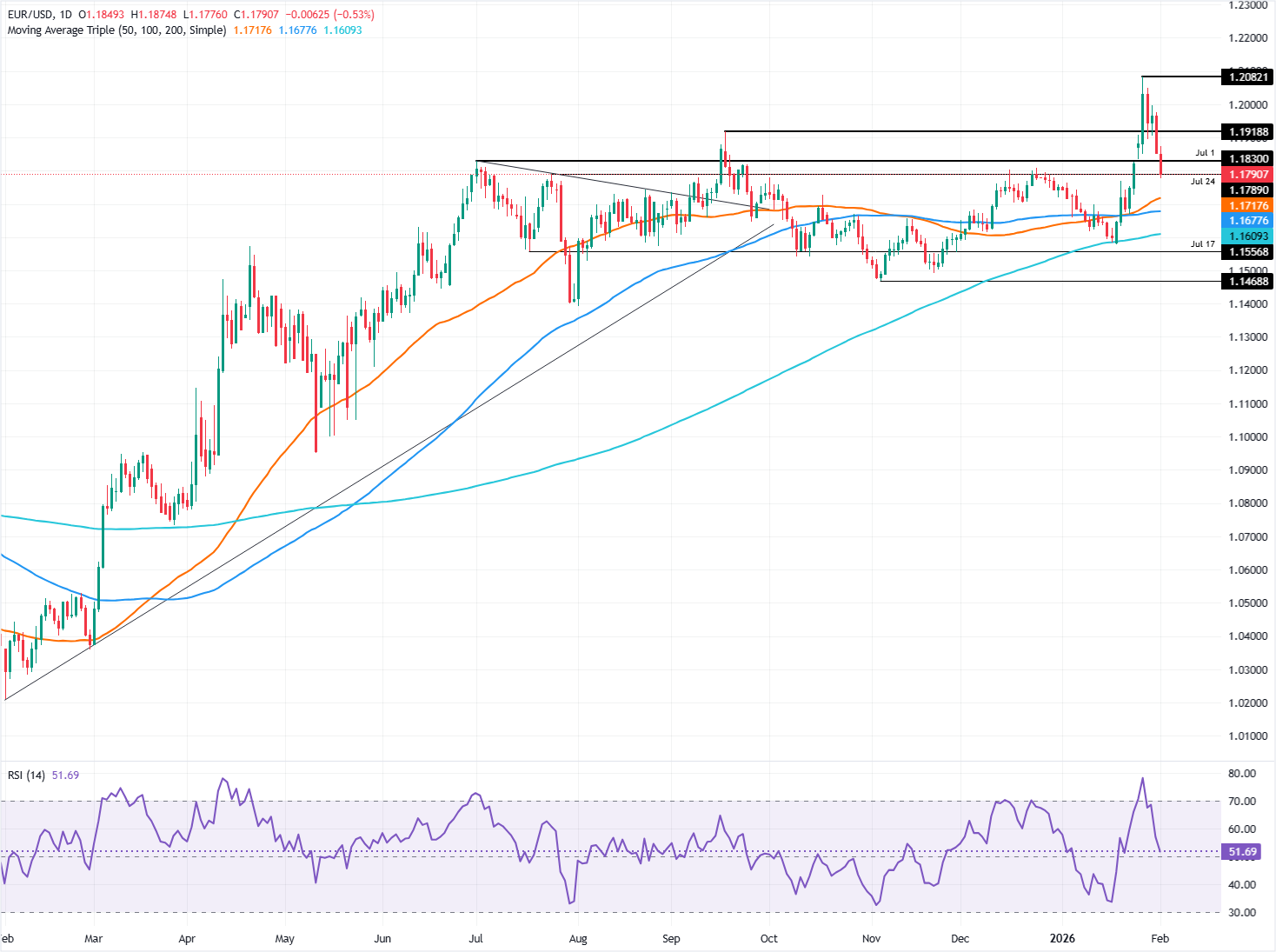
In the short-term the EUR/USD technical picture, depicts the pair is tilted to the downside after clearking a key support level at 1.1830 the July 1, which exacerbated the Euro’s sell-off past the 1.1800 figure. A daily close below the latter wull open the door to test the 50-day Simple Moving Average (SMA) at 1.1717. The next key support lies underneath at 1.1700.
Conversely, if EUR/USD stays above 1.1800, look for a test of 1.1830 followed by 1.1850. On further strength, up next is 1.1900, followed by 1.2000 and the yearly high at 1.2082.
Euro FAQs
The Euro is the currency for the 20 European Union countries that belong to the Eurozone. It is the second most heavily traded currency in the world behind the US Dollar. In 2022, it accounted for 31% of all foreign exchange transactions, with an average daily turnover of over $2.2 trillion a day. EUR/USD is the most heavily traded currency pair in the world, accounting for an estimated 30% off all transactions, followed by EUR/JPY (4%), EUR/GBP (3%) and EUR/AUD (2%).
The European Central Bank (ECB) in Frankfurt, Germany, is the reserve bank for the Eurozone. The ECB sets interest rates and manages monetary policy. The ECB’s primary mandate is to maintain price stability, which means either controlling inflation or stimulating growth. Its primary tool is the raising or lowering of interest rates. Relatively high interest rates – or the expectation of higher rates – will usually benefit the Euro and vice versa. The ECB Governing Council makes monetary policy decisions at meetings held eight times a year. Decisions are made by heads of the Eurozone national banks and six permanent members, including the President of the ECB, Christine Lagarde.
Eurozone inflation data, measured by the Harmonized Index of Consumer Prices (HICP), is an important econometric for the Euro. If inflation rises more than expected, especially if above the ECB’s 2% target, it obliges the ECB to raise interest rates to bring it back under control. Relatively high interest rates compared to its counterparts will usually benefit the Euro, as it makes the region more attractive as a place for global investors to park their money.
Data releases gauge the health of the economy and can impact on the Euro. Indicators such as GDP, Manufacturing and Services PMIs, employment, and consumer sentiment surveys can all influence the direction of the single currency. A strong economy is good for the Euro. Not only does it attract more foreign investment but it may encourage the ECB to put up interest rates, which will directly strengthen the Euro. Otherwise, if economic data is weak, the Euro is likely to fall. Economic data for the four largest economies in the euro area (Germany, France, Italy and Spain) are especially significant, as they account for 75% of the Eurozone’s economy.
Another significant data release for the Euro is the Trade Balance. This indicator measures the difference between what a country earns from its exports and what it spends on imports over a given period. If a country produces highly sought after exports then its currency will gain in value purely from the extra demand created from foreign buyers seeking to purchase these goods. Therefore, a positive net Trade Balance strengthens a currency and vice versa for a negative balance.
Author

Christian Borjon Valencia
FXStreet
Markets analyst, news editor, and trading instructor with over 14 years of experience across FX, commodities, US equity indices, and global macro markets.