EUR/USD retreats as safe-haven demand lifts US Dollar despite NFP shock
- EUR/USD falls on Friday despite weak US labor market data showing a sharp contraction in February employment.
- The NFP report reveals a loss of 92K jobs in February, far below expectations for a 59K increase, while the Unemployment Rate rises to 4.4%.
- Safe-haven demand for the US Dollar persists amid geopolitical tensions, helping the Greenback recover and pushing the pair lower.

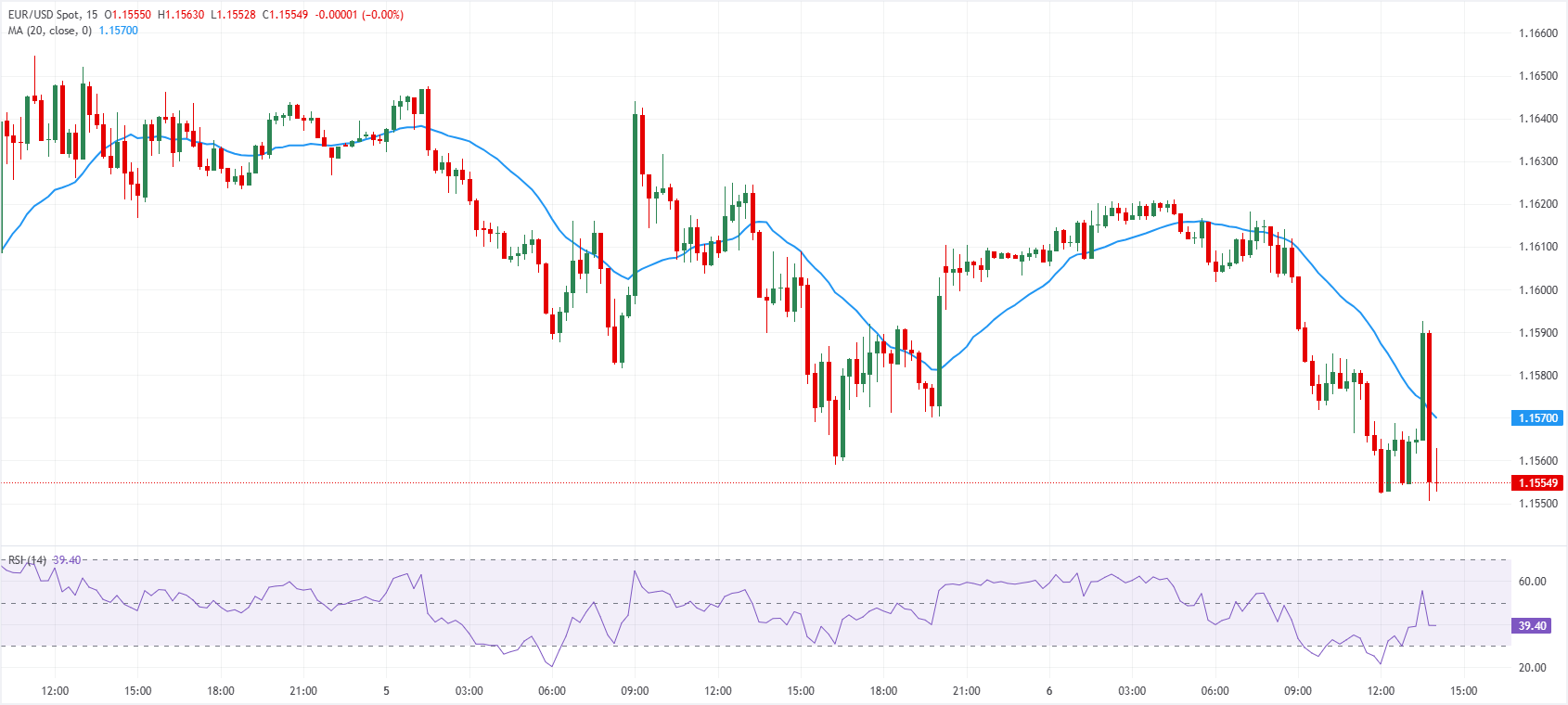
EUR/USD trades around 1.1560 on Friday at the time of writing, down 0.40% on the day after briefly rebounding toward 1.1590 following the release of the latest United States (US) labor market data.
The Nonfarm Payrolls (NFP) report published by the US Bureau of Labor Statistics showed that employment declined by 92K jobs in February, sharply missing expectations for an increase of 59K. The previous month’s figure was also revised slightly lower to 126K. At the same time, the Unemployment Rate rose to 4.4% from 4.3%, while the Labor Force Participation Rate edged down to 62%. However, wage dynamics remained relatively firm, with Average Hourly Earnings increasing by 0.4% MoM and 3.8% YoY.
This combination of deteriorating job creation and still-elevated wage growth complicates the outlook for the Federal Reserve (Fed). A weaker labor market would normally reinforce expectations of monetary easing, but resilient wage pressures may limit the central bank’s room for aggressive rate cuts in the near term.
At the same time, US Retail Sales data also highlighted signs of a cooling economy, with sales declining by 0.2% MoM in January. Although the contraction was smaller than expected, the data confirmed a slowdown in consumer momentum, reinforcing concerns about the resilience of domestic demand.
Meanwhile, the US Dollar (USD) is finding renewed support from safe-haven flows as geopolitical tensions continue to fuel global risk aversion. In a post published on Truth Social, US President Donald Trump stated that there would be “no deal with Iran except unconditional surrender,” adding that the United States and its allies would later help select a new leadership to rebuild the country. These remarks reinforced geopolitical tensions in the Middle East, prompting investors to seek safe-haven assets and supporting a rebound in the USD.
The US Dollar Index (DXY), which tracks the Greenback against a basket of six major currencies, trades 0.30% higher on Friday, near 99.30 at the time of press, and remains close to its recent three-month high, reflecting persistent demand for the US currency despite the disappointing employment figures.
In the Eurozone, economic momentum remains modest. The latest figures showed that Gross Domestic Product (GDP) expanded by 0.2% QoQ in the fourth quarter, slightly below earlier estimates. On an annual basis, growth came in at 1.2%, reflecting the region’s fragile recovery amid ongoing trade tensions and external uncertainties.
As markets head toward the weekend, volatility in EUR/USD remains elevated. While the weak US employment data initially triggered a brief rebound in the pair, the broader risk-off environment continues to favor the US Dollar, limiting upside attempts for the Euro in the near term.
Economic Indicator
Nonfarm Payrolls
The Nonfarm Payrolls release presents the number of new jobs created in the US during the previous month in all non-agricultural businesses; it is released by the US Bureau of Labor Statistics (BLS). The monthly changes in payrolls can be extremely volatile. The number is also subject to strong reviews, which can also trigger volatility in the Forex board. Generally speaking, a high reading is seen as bullish for the US Dollar (USD), while a low reading is seen as bearish, although previous months' reviews and the Unemployment Rate are as relevant as the headline figure. The market's reaction, therefore, depends on how the market assesses all the data contained in the BLS report as a whole.
Read more.Last release: Fri Mar 06, 2026 13:30
Frequency: Monthly
Actual: -92K
Consensus: 59K
Previous: 130K
Source: US Bureau of Labor Statistics
America’s monthly jobs report is considered the most important economic indicator for forex traders. Released on the first Friday following the reported month, the change in the number of positions is closely correlated with the overall performance of the economy and is monitored by policymakers. Full employment is one of the Federal Reserve’s mandates and it considers developments in the labor market when setting its policies, thus impacting currencies. Despite several leading indicators shaping estimates, Nonfarm Payrolls tend to surprise markets and trigger substantial volatility. Actual figures beating the consensus tend to be USD bullish.
Economic Indicator
Unemployment Rate
The Unemployment Rate, released by the US Bureau of Labor Statistics (BLS), is the percentage of the total civilian labor force that is not in paid employment but is actively seeking employment. The rate is usually higher in recessionary economies compared to economies that are growing. Generally, a decrease in the Unemployment Rate is seen as bullish for the US Dollar (USD), while an increase is seen as bearish. That said, the number by itself usually can't determine the direction of the next market move, as this will also depend on the headline Nonfarm Payroll reading, and the other data in the BLS report.
Read more.Author

Ghiles Guezout
FXStreet
Ghiles Guezout is a Market Analyst with a strong background in stock market investments, trading, and cryptocurrencies. He combines fundamental and technical analysis skills to identify market opportunities.














