EUR/USD Price Forecast: Upbeat US Dollar stresses on major currency pair
- The Euro falls to near 1.1593 against the US Dollar in the countdown to the US data.
- Fed Chair Warsh said that the central bank is committed to bringing inflation down to the 2% target.
- Eurozone’s flash HICP rises at a faster pace of 3.3% YoY in August.
The Euro (EUR) trades 0.2% lower to near 1.1593 against the US Dollar (USD) during the European trading session on Tuesday. The major currency pair is under pressure as the US Dollar outperforms its peers due to increased expectations that the Federal Reserve (Fed) will raise interest rates in the near term.
At press time, the US Dollar Index (DXY), which gauges the Greenback’s value against six major currencies, is up 0.2% to near 99.60.
Hawkish Fed expectations are supported by the Fed’s commitment that it will act to bring inflation down to the 2% target.
Fed chair Warsh strikes more hawkish tone on inflation path
Analysts at Rabobank note that Fed Chair Kevin Warsh “appeared to rebuild some of his credibility as an inflation fighter” in his first address to the annual Jackson Hole Symposium, emphasising that the Fed still has “work to do” to bring inflation back to its 2% target. They argue that the remarks represent “an important shift” from the communication strategy he has followed since taking office, with Warsh, for the first time as Chair, explicitly voicing dissatisfaction with recent inflation developments.
Rabobank highlights that Warsh also signalled he was open to further rate hikes unless underlying inflation shows a more convincing improvement. As he put it, “We must be convinced that underlying inflation is moving toward our target clearly and at a sufficient pace. Otherwise, we still have work to do.”
Meanwhile, investors shift their focus to the United States (US) ISM Manufacturing PMI data for August and the US JOLTS Job Openings data for July, which will be published at 14:00 GMT.
On the Eurozone front, the preliminary Harmonized Index of Consumer Prices (HICP) data for August comes in higher at 3.3% Year-on-Year (YoY), as expected, against 2.9% in July. The core HICP growth cooled down to 2.4%, while it was expected to remain steady at 2.5%.
EUR/USD Technical Analysis
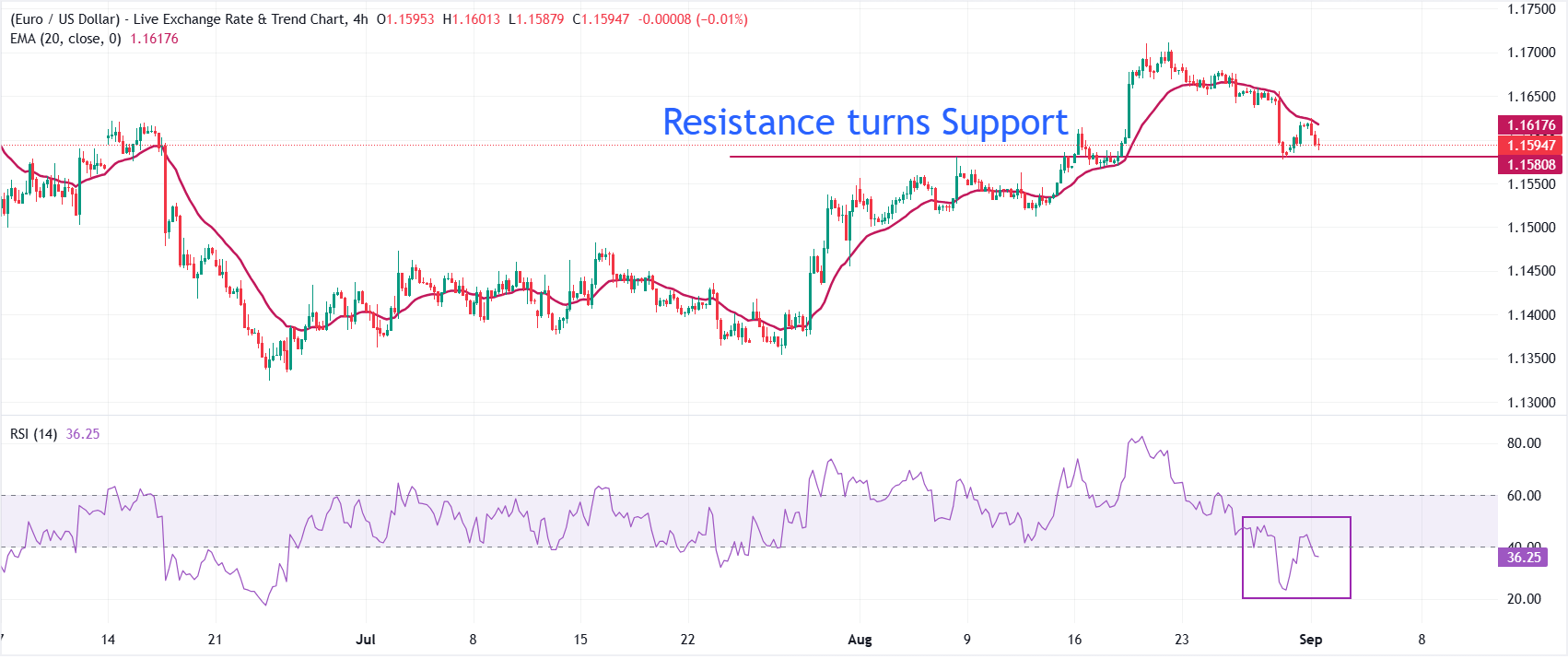
In the four-hour chart, EUR/USD trades at 1.1594, keeping a bearish near-term tone as it holds beneath the 20-period exponential moving average (EMA) at 1.1618. The pair is capped by this short-term EMA resistance, while the Relative Strength Index (RSI) at 36 stays below neutral, hinting at persistent downside pressure rather than an oversold condition.
On the topside, immediate resistance is defined by the 20-period EMA at 1.1618, which would need to be reclaimed to ease the current bearish bias and allow for a more sustained recovery. Looking down, the 1.1580 level is expected to act as a key support area.
(The technical analysis of this story was written with the help of an AI tool. Know more.)
Economic Indicator
Harmonized Index of Consumer Prices (YoY)
The Harmonized Index of Consumer Prices (HICP) measures changes in the prices of a representative basket of goods and services in the European Monetary Union. The HICP, released by Eurostat on a monthly basis, is harmonized because the same methodology is used across all member states and their contribution is weighted. The YoY reading compares prices in the reference month to a year earlier. Generally, a high reading is seen as bullish for the Euro (EUR), while a low reading is seen as bearish.
Read more.Last release: Tue Sep 01, 2026 09:00 (Prel)
Frequency: Monthly
Actual: 3.3%
Consensus: 3.3%
Previous: 2.9%
Source: Eurostat
Author

Sagar Dua
FXStreet
Sagar Dua is associated with the financial markets from his college days. Along with pursuing post-graduation in Commerce in 2014, he started his markets training with chart analysis.

















