EUR/USD Price Forecast: Turns sticky to 20-day EMA
- EUR/USD edges up to near 1.1600 as the US Dollar faces selling pressure.
- Investors keenly await the US NFP report for August, releasing on Friday.
- The ECB is highly anticipated to hike interest rates this month.

The Euro (EUR) trades slightly higher against the US Dollar (USD) at around 1.1600 during the early European trading session on Thursday. The major currency pair edges higher, but is broadly sideways, with investors awaiting the United States (US) Nonfarm Payrolls (NFP) data for August, which will be published on Friday.
Investors will closely track the US NFP report to get fresh cues regarding the Federal Reserve’s (Fed) monetary policy expectations.
According to TD Securities, the upcoming US payrolls release could trigger an uneven response in rates markets. Strategists warn that a "firm NFP may increase hike fears, but inflation keeps markets nervous and the reaction asymmetric," with investors reluctant to fully price in a more aggressive Fed path until they see the next CPI print. At the same time, TD Securities argue that "a modestly softer payroll print would allow the market to lower the pricing for a September rate hike," underscoring their view that downside surprises in employment data are more likely to be reflected in near-term policy expectations than upside ones.
Though the Euro is higher against the US Dollar, it is underperforming against its other peers despite financial markets remaining increasingly confident that the European Central Bank (ECB) will hike policy rates this month.
On Wednesday, ECB Governing Council member Joachim Nagel, an outspoken hawk, said that markets see over a 95% chance of a September rate hike.
EUR/USD Technical Analysis
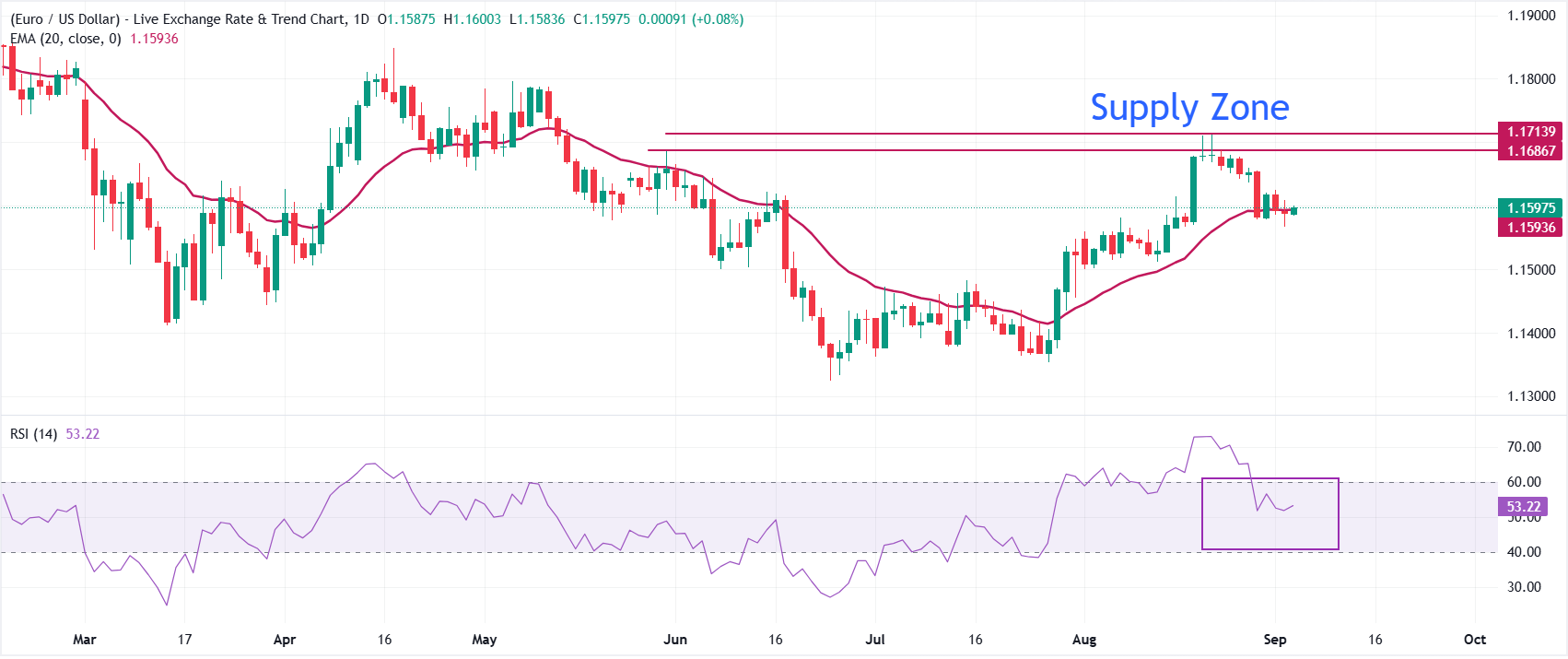
In the daily chart, EUR/USD trades at 1.1598. The pair holds just above the 20-period exponential moving average (EMA) at 1.1594, which suggests a mildly bullish near-term bias as price defends this dynamic support zone. The Relative Strength Index (14) at 53.23 sits in neutral territory with a slight positive tilt, hinting that upside momentum is constructive but not overstretched after the recent retreat from overbought readings seen above 70.
On the downside, immediate support is located at the 20-period EMA at 1.1594, where a daily close below would weaken the current constructive tone and expose deeper corrective pressure. On the upside, the 1.1687-1.1714 range will act as a key supply zone for the pair.
(The technical analysis of this story was written with the help of an AI tool. Know more.)
Nonfarm Payrolls FAQs
Nonfarm Payrolls (NFP) are part of the US Bureau of Labor Statistics monthly jobs report. The Nonfarm Payrolls component specifically measures the change in the number of people employed in the US during the previous month, excluding the farming industry.
The Nonfarm Payrolls figure can influence the decisions of the Federal Reserve by providing a measure of how successfully the Fed is meeting its mandate of fostering full employment and 2% inflation. A relatively high NFP figure means more people are in employment, earning more money and therefore probably spending more. A relatively low Nonfarm Payrolls’ result, on the either hand, could mean people are struggling to find work. The Fed will typically raise interest rates to combat high inflation triggered by low unemployment, and lower them to stimulate a stagnant labor market.
Nonfarm Payrolls generally have a positive correlation with the US Dollar. This means when payrolls’ figures come out higher-than-expected the USD tends to rally and vice versa when they are lower. NFPs influence the US Dollar by virtue of their impact on inflation, monetary policy expectations and interest rates. A higher NFP usually means the Federal Reserve will be more tight in its monetary policy, supporting the USD.
Nonfarm Payrolls are generally negatively-correlated with the price of Gold. This means a higher-than-expected payrolls’ figure will have a depressing effect on the Gold price and vice versa. Higher NFP generally has a positive effect on the value of the USD, and like most major commodities Gold is priced in US Dollars. If the USD gains in value, therefore, it requires less Dollars to buy an ounce of Gold. Also, higher interest rates (typically helped higher NFPs) also lessen the attractiveness of Gold as an investment compared to staying in cash, where the money will at least earn interest.
Nonfarm Payrolls is only one component within a bigger jobs report and it can be overshadowed by the other components. At times, when NFP come out higher-than-forecast, but the Average Weekly Earnings is lower than expected, the market has ignored the potentially inflationary effect of the headline result and interpreted the fall in earnings as deflationary. The Participation Rate and the Average Weekly Hours components can also influence the market reaction, but only in seldom events like the “Great Resignation” or the Global Financial Crisis.
Author

Sagar Dua
FXStreet
Sagar Dua is associated with the financial markets from his college days. Along with pursuing post-graduation in Commerce in 2014, he started his markets training with chart analysis.
















