EUR/USD Price Forecast: Needs to take out 1.1600 decisively for fresh upside
- EUR/USD trades cautiously at around 1.1500 as the US Dollar clings to Monday’s gains.
- Investors await the US JOLTS Job Openings data for June.
- The ECB is highly expected to raise interest rates in the September meeting.

The Euro (EUR) trades with caution at around Monday’s low of 1.1500 against the US Dollar (USD) during the European trading session on Tuesday. The major currency pair is expected to remain volatile as investors await key United States (US) economic release this week to get meaningful cues regarding the interest rate outlook.
At press time, the US Dollar Index (DXY), which gauges the Greenback’s value against six major currencies, holds onto Monday’s gains at around 100.00.
Investors will pay close attention to the US Nonfarm Payrolls (NFP) data for July, which will be released on Friday. The impact of the US official employment data will be significant on the Federal Reserve’s (Fed) monetary policy outlook, as the central bank has suspended delivering so called “forward guidance” on interest rates from the June policy meeting.
Later in the day, the US JOLTS Job Openings data for June is scheduled to be published at 14:00 GMT. US employers are expected to have posted 7.45 million fresh jobs, slightly lower than 7.594 million in May.
On the Eurozone front, traders seem increasingly confident that the European Central Bank (ECB) will hike interest rates in the September policy meeting. Analysts at Deutsche Bank have said in a report that the ECB September hike pricing is around 90%.
EUR/USD technical analysis
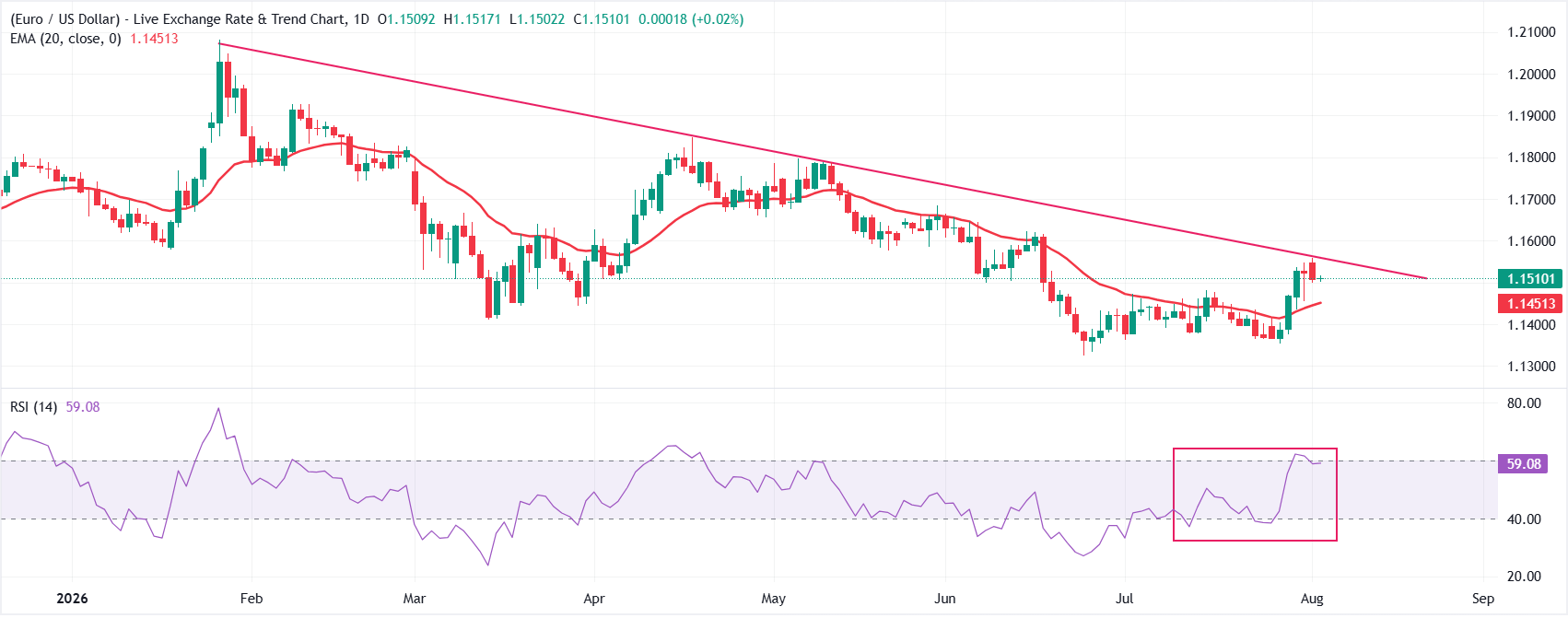
EUR/USD trades cautiously at around 1.1500 at press time. The pair holds a modest bullish near-term bias as price advances above the 20-period exponential moving average (EMA) at 1.1451, suggesting underlying demand after reclaiming that short-term trend reference.
The Relative Strength Index (14) at 59.1 stays below overbought territory yet leans higher, hinting that buying pressure remains constructive while not stretched.
On the topside, immediate resistance aligns with the downward-sloping trend-line break level at 1.1555, which caps further gains and marks the next hurdle of 1.1600 for bulls; above that, the pair would extend its upside journey towards the May 29 high at 1.1686. On the downside, initial support is provided by the 20-period EMA at 1.1451; a daily close back below this floor would weaken the current positive tone and expose the pair to the July 28 high at 1.1353.
(The technical analysis of this story was written with the help of an AI tool. Know more.)
Euro FAQs
The Euro is the currency for the 20 European Union countries that belong to the Eurozone. It is the second most heavily traded currency in the world behind the US Dollar. In 2022, it accounted for 31% of all foreign exchange transactions, with an average daily turnover of over $2.2 trillion a day. EUR/USD is the most heavily traded currency pair in the world, accounting for an estimated 30% off all transactions, followed by EUR/JPY (4%), EUR/GBP (3%) and EUR/AUD (2%).
The European Central Bank (ECB) in Frankfurt, Germany, is the reserve bank for the Eurozone. The ECB sets interest rates and manages monetary policy. The ECB’s primary mandate is to maintain price stability, which means either controlling inflation or stimulating growth. Its primary tool is the raising or lowering of interest rates. Relatively high interest rates – or the expectation of higher rates – will usually benefit the Euro and vice versa. The ECB Governing Council makes monetary policy decisions at meetings held eight times a year. Decisions are made by heads of the Eurozone national banks and six permanent members, including the President of the ECB, Christine Lagarde.
Eurozone inflation data, measured by the Harmonized Index of Consumer Prices (HICP), is an important econometric for the Euro. If inflation rises more than expected, especially if above the ECB’s 2% target, it obliges the ECB to raise interest rates to bring it back under control. Relatively high interest rates compared to its counterparts will usually benefit the Euro, as it makes the region more attractive as a place for global investors to park their money.
Data releases gauge the health of the economy and can impact on the Euro. Indicators such as GDP, Manufacturing and Services PMIs, employment, and consumer sentiment surveys can all influence the direction of the single currency. A strong economy is good for the Euro. Not only does it attract more foreign investment but it may encourage the ECB to put up interest rates, which will directly strengthen the Euro. Otherwise, if economic data is weak, the Euro is likely to fall. Economic data for the four largest economies in the euro area (Germany, France, Italy and Spain) are especially significant, as they account for 75% of the Eurozone’s economy.
Another significant data release for the Euro is the Trade Balance. This indicator measures the difference between what a country earns from its exports and what it spends on imports over a given period. If a country produces highly sought after exports then its currency will gain in value purely from the extra demand created from foreign buyers seeking to purchase these goods. Therefore, a positive net Trade Balance strengthens a currency and vice versa for a negative balance.
Author

Sagar Dua
FXStreet
Sagar Dua is associated with the financial markets from his college days. Along with pursuing post-graduation in Commerce in 2014, he started his markets training with chart analysis.