EUR/USD tests support at 1.1485 with German inflation on focus
- EUR/USD dives below 1.1500 to test support at 1.1485.
- Concerns of the economic impact of a long war in the Middle East are hammering the Euro.
- German inflation data and Fed Powell's comments will provide the macroeconomic background later on the day.

The Euro (EUR) has opened the week in the same weak tone that closed the previous one. The EUR/USD pair has given away the tame recovery seen during Monday's Asian session, retreating below the 1.1500 round level during the European trade to test 10-day lows, at 1.1485 at the time of writing.
The US Dollar maintains a solid tone, favoured by a dismal market sentiment, as investors come to terms with the Idea of a protracted war in the Middle East, with high Oil prices posing significant challenges for the crude oil-importing Eurozone economies.
US President Donald Trump keeps sending mixed messages. He said that the option of invading Iran's Kharg Island remains alive, in an interview at the Financial Times, only a few hours after affirming that current Iranian leaders are “very reasonable”.
Meanwhile, the entry of the Iran-backed Houthis on the scene adds a new layer to an already complex conflict. The Houthis have threatened to close off the Bab el Mandab Strait, another chokepoint for Oil traffic, which would push Crude prices to fresh records, adding pressure to an already strained global economy.
In this context, Euro rallies keep attracting sellers. The pair is on track to close March 2.5% lower in the worst monthly performance since July last year. On the macroeconomic front, a batch of Eurozone confidence indexes and German Harmonized Index of Consumer Prices (HICP) might gather some interest during the European session. In the US, the focus will be on the Federal Reserve (Fed) Chairman, Jerome Powell’s speech at Harvard University.
Technical Analysis: The immediate trend remains negative
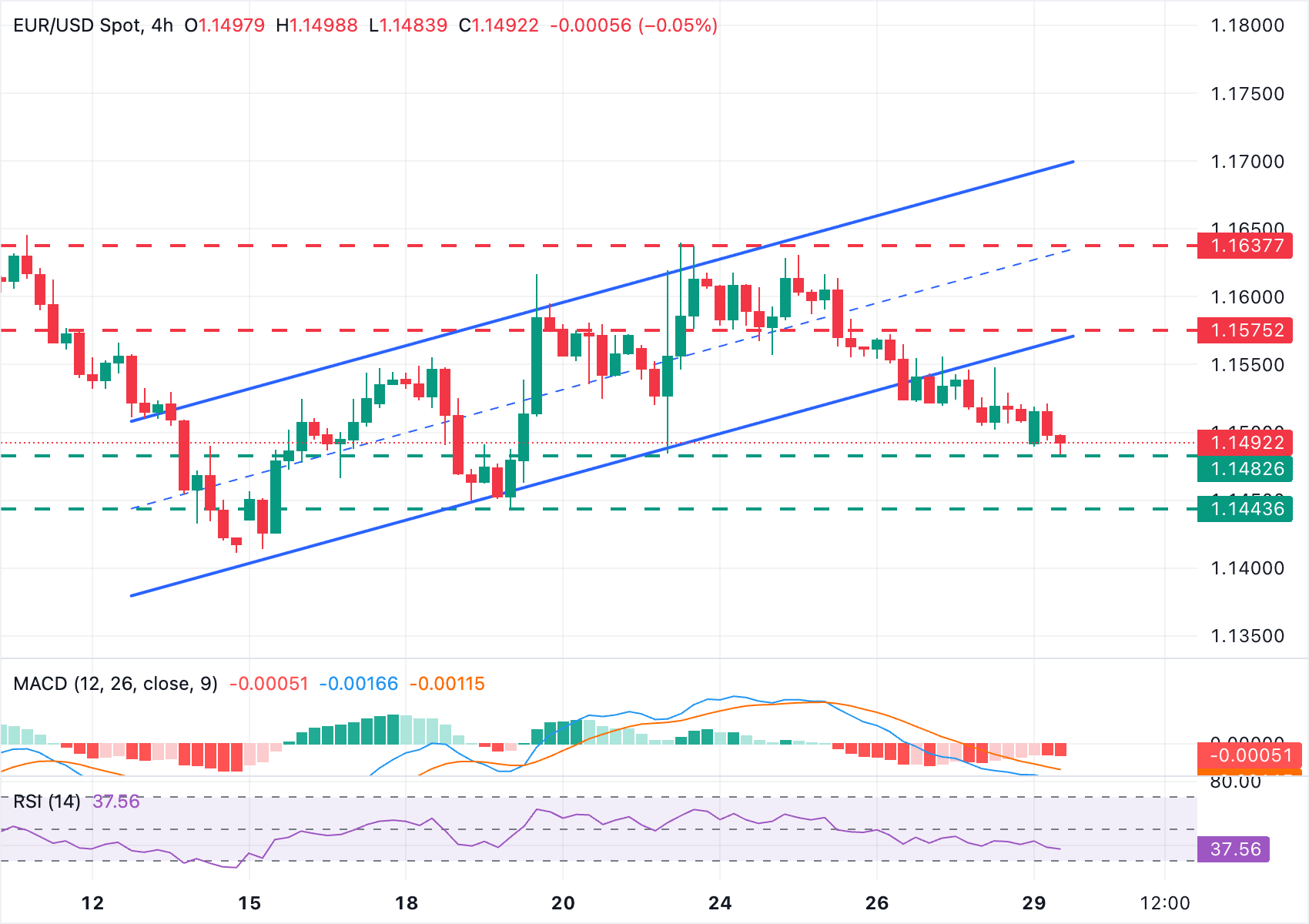
The EUR/USD trades at 1.1492, with the near-term bias mildly bearish after breaching the bottom of the ascending channel last week. The 4-hour Moving Average Convergence Divergence (MACD) histogram has turned negative with the line below the signal and both below zero, reinforcing building downside momentum, while the Relative Strength Index (RSI) has extended below the 40 line, indicating sellers retain control but without oversold conditions.
On the downside, the March 23 low, at 1.1484, is holding bears for now, closing the path towards the March 18 and 19 lows in the area of 1.1444.
Bulls are likely to be challenged at the reverse trendline, now around 1.1555, and the March 26 high, at the 1.1575 area. An unlikely confirmation above here would expose last week's highs in the vicinity of 1.1635.
(The technical analysis of this story was written with the help of an AI tool.)
Economic Indicator
Harmonized Index of Consumer Prices (YoY)
The Harmonized Index of Consumer Prices (HICP), released by the German statistics office Destatis on a monthly basis, is an index of inflation based on a statistical methodology that has been harmonized across all European Union (EU) member states to facilitate comparisons. The YoY reading compares prices in the reference month to a year earlier. Generally, a high reading is bullish for the Euro (EUR), while a low reading is bearish.
Read more.Next release: Mon Mar 30, 2026 12:00 (Prel)
Frequency: Monthly
Consensus: -
Previous: 2%
Economic Indicator
Consumer Price Index (YoY)
The Consumer Price Index (CPI), released by the German statistics office Destatis on a monthly basis, measures the average price change for all goods and services purchased by households for consumption purposes. The CPI is the main indicator to measure inflation and changes in purchasing trends. The YoY reading compares prices in the reference month to a year earlier. Generally, a high reading is bullish for the Euro (EUR), while a low reading is bearish.
Read more.Next release: Mon Mar 30, 2026 12:00 (Prel)
Frequency: Monthly
Consensus: -
Previous: 1.9%
which
Author

Guillermo Alcala
FXStreet
Graduated in Communication Sciences at the Universidad del Pais Vasco and Universiteit van Amsterdam, Guillermo has been working as financial news editor and copywriter in diverse Forex-related firms, like FXStreet and Kantox.