AUD/USD Price Forecast: Flattens near 0.6900, falling 20-day EMA warrants downside
- AUD/USD wobbles around 0.6890 ahead of the RBA monetary policy minutes and the US NFP data.
- In the June monetary policy, the RBA kept its OCE steady at 4.35%.
- The Fed is anticipated to deliver at least one interest rate hike this year.

The AUD/USD pair trades in a tight range around 0.6890 during the Asian trading session on Monday. The Aussie pair consolidates as the US Dollar (USD) starts the week on a flat note, with investors awaiting the United States (US) Nonfarm Payrolls (NFP) data for June, which will be released on Thursday.
At press time, the US Dollar Index (DXY), which gauges the Greenback’s value against six major currencies, trades calmly near 101.30.
The US NFP data is expected to significantly influence market expectations for the Federal Reserve’s (Fed) monetary policy outlook, which currently shows an almost 90% chance that the central bank will deliver at least one interest rate hike this year, according to the CME FedWatch tool.
According to estimates, the US economy created 114K fresh jobs, lower than 172K in May. The Unemployment Rate remains steady at 4.3%.
On the Australian Dollar (AUD) front, investors await Reserve Bank of Australia (RBA) monetary meeting minutes of the June policy, in which it decided to leave its Official Cash Rate (OCR) unchanged at 4.35% after hiking in three consecutive policy meetings.
AUD/USD technical analysis
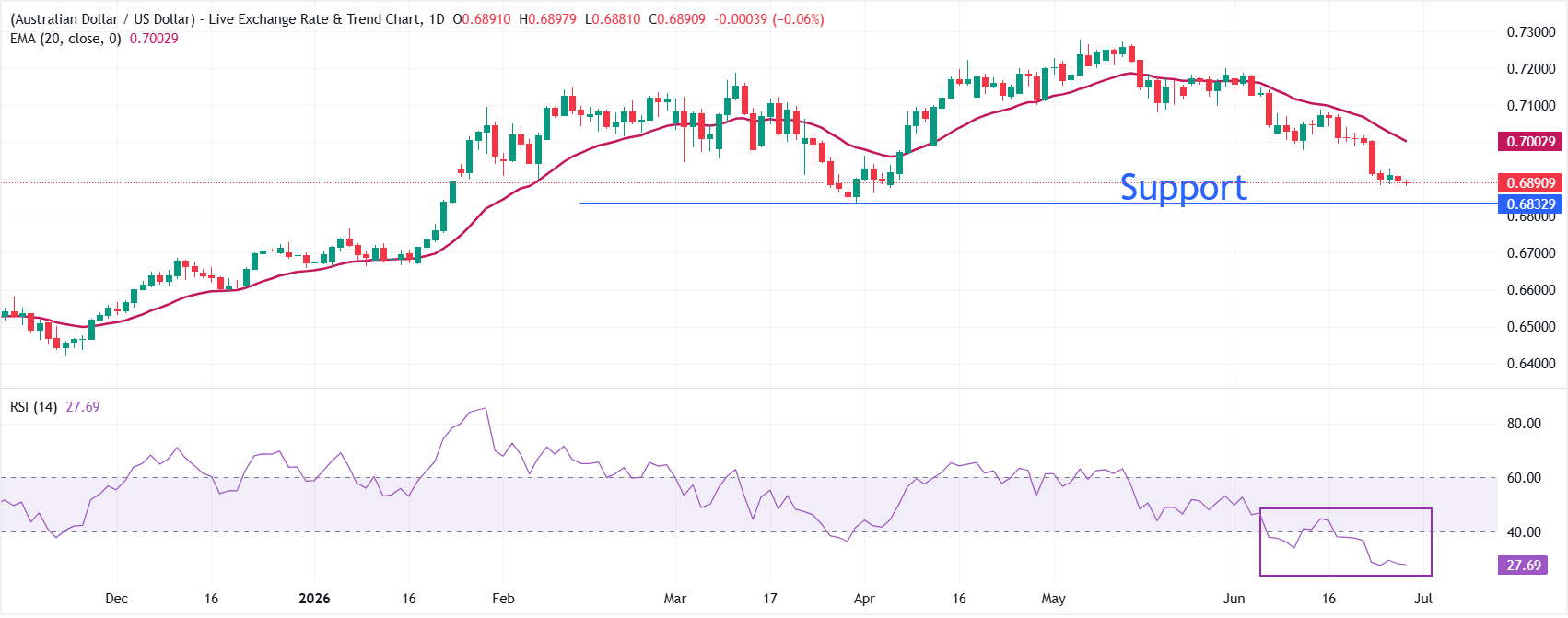
AUD/USD is almost flat at around 0.689 at press time; however, the near-term bias is bearish as it holds below the 20-day exponential moving average (EMA), which is at 0.7003. The pair has slipped into oversold territory, with the Relative Strength Index (RSI) at 27.70 hinting that downside momentum is stretched, though price action remains capped beneath the 20-day EMA.
On the topside, the 20-day EMA at 0.7003 is the first resistance to beat for any meaningful recovery, and a daily close above this barrier would ease immediate selling pressure and extend the recovery towards the June 15 high at 0.7088. On the downside, the pair is expected to decline further towards the March 30 low at 0.6833.
(The technical analysis of this story was written with the help of an AI tool.)
Economic Indicator
RBA Meeting Minutes
The minutes of the Reserve Bank of Australia meetings are published two weeks after the interest rate decision. The minutes give a full account of the policy discussion, including differences of view. They also record the votes of the individual members of the Committee. Generally speaking, if the RBA is hawkish about the inflationary outlook for the economy, then the markets see a higher possibility of a rate increase, and that is positive for the AUD.
Read more.Next release: Tue Jun 30, 2026 01:30
Frequency: Weekly
Consensus: -
Previous: -
Source: Reserve Bank of Australia
The Reserve Bank of Australia (RBA) publishes the minutes of its monetary policy meeting two weeks after the interest rate decision is announced. It provides a detailed record of the discussions held between the RBA’s board members on monetary policy and economic conditions that influenced their decision on adjusting interest rates and/or bond buys, significantly impacting the AUD. The minutes also reveal considerations on international economic developments and the exchange rate value.
Author

Sagar Dua
FXStreet
Sagar Dua is associated with the financial markets from his college days. Along with pursuing post-graduation in Commerce in 2014, he started his markets training with chart analysis.